

-Liberian Women Rise Against GBV
By Jerromie S. Walters
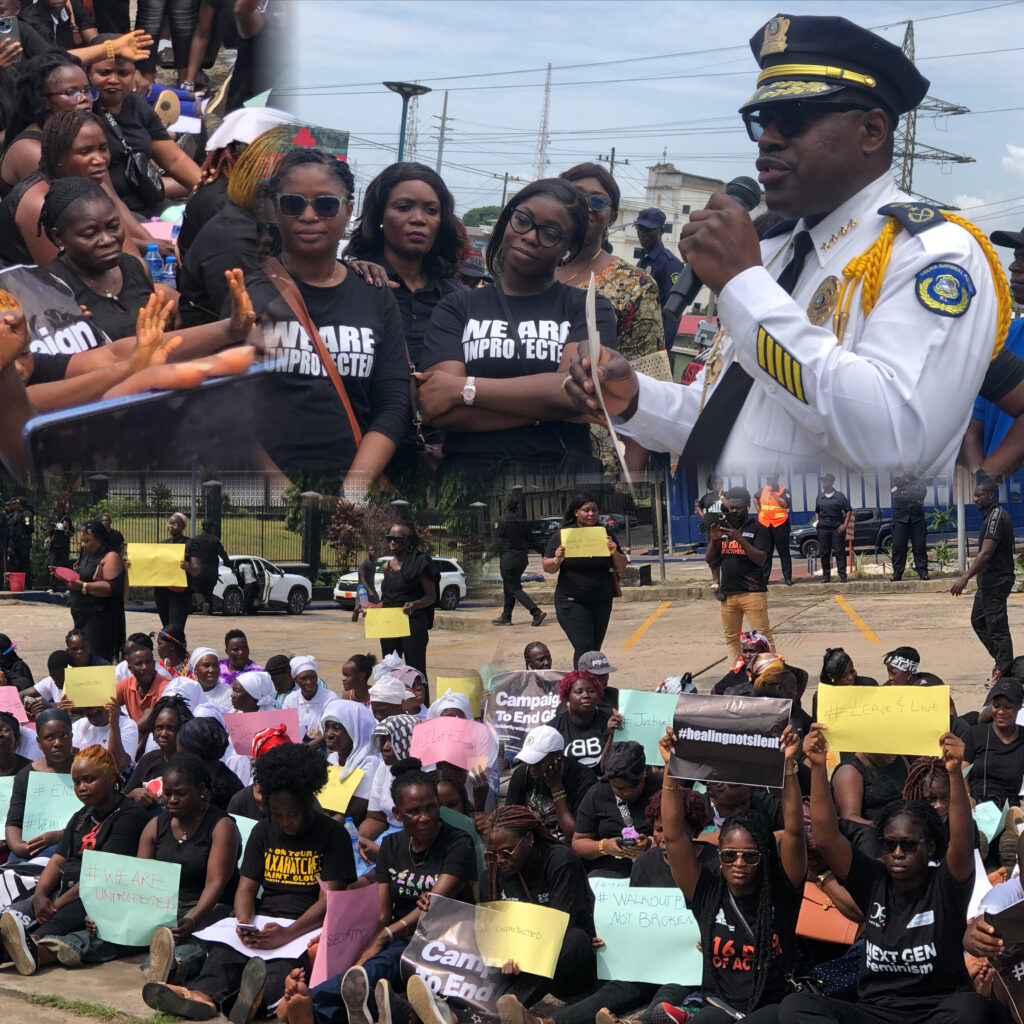
MONROVIA – Scores of women, survivors, and concerned citizens gathered at the Headquarters of the Liberia National Police (LNP) on Capitol Hill on Monday, March 16, 2026, demanding justice and an end to gender-based violence following the suspicious death of South African national Toni Jackson. The women carried placards bearing messages such as “#WEAREUNPROTECTED” and “Say No to GBV.”
In their petition statement to the Inspector General of the Liberia National Police (LNP), Nusone Perkins laid out a sweeping eight-point agenda aimed not only at securing justice in this specific case but at fundamentally transforming Liberia’s response to gender-based violence. Foremost among the demands is an immediate, impartial, and forensic-led investigation by the Liberia National Police, with regular public updates that do not compromise investigative integrity.
They called on the Attorney General and the courts to ensure that if evidence warrants prosecution, it is carried out fairly—underscoring the principle that no person should be above the law. The women are also pressing for full implementation of Section 16:23.2b of the Amended Penal Code—Liberia’s Domestic Violence Act—including timely protection orders and coordinated referrals. They are also calling for expedited passage of the Law to Establish the Family Court of Liberia, a specialized judicial mechanism designed to address violence within families promptly and sensitively through trained personnel.
“We need the Family Court now,” one activist at the rally emphasized. “We cannot continue to have family matters—matters of life and death—treated as minor disputes.” The coalition is also urging accelerated enactment of comprehensive Women and Children’s legislation to strengthen prevention, protection, and prosecution measures, alongside significant investment in police and forensic capacity. This includes equipping survivor-centered GBV units across the LNP for proper evidence collection and training officers in trauma-informed response.
Activists are calling for increased funding and geographic access to medical, psychosocial, legal, and shelter services—particularly in rural areas where survivors often have nowhere to turn. Finally, the statement calls for improved data collection and public awareness campaigns that challenge the norms normalizing violence and reduce the stigma that silences survivors. “We join the Women NGOs Secretariat of Liberia, survivors, and concerned Liberians in demanding justice for Mrs. Toni Jackson and urgent, systemic action to end gender-based violence in Liberia. We stand ready to support lawful, transparent investigations and reforms that put survivors first,” Perkins read.
The women’s demands come in the wake of the death of Mrs. Toni Jackson, wife of Liberian economist Samuel Jackson, whose body was discovered with a deep laceration to the head and multiple bruises—injuries that have led the Liberia National Police to name Mr. Jackson as a person of interest in a suspected homicide investigation. “We are deeply saddened by the tragic death of Mrs. Toni Jackson, a South African national and the wife of Liberian economist Mr. Samuel Jackson. The Liberia National Police (LNP) declared Mr. Jackson a person of interest in the suspected homicide investigation after authorities observed a deep laceration to the victim’s head and multiple bruises on her body.
“Mr. Jackson’s public livestream showing armed officers conducting a forensic search of his home, and his shifting public explanations — first citing a fall and later referencing “altercations” in the relationship — raise urgent concerns that this death may be linked to domestic violence,” Perkins declared. Mrs. Jackson died last week at the John F. Kennedy Memorial Hospital in Monrovia after being transferred from Catholic Hospital, where she was initially rushed for emergency brain surgery. On Saturday, March 14, 2026, the Liberia National Police (LNP) named her spouse, Liberian politician Mr. Samuel P. Jackson, as the prime suspect in the case.
While Mr. Jackson has stated that he found his wife unconscious and promptly sought medical care, the circumstances leading to her critical injuries remain unclear. The situation has been further inflamed by the circulation of graphic images on social media that appear to show lacerations on the deceased’s body, heightening public anguish and concern. The timing of the tragedy has added a bitter layer to the protest. As world leaders convene in New York for the 70th Session of the Commission on the Status of Women (CSW70) under the theme “Ensuring and strengthening access to justice for all women and girls.”
“This tragedy occurs as the world gathers in New York for the 70th Session of the Commission on the Status of Women (CSW70) under the theme “Ensuring and strengthening access to justice for all women and girls.” It is a painful reminder that while global leaders discuss justice for women, Liberian women and girls continue to face serious threats at home,” she added
The anger on display Monday is also rooted in years of harrowing data. National and international assessments consistently indicate that between one in three and nearly one in two Liberian women will experience physical violence in their lifetime. Yet, advocates stress that the numbers only tell part of the story.
Behind the statistics lies a broken system where most incidents go unreported. Survivors who do come forward face significant barriers, including limited survivor-centered policing, woefully under-resourced forensic capacity, a shortage of shelters, and gaping holes in legal remedies and specialized judicial mechanisms. The case of Toni Jackson has crystallized these systemic failures. Public details surrounding the investigation—including Mr. Jackson’s own livestream showing armed officers conducting a forensic search of his home, coupled with his shifting explanations that first cited a fall and later referenced “altercations” in the relationship—have only heightened public alarm.
Inspector General Gregory O. W. Coleman accepted a petition from women protesters, thanking them for their peaceful demonstration. He reaffirmed the Liberia National Police’s (LNP) commitment to protecting women’s rights and addressing gender-based violence with professionalism. On the investigation into economist Samuel Jackson, the Inspector General stated the process is evidence-based and professional, urging the public not to panic.
The LNP promised a thorough and transparent investigation, with updates to follow.
Inspector General Coleman also assured the gathering that the police remain dedicated to upholding the rule of law and responding to concerns surrounding violence against women with professionalism and diligence. Coleman also announced major reform in the LNP women and children division which would see full actualization this month.
In additional to the women’s call, the Association of Female Lawyers of Liberia (AFELL) is also demanding a transparent investigation into the death of Ntombi Toni Khumalo Jackson, a South African national whose passing has attracted national concerns. In a statement released on Sunday, AFELL stressed that the tragic incident serves as a “painful reminder that violence against women remains a critical national concern that demands decisive and sustained action.”
The women assembled at the LNP Headquarters on Monday under the banner of the Women NGOs Secretariat of Liberia (WONGOSOL). The Women NGOs Secretariat of Liberia (WONGOSOL) is a network of over 250 women-led and women-focused civil society organizations across Liberia. Since 1998, WONGOSOL has been at the forefront of promoting women’s rights, social justice, and good governance through advocacy, policy engagement, and grassroots mobilization.