


-As Record Shows His Political Interest
By Jerromie S. Walters
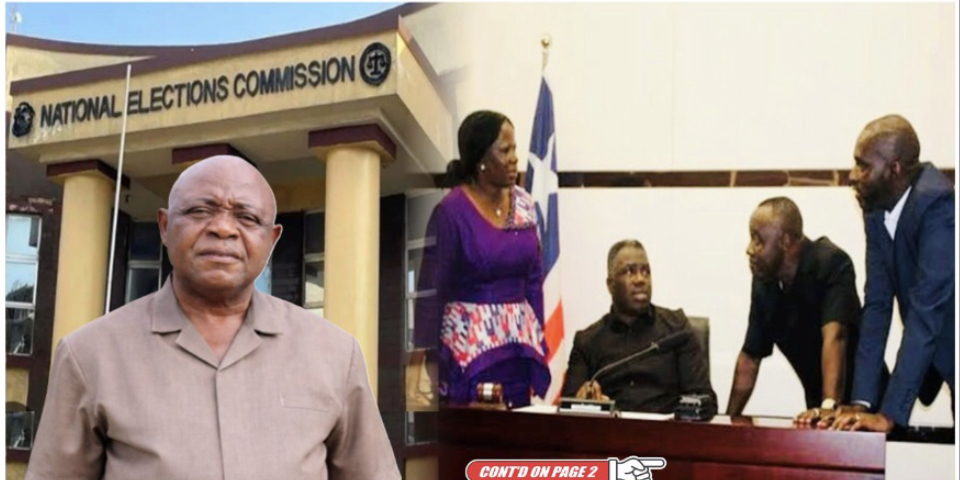
Monrovia: President Boakai has appointed Jonathan K. Weedor, a former commissioner with extensive electoral experience, to lead the National Elections Commission (NEC). However, many Liberians have questioned his independence due to past political affiliations, setting the stage for a contentious confirmation process in the Liberian Senate.
Following the resignation of Madam Davidetta Browne-Lansanah, President Joseph Nyuma Boakai, Sr., nominated Mr. Jonathan K. Weedor as Chairman of the National Elections Commission (NEC) on March 30, 2026. The appointment is subject to confirmation by the Liberian Senate, which is currently in recess until May. In the interim, President Boakai has directed Mr. Weedor to serve as Acting Chairman..
According to the amended election law of 1986, presidential appointees require Senate consent. The NEC’s seven-member governing board is composed of a chairperson, co-chairperson, and five commissioners. The law stipulates that commissioners must be Liberian citizens, at least 35 years of age, of good moral character, and unaffiliated with any political party.
It is the requirement of non-partisan status that has drawn public scrutiny. Critics argue that Mr. Weedor’s past political involvement undermines his suitability for the role. Anderson Miamen, Executive Director of the Center for Transparency and Accountability, expressed concern in a Facebook post. “Mr. Jonathan Weedor has the required experience and technical capacity, but his full independence is the issue,” Mr. Miamen wrote.
He noted that while Mr. Weedor’s expertise is not in doubt, a video circulating on social media suggests a strong connection to the ruling Unity Party. “This is concerning, when there are several equally qualified and verifiably independent-minded Liberians that could occupy the position,” he added, questioning why the administration would not avoid potential conflicts of interest from the outset.
Opposition voices have been more forceful. Jefferson Koijee, Secretary General of the opposition Congress for Democratic Change (CDC), characterized the nomination as politically motivated. “In 2023, Weedor, as head of the UP War Room and chief strategist, triumphantly proclaimed that the Unity Party had won in the first round based on his calculations,” Koijee stated in a post on Tuesday. He further criticized the broader record of the Boakai administration, arguing that the appointment reflects a pattern of moral decay and political manipulation.
His words: “Even if this morally bankrupt leadership were to appoint Lucifer himself as Chairman of the National Elections Commission, their defeat would be inevitable. Every passing day, the economically brutalized and disillusioned citizens of Liberia grow more resolute. On October 10, 2029, the people’s wrath will speak through the ballot box, turning the false triumph of Boakai and Koung gang rape regime into a decisive national reckoning and the rebirth of our country’s honor.”
Conversely, some Liberians argue that the situation is not unprecedented. P. Karzee Saye pointed to the tenure of former NEC Chairman Cllr. Jerome Kokoyah, who, after contesting as a candidate for the Unity Party in 2011, was later appointed to lead the Commission. Under Cllr. Kokoyah’s chairmanship, former President George Weah won the presidency in 2017.
“Former National Elections Commissioner (NEC) Boss Cllr. Jerome Kokoyah contested on the Unity Party ticket in electoral district number one (D#1) Bong County in 2011 and lost the vote. At the end, Madam Sirleaf appointed him to serve the very NEC as chairman. Under his chairmanship former president George Weah won the presidency of Liberia,” he said.
The CDC announced that its National Executive Committee would convene Tuesday evening to discuss the appointment. However, President Boakai has expressed full confidence in Mr. Weedor’s competence, integrity, and professionalism, stating his expectation that the NEC will continue to uphold principles of transparency and credibility under the nominee’s leadership.
Mr. Weedor brings a lengthy background in electoral administration. He previously served as a commissioner of the NEC from 2004 to 2020, with oversight of key areas including Human Resources, Finance, and Procurement, and also acted as Co-Chairman. His experience extends internationally, having participated in electoral missions across Africa, including assignments in Kenya, Ghana, and Nigeria, as well as missions with the African Union and ECOWAS.
He holds a Master of Arts in Development Studies from the School for International Training in Vermont and a Bachelor of Science in General Forestry from the University of Liberia The confirmation process now rests with the Liberian Senate. The body, which concluded the first quarter of its third session last week, is set to return in May. The Senate is composed of 30 senators representing the country’s 15 counties.
Vice President Jeremiah Koung serves as President of the Senate in an ex-officio capacity while President Pro Tempore Nyonblee Karnga-Lawrence, a member of the Liberty Party—a key ally in the governing coalition—holds significant influence. The Senate is highly fragmented, with no single party holding a majority, making the confirmation vote an unpredictable test for the administration’s nominee.
The National Elections Commission (NEC) is an autonomous public body mandated to conduct elections for all elective public offices and to administer and enforce election laws across Liberia. Established under Chapter X, Article 89 of the Liberian Constitution, the commission was originally known as the Elections Commission (ECOM).