

By Vaye Abel Lepolu
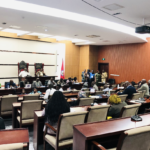
Monrovia – The trial of five women accused of attempting to traffic fourteen children has resumed at the First Judicial Circuit, Criminal Court “A” in Montserrado County. The case, which has drawn significant public interest, continued on Monday, February 16, 2026, marking the sixth day of proceedings before a full jury panel.
The defendants—Halimatu Daramy, Harrieta Beaye, Grace H. Sesay, Hawa Kamara, and Famata Doe—are charged with human trafficking and criminal conspiracy. They have each pleaded not guilty to the charges brought by the Republic of Liberia.
The session, presided over by Resident Circuit Judge Roosevelt Z. Willie, commenced at approximately 10:00 a.m. with the traditional call to order. Following confirmation of presence from both the prosecution and defense teams, the defendants were seated in the dock.
The Republic of Liberia is represented by a strong legal team from the Ministry of Justice, including Cllr. Dr. Aloysius F. K. Allison and Cllr. Sumo Kutu Akoi. They are joined by Cllr. Randolph D. M. O. Johnson, in association with the Ministries of Labor and Gender, Children and Social Protection. Atty. Margrette Philip was also present for the state.
The Office of the Public Defender is representing the accused, with Cllr. Sennay Calor II appearing for the defense. Early in the proceedings, defense counsel requested that one of the defendants, Hawa Kamara, be temporarily excused from the courtroom to attend to her sick child. The prosecution did not object, acknowledging that while a defendant’s presence is a right, it can be waived under certain circumstances.
Citing Sections 2.4.1 and 2.4.3 of the Criminal Procedure Law, Judge Willie granted the request. He ruled that while the defendant would be absent, she would remain legally bound by all proceedings conducted during that time.
Following this, the prosecution moved to qualify and sequester its witnesses, a request the court granted. The first witness called was Inspector Williet D. Kangar of the Liberia Immigration Services (LIS).
Inspector Kangar testified that on April 10, 2025, she and two other LIS officers were conducting routine travel document inspections at the SDS Parking area in Redlight, Paynesville. It was there that they intercepted the five defendants attempting to travel with fourteen children.
According to her testimony, the officers grew suspicious when the children appeared fearful and some could not communicate in English. Suspicion deepened when a woman in the group carrying a crying infant refused to breastfeed the child. One of the defendants, Halimatu Daramy, reportedly identified herself as the group’s leader.
With the help of a bystander who spoke the Vai dialect, officers were able to communicate with one of the children. The interaction led the officers to believe the children were not biologically related to the women. The group was prevented from boarding their bus and was initially turned over to immigration operations officers before the case was transferred to the Liberia National Police’s Human Trafficking Division for formal investigation.
During cross-examination, defense counsel questioned the basis of Inspector Kangar’s conclusion that the women were not the children’s mothers. The defense’s line of questioning drew several objections from the prosecution, many of which were sustained by Judge Willie. The court ruled that some questions were ambiguous, misstated the witness’s testimony, or sought to entrap the witness into making a scientific determination she was not qualified to give.
Judge Willie clarified that the arresting officer’s conclusions were based on professional observations and the circumstances at the scene, not on definitive scientific proof such as DNA testing. Consequently, the court barred questions that required the witness to draw such absolute biological conclusions.
The trial continues, with the state expected to call more witnesses to testify. All five defendants remain under the court’s jurisdiction as the proceedings move forward.