

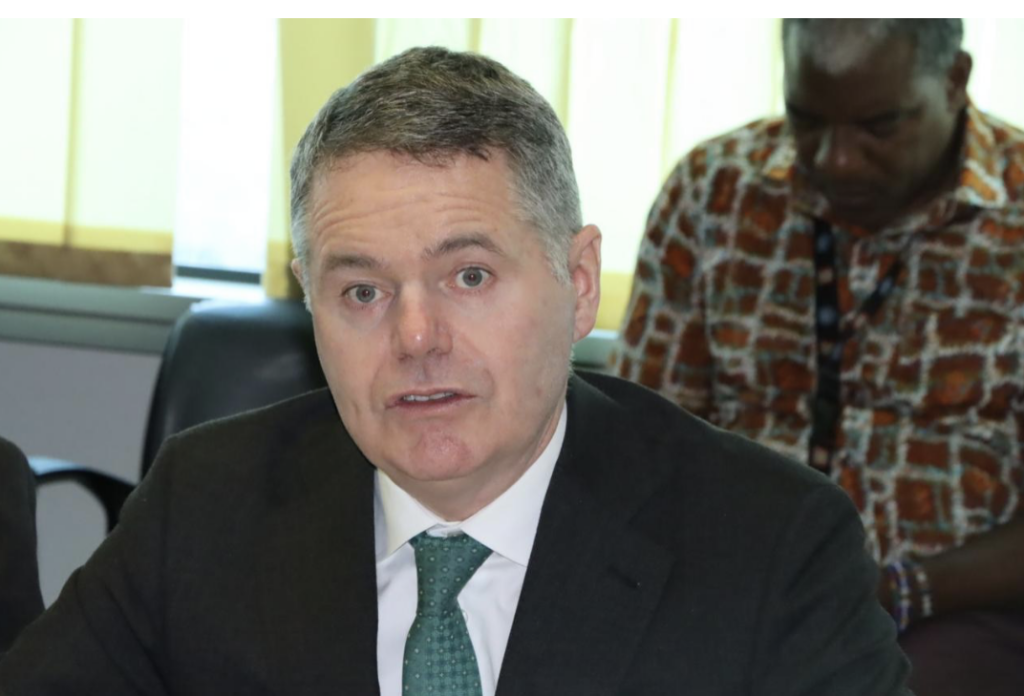
The World Bank Group Managing Director and Chief Knowledge Officer, Mr. Pascal Donohoe, on March 23, 2026 endorsef the Central Bank of Liberia’s (CBL) reform agenda, citing record-low inflation, a strengthened banking system, and rapid digital financial expansion as clear signs of a resurgent and resilient economy.
Describing the moment as a “critical window of opportunity,” Mr. Donohoe praised Liberia’s macroeconomic progress despite global uncertainties. He emphasized that the country’s economic future will hinge on unlocking private sector growth, noting that nearly 90 percent of Liberian businesses employ fewer than eight people making them central to job creation and economic transformation.
He highlighted the success of the Liberia Investment, Finance, and Trade (LIFT) Project, which has already injected US$6 million through seven financial institutions to support over 200 small and medium-sized enterprises. Notably, 40 percent of these businesses are accessing formal credit for the first time an important milestone in expanding financial inclusion and entrepreneurship.
Reaffirming the World Bank’s commitment, Mr. Donohoe pledged continued support to the CBL’s structural reforms, including the rollout of a national Credit Reference System in April 2026 and ongoing insolvency reforms. He stressed that sustainable economic growth cannot rely solely on strong tax revenues, but must be driven by a vibrant and competitive private sector.
Mr. Donohoe made the remarks during his visit to the Central Bank of Liberia headquarters on March 20—his first trip to West Africa since assuming office in November 2025.
In response, the Executive Governor of the Central Bank of Liberia, Mr. Henry F. Saamoi, outlined a series of landmark achievements driven by disciplined policy measures and institutional reforms aimed at fostering inclusive and sustainable growth.
Governor Saamoi revealed that inflation has fallen to 4 percent as of end-December 2025—the lowest level recorded in nearly two decades—and continued its downward trajectory to 3.2 percent in January and 3.1 percent by the end of February 2026. He attributed this historic decline to prudent monetary policy and enhanced macroeconomic management.
He further reported a major turnaround in the banking sector, with non-performing loans sharply reduced from 21.6 percent in January 2025 to 12.79 percent by end-February 2026. This improvement, he noted, reflects stronger regulatory oversight, better risk management, and increased compliance across financial institutions.
The Governor also pointed to the successful introduction of a new family of Liberian banknotes, which has strengthened public confidence in the currency and improved the efficiency and security of cash transactions nationwide.
On digital transformation, Governor Saamoi disclosed that Liberia’s Instant and Inclusive Payment System (IIPS), launched on December 16, 2025, has already processed more than 1.53 million transactions valued at approximately LRD 1.43 billion and US$9.03 million as of March 15, 2026—within just three months of operation. He emphasized that this performance was achieved using only two initial services: person-to-person and government-to-person payments.
Looking ahead, he announced that the Central Bank is advancing the implementation of the National Electronic Payment Switch, a transformative initiative that will integrate all financial institutions into a seamless, modern, and efficient payments ecosystem.
Governor Saamoi also underscored ongoing governance reforms within the CBL, including strengthened internal controls and enhanced transparency. These measures have resulted in the Bank recording operational surpluses in both 2024 and 2025 for the first time in over twenty years—signaling a new era of financial discipline and institutional credibility.