

-As It Secures US$266 Million Deal and Targets Rice Self-Sufficiency
Monrovia, Liberia – The government has secured a US$266 million climate and resilience facility from the International Monetary Fund (IMF), while simultaneously launching a historic agricultural partnership with California to eliminate the nation’s US$200 million annual rice import bill.
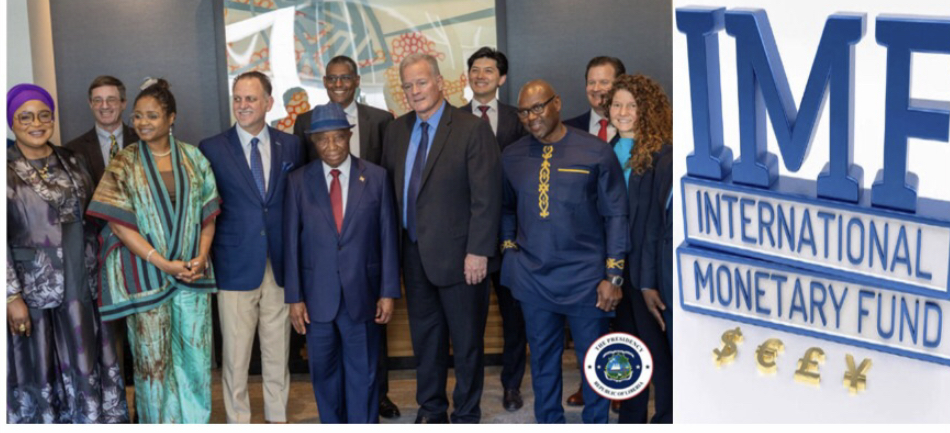
The IMF Executive Board approved on April 27, 2026, a 21-month financing arrangement under the Resilience and Sustainability Facility (RSF) amounting to approximately US$266 million (SDR 193.8 million). The facility will support Liberia’s climate adaptation efforts, resilient infrastructure projects, and pandemic preparedness, while also catalyzing external financing and balance of payments support for the Central Bank of Liberia.
The IMF noted that Liberia’s economic performance remains strong, with growth accelerating to 5.1 percent in 2025, largely driven by mining production. The political environment, the Fund added, continues to support reforms under the government’s national development framework, the ARREST Agenda for Inclusive Development.
Following the Executive Board discussion, Mr. Bo Li, Acting Chair and Deputy Managing Director, praised the government for maintaining sound macroeconomic policies and making progress on structural reforms. “Fiscal adjustment has helped reduce debt vulnerabilities. Expenditure rationalization has supported the reallocation of resources toward priority investment projects and critical social programs,” he said, while noting that further progress is needed.
To mitigate the impact of elevated oil prices, Li acknowledged that the authorities have introduced temporary and targeted subsidies to support public transportation, and that a recently adopted supplementary budget allows for higher social spending while preserving fiscal discipline.
Reacting to the Board’s decision, Finance and Development Planning Minister Augustine Kpehe Ngafuan said, “We are elated that our country has been approved to receive additional financing for development and macroeconomic stability under the RSF. The journey that led to Liberia’s qualification under the RSF began in October 2024.”
Minister Ngafuan thanked President Boakai for his leadership and guidance, as well as the IMF Liberia mission team for their partnership. He emphasized that disbursements will be made over 21 months, contingent on meeting specific triggers for each tranche, and that the approval reflects growing international confidence in Liberia’s reform trajectory.
In a parallel development, the IMF Board also concluded the third review of Liberia’s 40-month arrangement under the Extended Credit Facility (ECF), allowing an immediate disbursement of US$26.49 million. Total disbursement under the ECF arrangement has now reached approximately US$105.96 million. The ECF arrangement, totaling SDR 223 million, was approved on September 25, 2024, to support macroeconomic stability, debt sustainability, financial stability, and governance reforms.
Separately, the Government of Liberia and a delegation from California’s agricultural, academic, and investment sectors over the weekend launched a joint initiative to eliminate Liberia’s US$200 million annual rice import bill and modernize the country’s farming sector.
The announcement follows a multi-stakeholder strategy session held April 24, 2026, in Sacramento, California, where both parties committed to a rapid-action plan that moves Liberia from importing 61 percent of its rice to full self-sufficiency, positioning the nation to become a regional exporter.
“This partnership marks a turning point for Liberian agriculture,” the joint communiqué stated. “By combining Liberia’s natural resources and workforce with California’s innovation and investment, we are building a pathway to food security, job creation, and sustainable economic growth.”
Under the framework, pilot projects will target 50,000 hectares of lowland areas for rice cultivation. The model integrates smallholder farmers with multinational processors through nucleus estate and out-grower schemes, ensuring access to markets, mechanization, and financing. The partnership will also tackle critical constraints including irrigation, seed and fertilizer access, post-harvest processing, and affordable credit for farmers.
The University of California system will lead technology and knowledge transfer, deploying expertise in irrigation, plant breeding, soil health, and livestock nutrition. Innovations discussed include nitrogen-fixing cereals to cut fertilizer dependence and black soldier fly protein systems for animal feed, supported by digital optimization tools. California representatives further committed to mobilizing their networks of investors and agribusiness firms to participate in Liberia’s agricultural transformation.
As a follow-up, an international investment forum is planned for Liberia by August 2026 in partnership with the Food and Agriculture Organization (FAO). A detailed joint work plan outlining target crops, implementation timelines, and partnership structures will be delivered by the California delegation within the next two weeks. Technical teams from the University of California are preparing to deploy to Liberia shortly thereafter to begin pilot implementation.
Beyond rice, the initiative will assess opportunities in cassava, maize, vegetables, coffee, cocoa, livestock, fisheries, and aquaculture, with investments tailored to the comparative advantages of Liberia’s regions.
The Government of Liberia remains steadfast in sustaining reform momentum, strengthening economic governance, and leveraging international partnerships to drive inclusive growth and long-term national development. With US$266 million in fresh IMF financing and a transformative agricultural partnership now in motion, analysts say Liberia is positioning itself for a more resilient and self-sufficient future.