

-How Liberian Newspapers Are Being Suffocated by Advertisement Diversion
By the Editorial Board
For years, a quiet crisis has been building beneath the surface of Liberia’s public conversation. This is not a political scandal or a sudden rise in violence—it is something more insidious: the slow, steady suffocation of the very institutions that protect our freedom of information. The media is suffering. This is not hyperbole; it is a tangible, daily reality of real suffering—of missed salaries, and of journalists forced to choose between reporting the news and feeding their families.
The traditional model that sustained responsible journalism for decades is collapsing without a viable replacement. Once upon a time, a newspaper’s heartbeat came from announcements, public notices, and government advertisements. These were not merely commercial transactions; they were the backbone of operations, paying for ink, newsprint, fuel, and the modest salaries of hardworking reporters. Today, that announcement that we used to publish before is no longer coming to our desks.
Instead, critical state notices, requests for bids, and essential public information are being thrown out like scraps into the chaotic digital spaces of social media chat rooms. Government institutions, have adopted a lazy and irresponsible habit: dumping advertisements into WhatsApp groups and Facebook pages frequented by unregulated bloggers. This act, seemingly small, is a mortal wound to professional media houses.
Let us be unequivocal: A responsible government does not deny the media its oxygen. Advertisement and paid announcements are the backbone of every media platform—be it print, radio, or television. When the state withholds this revenue, it is not saving money; it is deliberately defunding the watchdogs that hold it accountable. This is not a problem exclusive to WomenVoices Newspaper alone. Every independent media institution in Monrovia and beyond is feeling the same chilling effect.
The core principle is simple: the business aspect of journalism should be published and paid for. That exchange—content for compensation—is the oldest and most honorable way of empowering the media. It is a recognition that a free press is a public good, one that requires economic viability to function. When the government refuses to pay for the space it occupies in our newspapers, it is effectively stealing the value we create while simultaneously undermining the very platform it needs to communicate with the citizenry.
However, the reality on the ground has become the opposite of this healthy symbiosis. These days, government institutions favor bloggers who operate from their bedrooms with smartphones. They do this because it is cheap and immediate. But cheap information is often dangerous. Regrettably, the virus has spread. Even some international NGOs operating under the United Nations umbrella in Liberia have begun doing the same, bypassing professional media to post job vacancies and project updates on unverified social media pages.
How do they expect the media to be strong? How do they expect media institutions to pay their employees—men and women who survive on these salaries for their daily bread, for school fees, for clinic visits? When a government entity places an ad or announcement on Facebook instead of doing so in a newspaper, that entity is directly responsible for scores of journalists going unpaid.
The more tragic irony is that nothing is put in place to ease this transition. If the government wishes to move to digital communication, it must do so with regulation and fairness. This is a noble profession so why are they treating it this way? Why is the state treating legitimate journalists like beggars while enriching anonymous bloggers?
The consequences of this neglect are now visible on the streets. Today, any person can open their own media platformvonce they possess a smartphone and a Facebook account. This has led to an exponential increase in online media platforms with no regulations, no editorial oversight, and no ethics. The result is a toxic ecosystem rife with the wide spread of misinformation and disinformation. Fake news travels faster than the truth, and it is destroying our national cohesion.
Because of this economic starvation, even the good soldiers—the veteran journalists who have spent decades learning the craft of verification, fairness, and balance—are not being paid. Why would a trained journalist stay at a newspaper that cannot pay a salary when they can become an unregulated influencervpaid in the promise of future favors or small cash handouts?
This is not a failure of journalistic will; it is a failure of capital. Media house managements are not getting advertisements or other forms of business which they rely on for operations. Consider a newspaper that doesn’t own its own printing press. Such an institution must pay upfront, in cash, to a commercial printer for every single copy produced. Even those newspapers that were fortunate enough to buy their own printers still need funds for diesel, spare parts, ink, and rollers to keep the machines running.
Unfortunately, the jobs that sustain this ecosystem are not available to underwrite printing costs, office management, and staff salaries because the media is being denied of advertisement—its backbone. It is a death spiral: no ads means no revenue, no revenue means no quality content, no quality content means fewer readers, and fewer readers mean no ads. The government needs to act.
More regrettably, the situation has moved from neglect to outright bad faith. The Government of Liberia has refused to pay some media institutions debts it has owed them since last year. Several newspapers have invoices sitting on the desks of finance officers that are several months old. These are not disputes over services; these are deliberate delays. Until today, the status of said payments remains unclear despite immense efforts by media owners to engage the Ministry of Finance.
The media institutions are falling. We are watching them collapse in slow motion. How will the media even be respected if it cannot pay its staff? A journalist who has not received a salary in three months cannot afford to travel to a remote district for an investigation. A newsroom with no stationery cannot print. Respect is earned through independence, and independence is bought with financial stability. When the state controls the purse strings—or simply cuts them off—respect vanishes.
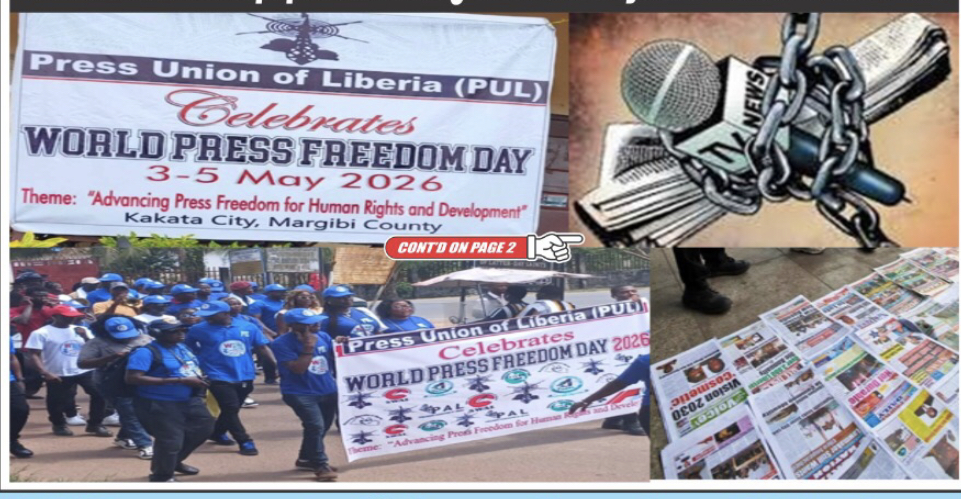
We recently marked World Press Freedom Day on May 3, 2026. This year’s celebrations focused on the critical role of independent media in global stability and the impact of emerging technologies like AI on information integrity. The official theme, “Shaping a Future at Peace: Promoting Press Freedom for Human Rights, Development, and Security,” was a clarion call. It emphasizes how free journalism fosters dialogue and prevents conflict. But in Liberia, we are not using AI to shape a peaceful future; we are using government negligence to destroy a peaceful present.
If there is no free press, there is no development. Investors will not come to a country where information is controlled or chaotic. Donors will not fund a nation that lets its watchdogs starve. And the ordinary Liberian will suffer in silence, unable to know which contracts are being signed, which roads are being built, or which taxes are being levied. The government must immediately settle all outstanding debts owed to media houses. It must ensure that all state advertisements are first offered to accredited, professional media outlets.
Furthermore, the government must consider that
bloggers are not a substitute for the independent media. If an international NGO under the UN wants to speak to Liberians, let them buy an ad in a Liberian newspaper. The standard must be raised. Until then, we will continue to warn the public: when you starve the media, you are not saving money. You are silencing the only force that can speak truth to power. And a silenced society is not a peaceful one—it is a captive one.