

-In Liberia, During World Press Freedom Day Observance
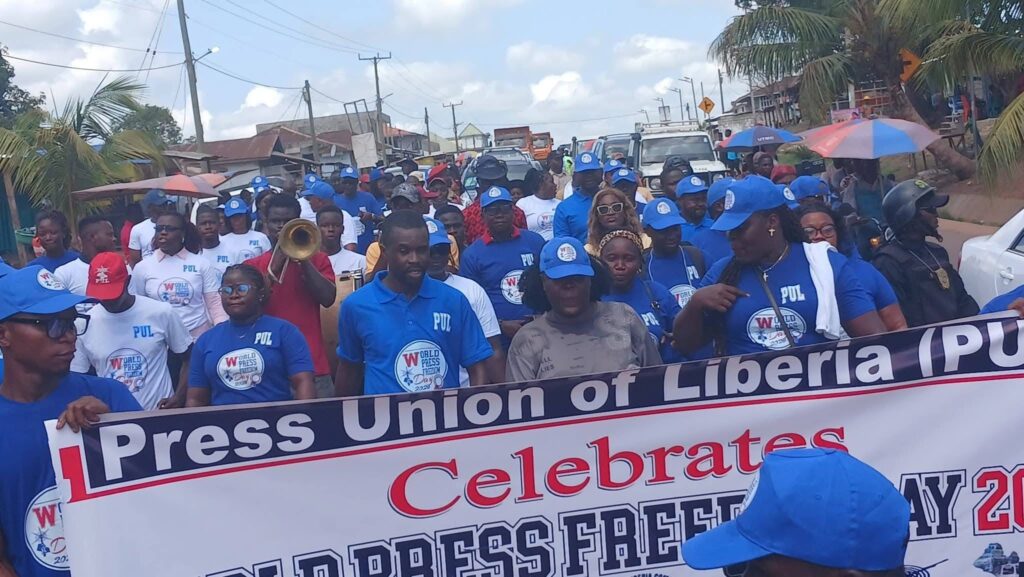
KAKATA CITY, Margibi County – As Liberia joined the global community to commemorate World Press Freedom Day on May 4, 2026, the President of the Press Union of Liberia (PUL), Julius Kanubah, delivered an awkward account of mounting challenges facing journalists across the country, documenting more than a dozen incidents of threats, intimidation, arrests, and abuse since May 2025.
Speaking at a ceremony in Kakata City under the global theme “Shaping a World at Peace: Promoting Press Freedom for Human Rights, Security, and Development,” Kanubah stood alongside UNDP Resident Representative Aliou Mamadou Dia and government officials to honor fallen colleagues and sound the alarm on what he described as a gradual erosion of democratic norms.
“In the period between May 3, 2025, and May 3, 2026, a lot has happened in Liberia with respect to press freedom,” Kanubah told an audience that included Acting Information Minister Johnny Tarkpah, Margibi County Superintendent O. Jay Morris, and scores of journalists from across the country.
Kanubah’s address meticulously cataloged incidents spanning nearly every region of Liberia, from Monrovia to Maryland County, Nimba to Grand Cape Mount.
Among the most serious cases:
· January 2025: Two Daily Observer journalists, Bai Best and David Yates, were named as “suspects” and “persons of interest” by the Liberia National Police’s Office of the Deputy Police Director for Criminal Investigations in connection with their reporting on the mysterious death of a foreign hotel manager. The PUL’s intervention led to the cessation of harassment, though a complaint from the Inspector General remains before the National Media Council.
· February 2025: Journalists Philip Gbana and Elvis Gono were detained for three days at the Kakata Central Prison after standing bond for a pregnant woman linked to a crime. The journalists claimed they were unaware the woman was needed by the 13th Judicial Circuit Court—a claim contested by the Margibi County Attorney.
· June 2025: Broadcast journalist Alex Yormie of Radio Lar-Wehyi in Tappita, Nimba County was abducted by men believed to be members of the Poro Society after broadcasting a Ministry of Internal Affairs directive suspending traditional society activities. The arrest of the central figure, Melvin Duo, followed the PUL’s persistent advocacy.
· July 2025: Edward Stemn of Voice of Hope in Maryland County spent nine days in detention on “Criminal Contempt of Court” charges after broadcasting allegations of bribery against Associate Magisterial Nyemade Bedell. The PUL secured his release.
· August–September 2025: Journalists Eric Opa Doue and Methuselah Gaye faced intimidation from two magisterial courts in Rivercess County. Doue was actually sentenced to 30 days in prison on what the PUL called a “baseless charge of criminal coercion” before sustained advocacy—including from lawyers Cllr. Bruce Boweh and Cllr. Samwar Fallah—secured their freedom.
· September 2025: Veteran journalist Frankie Sainworla had photos deleted from his phone by Monrovia City Police after documenting the harassment of a female petty trader. “Thanks to technology,” Kanubah noted dryly, the images were recoverable.
The list also included the use of pepper spray on journalists in Grand Bassa County, online harassment of female journalist Jenneh Kemokai in Grand Cape Mount, criminal libel charges against two journalists in Bomi County, and the bizarre case of four journalists in Margibi County who were reportedly “swallowed” by the “country devil” of the traditional Poro Society—released but refusing to discuss their ordeal on grounds that “traditional matters” cannot be revealed.
Kanubah did not shy away from addressing friction between the PUL and the Ministry of Information following the Union’s April 22, 2026 position statement on “the gradual erosion of democratic norms in Liberia, particularly freedom of speech and expression, under the administration of President Joseph Boakai.”
“From all indications, that statement angered the Ministry of Information to the extent that both the Minister and the Deputy Minister are still angry,” Kanubah said. “Their anger has led to a rather bizarre accusation: that the PUL has been ‘katorized.’ Whatever that means, it’s up to them.”
Referring to a September 2025 incident involving journalist Franklin Doloquee of Okay FM and Information Minister Jerolinmik Matthew Piah—where the PUL concluded that Minister Piah violated press freedom while the journalist was also found in breach of professionalism—Kanubah called for improved relations between the press and public officials.
“We are happy that the Ministry of Information through the Office of the Acting Minister, Honorable Johnny S. Tarkpah, and the team at the MOI have joined us,” Kanubah said. “Hope they are not angry. Because as a Union, we aim not to anger but to advance freedoms in the public interest.”
Speaking earlier at the same event, UNDP Resident Representative Aliou Mamadou Dia struck a supportive tone while also emphasizing the responsibilities that accompany media freedom. “Let me be clear: a journalist’s safety is non-negotiable,” Dia said. “No reporter should ever be intimidated, assaulted, or silenced for doing their job. Protecting journalists is a shared responsibility across society.”
Dia outlined UNDP’s ongoing support for Liberia’s media community, including: training journalists in election reporting and conflict-sensitive journalism through the Liberia Electoral Support Project (LESP+ 2023–2026); supporting investigative anti-corruption journalism in partnership with CENTAL, Accountability Lab Liberia, and Integrity Watch Liberia; convening a media-law enforcement conference in Zwedru in December 2025 that updated Standard Operating Procedures for media-security interactions; and enhancing digital media resilience through fact-checking initiatives with Internews and iVerify.
“Peace, democracy, and sustainable development all depend on the free flow of information, the courage of journalists, and our collective commitment to defending truth,” Dia said. ‘No Press Freedom When Journalists Live in Poverty’ Perhaps Kanubah’s most pointed observation went beyond legal threats to the material conditions of Liberian journalists themselves.
“One of the most troubling areas that the PUL will have to work on is the issue of the welfare of journalists,” he said. “There can be no press freedom when journalists live in poverty. Journalists in Liberia, on the overall, are making poverty wages.”
He noted that journalists frequently turn to the Union when sick or in difficulty, but the PUL’s capacity to intervene remains severely constrained. The Union plans to address journalist welfare and safety on May 5, 2026. Kanubah drew a direct line from Liberia’s founding constitutional principles to the present moment. The 1847 constitution—Africa’s first republican constitution—explicitly declared that “the liberty of the press is essential to the security of freedom in a state; it ought not, therefore, to be restrained in this republic.”
He quoted UN Secretary-General António Guterres, who said just a day earlier: “All freedom depends on press freedom. Without it, there can be no human rights, no sustainable development—and no peace.”
“Press freedom is the singular and most consequential of all freedoms that every human society aspires to achieve and maintain,” Kanubah concluded. “Without press freedom, there can be no development; without press freedom, there can be no human rights; without press freedom, there can be no security; and without press freedom, there can be no rescue.”
He urged the administration of President Joseph Boakai to “go beyond commitments and principles” and “demonstrate in practice the upholding and respect for freedom of speech and expression.”
The ceremony began with a moment of silence for colleagues who died between May 2025 and May 2026, as well as prayers for those battling serious illnesses. The PUL also recognized former leaders, international partners including the Association of Liberian Journalists in the Americas (ALJA), and legal advocates who have defended journalists pro bono.
The event concluded with PUL’s reaffirmation of independence: “Whether we are branded as political, katorizing, divisionist, or mortgaging the PUL, we will not get distracted by distractionists, neither will we be distorted by distortionists. We will not be diverged by diversionists.”