

-Former President Sirleaf Reacts to Miatta Fahnbulleh’s Criticism:
By Jerromie S. Walters
MONROVIA — Former President Ellen Johnson Sirleaf on Wednesday declined to engage with recent controversial comments made by Liberian singer and political activist Miatta Fahnbulleh, stating simply, “Tell her ain’t gat time for her.”
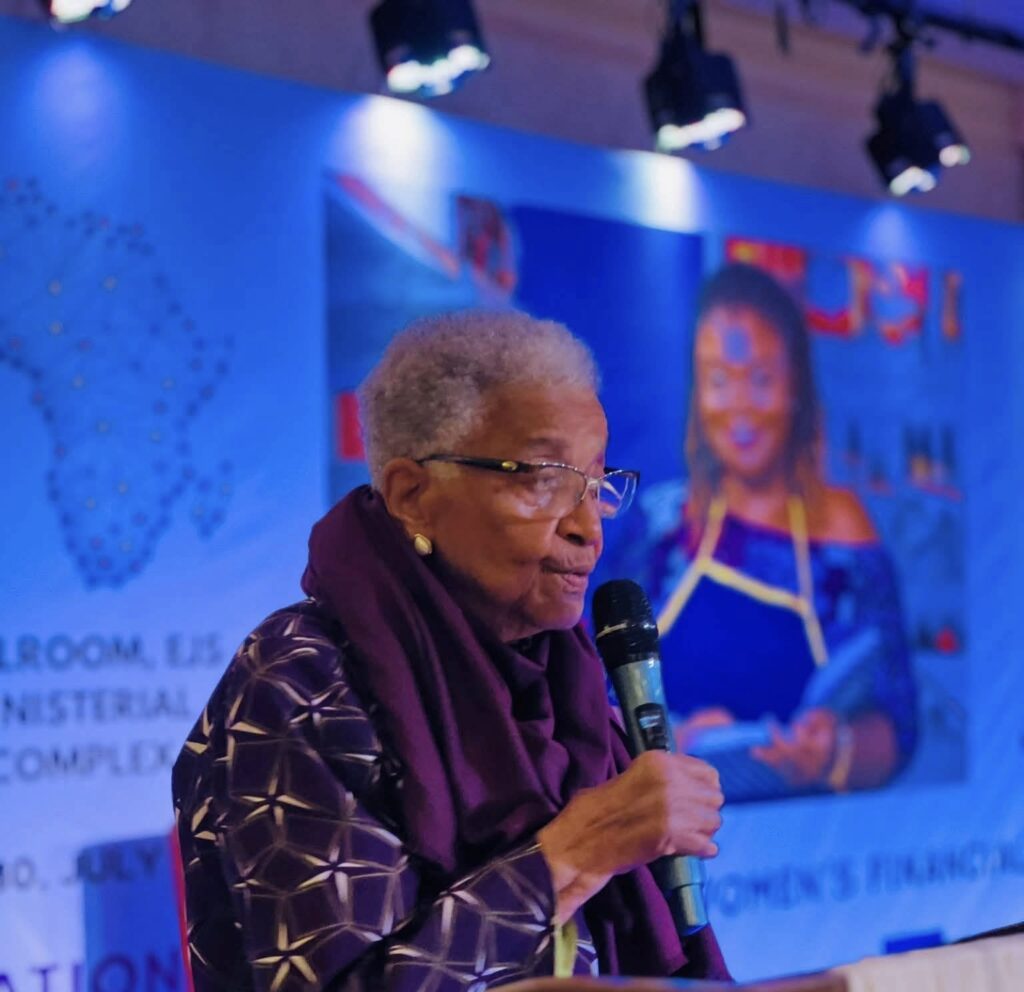
Sirleaf made the remark during a brief media engagement at the Ministerial Complex in Congo Town, where she attended the Africa Women Leaders Network (AWLN) Liberia Chapter’s two-day National Conference on Women’s Financial Inclusion, in partnership with the Central Bank of Liberia.
The former president’s response came amid growing public backlash against Fahnbulleh following her interview with Ghanaian journalist Kafui Dey, in which she claimed Sirleaf’s legacy included “unleashing” former President George Weah onto the country and characterized Weah’s presidency as an unmitigated disaster while suggesting athletes lack capacity for high-level governance.
Fahnbulleh Faces Widespread Criticism
Critics have condemned Fahnbulleh’s remarks as elitist and out of touch, accusing her of showing “disdain for the ordinary people” and positioning herself as part of a “ruling class” that refuses to accept democratic outcomes.
Nimba County District 7 Representative Musa Bility stated via Facebook that Fahnbulleh’s comments revealed frustration over lost political privilege. “It shows her disdain for the ordinary people who made their decision,” Bility wrote. “I guess the right thing for her would have been for Madam Sirleaf to have aborted the wishes of the people then. Simply put, she’s out of her depth. I guess she should stay in her lane, SINGING.”
Sekou Kalasco Damaro, former presidential aide to ex-president Weah, accused Fahnbulleh of viewing herself as part of a ruling class that considers no one outside that circle worthy of the presidency. Damaro argued that such thinking considers Weah’s background as having “desecrated and stained” the presidency.
Critics also pointed out that Weah was not “unleashed” by Sirleaf but democratically elected by millions of Liberians at the ballot box in 2017, winning a decisive victory over Sirleaf’s chosen successor, former Vice President Joseph Boakai.
However, several citizens defended Fahnbulleh, praising her for speaking what they consider an uncomfortable truth about leadership standards. Daniel O. Sando, Deputy Minister for Press and Public Affairs at the Ministry of Information, said, “Aunty Miatta Fahnbulleh spoke well, and we agree with everything she said.”
Supporters argued that Weah’s tenure did real harm to institutional governance and the economy, validating concerns that popularity should never substitute for governance experience.
Sirleaf Addresses Investment, Institutional Confidence
During the conference opening program, Sirleaf emphasized the need for Liberia to build confidence in its institutions to attract genuine investment.
“If you want more banks to open, if you want investment to come, they have to have confidence in our government — a government that they must respect, a government that they can rely on, a government that has the reputation to attract them,” Sirleaf said.
“Otherwise, you will have only the bad businesses, like these drug people who come here.” Sirleaf called for building confidence so the government can tell investors, “Come to Liberia, bring us your money, do your investment, do your business, make sure you get your return.”
Sirleaf, Africa’s first elected female head of state, took office after 14 years of civil war and maintained national peace throughout her two terms. She secured the erasure of $4.6 billion in external national debt, attracted foreign investment, and won the 2011 Nobel Peace Prize.
She facilitated the first peaceful democratic transfer of power between opposing parties in Liberia since 1944 when she handed over to Weah in 2018.
However, she faced criticism for failing to curb systemic corruption, appointing three of her sons to high-level state positions, and struggling to translate foreign investment into grassroots poverty reduction.
Weah, a global football icon, rode to power on a populist wave in 2017. He built community roads, abolished tuition fees at public universities, and signed the Kamara Abdullah Kamara Act decriminalizing speech offenses against the president.
However, his administration faced high inflation, currency instability, and the missing 16 billion Liberian dollars scandal. Several top officials faced US Treasury sanctions for corruption, and he was criticized for spending prolonged periods abroad during national crises.
In 2014, Fahnbulleh ran as an independent candidate for the Montserrado County senatorial seat, suffering a steep defeat to Weah, who won the seat overwhelmingly.
Fahnbulleh is one of West Africa’s most prominent musical icons and social activists, with a career spanning over five decades.