

–Critics Blast Miatta Fahnbulleh Over Controversial Comments Toward Sirleaf and Weah
By Jerromie S. Walters
MONROVIA — Critics have condemned Liberian singer and political activist Miatta Fahnbulleh as elitist and out of touch following her recent interview remarks about former presidents Ellen Johnson Sirleaf and George Weah. Some accuse her of showing “disdain for the ordinary people” and others described her as part of a “ruling class” that refuses to accept democratic outcomes.
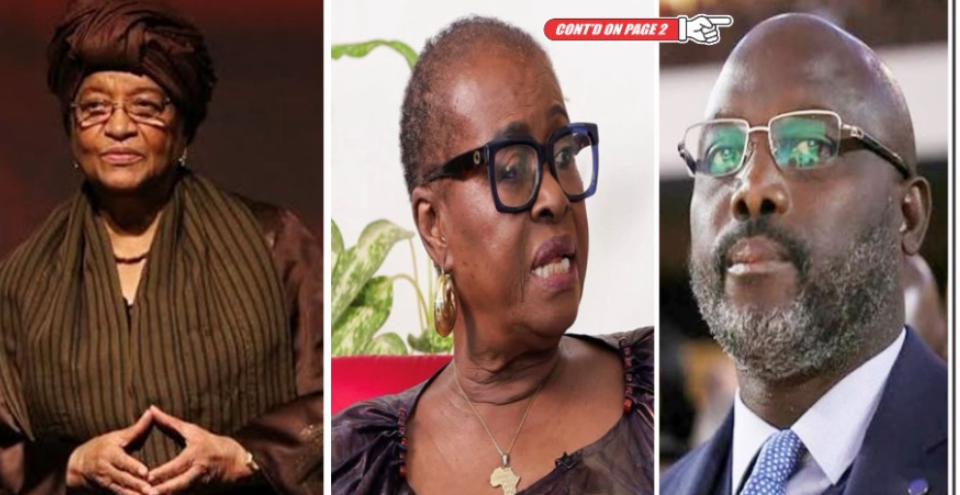
The backlash comes after Fahnbulleh, in an interview with Ghanaian journalist Kafui Dey, claimed that Sirleaf’s true legacy was “unleashing” Weah onto the country while characterizing Weah’s presidency as an unmitigated disaster and suggesting athletes lack the capacity for high-level governance.
Opponents have heavily criticized Fahnbulleh, arguing that her remarks exposed an outdated, elitist mindset historically associated with some Americo-Liberian factions who consider themselves the natural ruling class of the country.
Critics pointed out that Weah was not “unleashed” by Sirleaf but democratically elected by millions of ordinary Liberians at the ballot box in 2017, winning a decisive victory over Sirleaf’s chosen successor, former Vice President Joseph Boakai.
They maintained that dismissing a leader because of their humble beginnings or sporting background invalidates the legitimate votes of the populace and disrespects the democratic process that Liberians fought for decades to establish.
Nimba County District 7 Representative Musa Bility stated via his official Facebook page that Fahnbulleh’s comments showed disdain for ordinary people who made their democratic choice. “While I’m not surprised at her statement, I feel it shows her disdain for the ordinary people who made their decision. The same people who made the decision that we are suffering from today. Now she wants to blame Madam Sirleaf for taking away her inheritance.”
Bility suggested that Fahnbulleh’s remarks reflected frustration that Sirleaf allegedly took away her “inheritance” of political privilege, implying that Fahnbulleh believed political power should remain within a select educated elite. “It is actually shameful and abhorrent. I guess the right thing for her would have been for Madam Sirleaf to have aborted the wishes of the people then. Simply put, she’s out of her depth. I guess she should stay in her lane, SINGING.”
Sekou Kalasco Damaro, a former presidential aide to ex-president Weah, accused Fahnbulleh of viewing herself as part of a ruling class that considers no one outside that circle worthy of the presidency. Damaro argued that for people like Fahnbulleh, a slum dweller and football player like George M. Weah is outside the ruling class and therefore unfit to become president.
He maintained that such thinking considers Weah’s background as having desecrated and stained the presidency of Liberia, a view he described as toxic and venomous. Damaro further stated that Fahnbulleh and her group remain angry that Weah continues to be a defining political figure within Liberia’s body politic.
He declared that a new dawn has arrived in Liberia’s political landscape where Liberians are opting for leaders that represent their kind and background. Damaro emphasized that Fahnbulleh has failed to realize that the political tide has swung and the entitlement mentality of the so-called educated class no longer exists in Liberian politics.
Isaac Doe, a member of the former ruling Coalition for Democratic Change, questioned Fahnbulleh’s handling of inauguration money from a past event, though he did not provide specific details or evidence. Doe also criticized Fahnbulleh for what he described as achieving the feat of making a president faint, referring to an incident involving Weah that occurred during his presidency.
Several other Liberians called out Fahnbulleh’s perceived hypocrisy, noting that she herself is a professional musician who previously ran for the Liberian Senate. They asked why an entertainer felt qualified to seek public office while gatekeeping the same right from an athlete, pointing to what they saw as a double standard in her reasoning.
A segment of the public rejected the notion that Sirleaf was responsible for Weah’s political rise, noting that Weah belonged to an entirely separate opposition party, the Coalition for Democratic Change. They questioned how Sirleaf could be blamed for an election outcome decided strictly by the electorate, especially since Weah ran against her party’s candidate.
Lauding Fahnbulleh Remarks:
Conversely, many citizens rushed to defend Fahnbulleh, praising her for speaking an uncomfortable truth about the country’s leadership standards and the dangers of electing unqualified leaders based on popularity alone.
Daniel O. Sando, Deputy Minister for Press and Public Affairs at the Ministry of Information, noted that he agreed with everything Fahnbulleh said, lending official weight to her perspective. “Aunty Miatta Fahnbulleh spoke well, and we agree with everything she said,” he said.
Other supporters argued that Weah’s tenure did real harm to institutional governance and the economy, validating her concerns that popularity and celebrity charisma should never substitute for policy preparation and governance experience. Others maintained that that questioning qualifications is not elitism but responsible citizenship.
Sirleaf-Weah Legacies:
Former president Ellen Johnson Sirleaf made history as Africa’s first elected female head of state, taking office after 14 years of brutal civil war that had devastated the country. She maintained uninterrupted national peace throughout her two terms and successfully managed the complete withdrawal of the UN Peacekeeping Mission, which had been present in Liberia since 2003.
Sirleaf also secured the historic erasure of 4.6 billion dollars in external national debt under the Heavily Indebted Poor Countries initiative, freeing significant resources for national development. She attracted massive foreign direct investment, restored global diplomatic relations that had been severed during the war years, and won the 2011 Nobel Peace Prize for her work in promoting women’s rights and peacebuilding.
The former president facilitated the first peaceful, democratic transfer of executive power between opposing political parties in Liberia since 1944 when she handed over to Weah in 2018.
However, she failed to curb systemic corruption, famously backtracking on her inaugural promise to make corruption “public enemy number one,” a pledge that raised expectations among anti-corruption advocates. Sirleaf faced intense nepotistic criticism for appointing three of her sons to high-level state positions, including the head of the National Security Agency and the National Oil Company of Liberia.
She also struggled to translate billions in foreign investment into grassroots poverty reduction, leaving rural infrastructure severely underdeveloped despite significant international financial support. She was criticized for a slow, initially militarized response to the 2014 Ebola outbreak, which exposed deep vulnerabilities in the health sector and contributed to thousands of preventable deaths.
Meanwhile, George Weah, a global football icon and the only African player to win FIFA World Player of the Year, rode to power on a populist wave, promising to uplift ordinary citizens and break the grip of traditional elites. He built extensive networks of paved community roads, connected marginalized neighborhoods to the capital, and constructed new public markets through his Pro-Poor Infrastructure agenda.
Weah abolished tuition fees for undergraduate students at all public universities and paid West African examination fees for high school students, making education more accessible to poor families. He signed the landmark Kamara Abdullah Kamara Act, which decriminalized speech offenses, libel, and insults against the president, expanding press freedoms and freedom of expression.
Weah solidified Liberia’s democratic credentials by peacefully conceding his 2023 re-election loss before official final tallies were finished, avoiding the post-election violence that had plagued other African nations.
However, he oversaw a period of high inflation, currency instability, and the infamous missing 16 billion Liberian dollars scandal that triggered mass protests and eroded public confidence in his administration.
Weah faced accusations of weakening state transparency institutions, alongside a perceived rise in unexplained deaths and insecurity that alarmed human rights organizations. Several of his closest top officials, including his Chief of Staff, were hit with US Treasury sanctions for public corruption and bribery, damaging Liberia’s international reputation.
He was also criticized by political opponents for spending prolonged periods abroad during national crises, leading to accusations of a lack of interest in governance and detachment from the suffering of ordinary Liberians.
Their Critic:
In 2014, Madam Miatta Fahnbulleh officially ran as an independent candidate for the highly contested Montserrado County senatorial seat, a race that drew significant national attention.
However, Weah ultimately won the seat overwhelmingly, while Fahnbulleh suffered a steep defeat, a result that some now view as a precursor to the political dynamics that would later define Weah’s presidential victory.
Madam Miatta Fahnbulleh is one of West Africa’s most prominent musical icons, social activists, and cultural ambassadors, with a career spanning over five decades.
Known as the “doyenne diva” of Liberian music, she has spent her career blending her artistry with fierce political advocacy, earning both admiration and controversy for her outspoken views on governance and social justice.