

By: Sampat JMB Kpakimah
President Joseph Nyuma Boakai has called on government ministries and agencies, the private sector, civil society, the media, and international partners to take collective responsibility for Liberia’s development, stressing that the country’s progress requires honesty, accountability, and effective management of national resources.
Speaking today, Augustine 11, 2026 President Boakai said Liberia possesses the resources and human capacity needed to improve the lives of its citizens, but stressed that every Liberian has a responsibility to contribute to the country’s progress.
“Everything that is required to make life better is right here in Liberia,” President Boakai said, recalling his previous experience in government when poverty reduction was a major national priority.
He acknowledged that addressing poverty remains a difficult challenge but urged Liberians to recognize their individual and collective responsibility in confronting the problem.
“Poverty is poverty. I don’t care about what we do. Each and everyone has a responsibility,” the President said, urging citizens not to blame others for the country’s challenges without first examining their own roles.
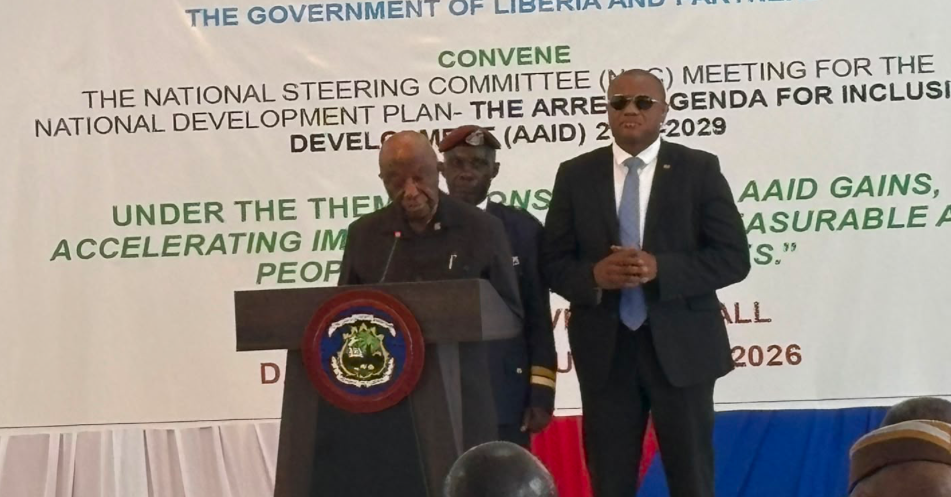
President Boakai made the statement at the AAID National Steering Committee meeting held at the Monrovia City Hall in Sinkor, he said his administration remains committed to delivering tangible results to the Liberian people, including quality roads, improved public services, job creation, expanded access to education, and other critical development initiatives.
He commended ministers, government agencies, civil society organizations, international partners, and other stakeholders for their contributions, noting that increased coordination and collaboration are essential to achieving national development objectives.
The President said the launch of the government’s development agenda in 2025 was based on a promise to the Liberian people to produce tangible and measurable results.
“While progress has been made, we must be honest with ourselves,” he said, warning that institutional gaps and shortcomings must be identified and addressed rather than ignored.
President Boakai urged government officials to accept criticism and make necessary corrections, emphasizing that public officials must be held accountable for their performance.
“We must be honest to admit and take corrections,” he said, adding that positions and promotions should be based on performance and merit.
He cautioned public officials against making excuses for poor performance, stressing that Liberians expect results from their government.
“Liberians are not going to forgive you for the excuses, and the media are not going to listen to you,” President Boakai warned.
He said the National Steering Committee has an important responsibility to provide effective oversight and strengthen coordination among institutions to ensure that government programs are implemented efficiently.
According to President Boakai, the development process must serve as a platform for critical reflection, allowing government institutions to examine what is working, identify weaknesses, and make the necessary adjustments.
He identified job creation, expanded access to education, improved communication, and effective public service delivery as key areas requiring sustained attention.
The President also stressed the importance of responsible management of national resources, warning that every dollar allocated for development must be handled with the highest level of responsibility.
“All of the resources are for the development of this country. We have the responsibility of managing them. Every dollar must be managed with the highest responsibility,” he said.
President Boakai called for greater efficiency and transparency in government reporting, declaring that timely reporting is non-negotiable.
He directed ministries and agencies to submit their reports on time, warning that repeated delays, ineffectiveness, and inconsistencies in reporting would not be tolerated.
“Moving forward, all ministries and agencies are expected to make reports on time. Repeated delays, ineffectiveness, and inconsistency are unacceptable,” he said.
The President also emphasized the importance of the private sector in Liberia’s development, urging businesses to operate with competence, integrity, and professionalism.
He said the government’s development agenda provides opportunities for private-sector investment and called on businesses to see themselves as partners in national development.
President Boakai further called on civil society organizations and the media to play their respective roles in ensuring accountability and promoting informed public discourse.
“Society must play a role in impacting change. I see you as partners. You are more than just observers,” he said.
He encouraged all stakeholders to work together to ensure that government institutions deliver on their mandates and that development efforts translate into meaningful improvements in the lives of ordinary Liberians.
President Boakai concluded by thanking the participants, noting that their presence demonstrated a commitment to Liberia’s development and the collective responsibility of building a better country.
In a remark the Minister of Finance and Development Planning, Augustine Kpehe Ngafuan said called for stronger coordination among government institutions and development partners to ensure that Liberia’s national development priorities translate into measurable results for citizens.
Speaking at a high-level engagement with members of the National Steering Committee, the Minister emphasized the importance of regularly reviewing progress, identifying operational challenges and agreeing on practical measures to accelerate implementation.
He said such engagements provide an opportunity for stakeholders to assess achievements made during the implementation of the country’s development agenda while identifying areas that require greater attention and corrective action.
According to the Minister, Liberia has made progress in several areas, but significant challenges remain and require sustained policy action, stronger institutions and effective coordination.
He noted that the government remains committed to strengthening public institutions and improving the delivery of essential services, while ensuring that national resources are directed toward programs that produce measurable development outcomes.
The Minister further stressed the need to strengthen the country’s domestic resource mobilization efforts and improve public financial management as part of broader efforts to sustain Liberia’s development gains.
He said ongoing reforms are intended to improve the effectiveness and efficiency of government operations, strengthen accountability and create an enabling environment for investment and economic growth.
The Finance Minister also highlighted the importance of aligning development programs with national priorities, cautioning that resources must be properly utilized to achieve tangible benefits for citizens.
He said the government will continue working with stakeholders to address implementation delays, strengthen coordination and ensure that development interventions are effectively delivered.
The Minister reaffirmed the government’s commitment to advancing Liberia’s national development aspirations, noting that achieving the country’s long-term goals will require collective responsibility, sustained commitment and measurable results.
He urged members of the National Steering Committee and other stakeholders to remain focused on implementation, coordination and accountability as Liberia works toward achieving its broader development objectives.
Meanwhile, the Minister of Finance and Development Planning is expected to present an assessment of the AAID’s first year of implementation, including progress, emerging challenges and priorities for the next phase of the national development agenda.
The AAID National Steering Committee meeting brings together government and key development stakeholders to review implementation of Liberia’s national development priorities and strengthen coordination towards achieving measurable results for citizens.