


BY: SHALLON S. GONLOR
shallonsgonlor@gmail.com
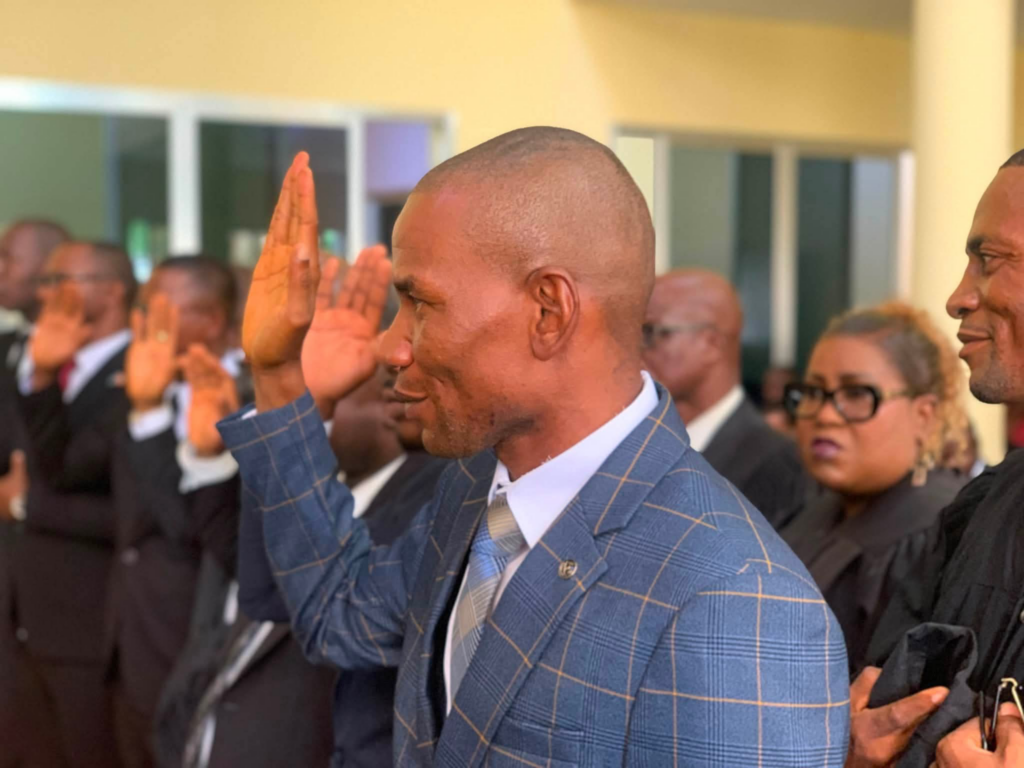
SANNIQUELLIE, Nimba County — Eight newly qualified attorneys-at-law have been admitted to the Nimba Bar Association, pledging to uphold integrity, accountability, professionalism, and public service as they begin their legal careers.
The admission took place Monday during the formal opening ceremony of the August 2026 Term of Court at the 8th Judicial Circuit Court Complex in Sanniquellie, Nimba County.
The newly admitted attorneys are Anthony S. Doyah, Melvin T. Jimmy, Josiah M. Monmia, E. Kpon Saye, Albert G. Tougbaye, Nuakeh K. Karway, Dahnu Mianyen, and Niasehkai Gluaseay.
Their admission followed the successful completion of legal education at the Louis Arthur Grimes School of Law of the University of Liberia and the successful completion of the Supreme Court of Liberia Bar Examination, a mandatory requirement for admission to legal practice in Liberia.
With their admission to the Nimba Bar, the eight attorneys are now formally authorized to practice law and represent clients in accordance with Liberia’s Constitution, statutory laws, professional rules, and established ethical standards.
Their entry into the profession adds to the pool of qualified legal practitioners available to serve individuals, businesses, institutions, and communities in Nimba County and beyond.
As members of the legal profession, the new attorneys are expected to demonstrate competence, integrity, impartiality, professionalism, and respect for the rule of law while protecting the rights and interests of those they represent.
Their admission comes as Nimba’s judicial system continues to handle a broad range of civil, criminal, labor, and other legal matters, underscoring the importance of competent and ethical lawyers in providing representation and promoting access to justice.
The new attorneys are expected to contribute to the administration of justice through legal representation, legal advice, advocacy, and other lawful means aimed at protecting citizens’ rights and strengthening public confidence in the justice system.
Speaking on behalf of the eight newly admitted lawyers, Atty. E. Kpon Saye delivered a strong message on the responsibilities that accompany membership in the legal profession.
Saye described the black gown worn by lawyers as more than a symbol of professional achievement or status, characterizing it instead as a “sacred trust” that carries significant responsibilities to clients, the courts, the Constitution, and society.
He emphasized that the privileges granted to lawyers must be exercised with humility, discipline, professionalism, and an unwavering commitment to justice.
According to Saye, a lawyer’s license should never become an instrument for personal enrichment, political influence, intimidation, or exploitation of vulnerable people.
“Your license is not a mission slip for personal gain,” Saye warned.
He stressed that lawyers occupy a unique position in society because they are entrusted with protecting rights, interpreting and applying the law, representing clients, and assisting in the administration of justice.
He therefore urged the newly admitted attorneys to recognize that their professional responsibilities extend beyond individual clients to the wider society and the justice system.
Saye reminded his colleagues that becoming a lawyer should not be viewed merely as the culmination of years of academic and professional training, but as the beginning of a lifelong obligation to justice, the Constitution, and the people they are licensed to serve.
Saye further encouraged the new lawyers to use their legal knowledge and professional standing to defend vulnerable people, speak for those without a voice, and help ensure that individuals who lack financial resources, social influence, or political connections are not denied justice.
He urged them to challenge wrongdoing regardless of the social status, wealth, or political influence of the individuals involved.
Saye particularly cautioned against selective justice, stressing that fairness, accountability, and equal protection under the law must apply equally to the powerful and the less privileged.
According to him, the credibility of the legal profession depends significantly on the conduct of individual lawyers and their willingness to place justice and professional ethics above personal interests.
He also urged the new attorneys to resist financial inducements, political pressure, conflicts of interest, and other forms of improper influence that could compromise their professional independence.
Integrity as a Daily Choice
The Nimba lawyer reminded his colleagues that integrity is not something demonstrated only during court proceedings, official ceremonies, or other public appearances.
Instead, he said, integrity must be a daily choice that guides lawyers in their dealings with clients, opposing counsel, judges, court personnel, public officials, and ordinary citizens.
He cautioned the newly admitted attorneys against viewing their admission to the bar simply as a personal achievement or the end of a difficult educational journey.
Rather, he said, it should represent a renewed commitment to public service and the administration of justice.
Saye emphasized that the true dignity of a lawyer is not determined merely by the black gown worn in court, but by the conduct, principles, character, and commitment to justice demonstrated throughout the lawyer’s career.
The admission of the eight attorneys represents a significant personal achievement for the newly qualified lawyers while also adding professional capacity to Nimba County’s legal community.
Their presence is expected to increase access to legal services and provide additional professional capacity for individuals and institutions seeking legal representation and advice.
The Nimba Bar Association operates as a local chapter of the Liberian National Bar Association (LNBA) and plays a role in promoting professional standards and access to justice within the county.
The association is headed by Cllr. Kim Amelia Harris, who is the first female president in the history of the local bar association. She was elected and inducted into office in early 2025.
Upon taking office, Harris pledged to expand pro bono and free legal services for indigent citizens who cannot afford legal representation.
Her administration oversees a growing legal community that continues to welcome newly qualified lawyers through formal court admissions.
Nimba Bar is regarded as one of Liberia’s larger and fastest-growing local bar associations, with membership reportedly exceeding 100 attorneys.
The admission ceremony was attended by several senior judicial officers, including Chief Justice Yarmin Quiqui Gbeisaye, Resident Judge Pepe Suah, Sexual Offenses Division Judge Musa Sedibey, and newly inducted Labour Court Judge Tarlo Wehyee.
The occasion marked both a celebration of the attorneys’ academic and professional accomplishments and a reminder of the weighty responsibilities that accompany the privilege of practicing law.
As they begin their professional careers, the eight new attorneys join a legal profession entrusted with upholding justice, defending the rule of law, protecting constitutional rights, and helping citizens obtain meaningful access to legal representation and judicial remedies.
For the newly admitted lawyers, the black gown may distinguish them as members of the legal profession, but, as Saye emphasized, their character, integrity, professionalism, and commitment to justice will ultimately define the dignity and legacy of their careers.
Nimba County also has a notable history within Liberia’s legal profession, having produced three Chief Justices, including the late Cllr. Emmanuel Gbalazaye and former Chief Justice Yarmin Quiqui Gbeisaye.
The latest admission therefore adds another group of legal professionals to a county with a longstanding connection to Liberia’s judiciary and legal institutions.
For the eight newly admitted attorneys, however, the immediate challenge is clear: to transform years of legal education and professional training into ethical practice, effective representation, and meaningful service to the people.
Their admission is consequently not only the beginning of a new professional chapter but also a call to uphold the trust placed in lawyers by the courts, clients, communities, and the Liberian Constitution.