


By Vaye Abel Lepolu
MONROVIA, Liberia— The Central Bank of Liberia (CBL) has announced plans to intensify efforts to address high levels of non-performing loans (NPLs) in the country’s financial sector, warning that the growing challenge could undermine financial stability, private-sector growth and access to credit.
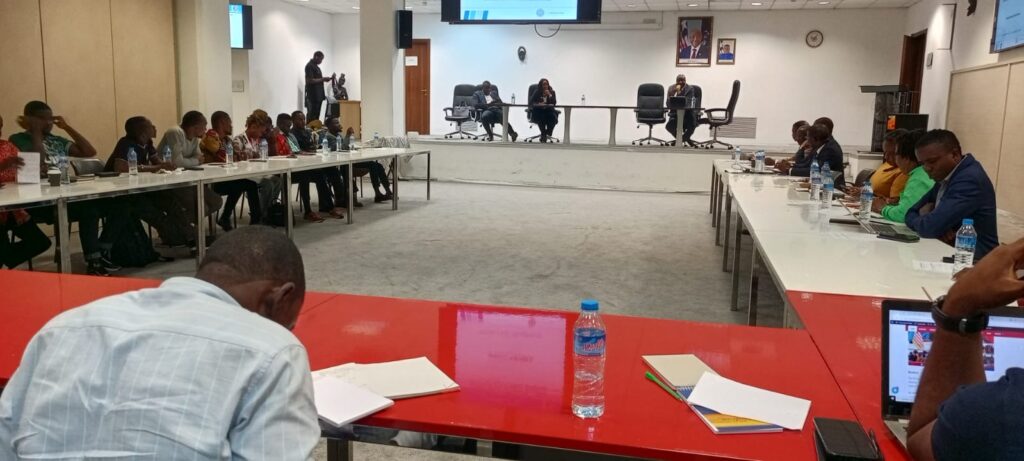
The CBL tackling the Non-Performing Loans made during a media orientation held ahead of the National Non-Performing Loans conference, which is expected to bring together policy’s makers, commercial banks, members of the judiciary, legal professionals, development partners, legislators and business leaders.
Cllr. P. Alphonsus Zeon, Head of Corporate Communications at the CBL, said the conference is intended to provide a national platform for addressing persistent challenges surrounding loan recovery, collateral enforcement, credit discipline and responsible lending.
He said non-performing loans do not affect banks alone, but also entrepreneurs, farmers, women-owned businesses, young people and communities that depend on access to financing to expand economic opportunities.
According to Zeon, when loans are not repaid according to agreed terms, financial institutions become more cautious about issuing new credit, businesses face financing constraints, investor confidence can decline and economic growth may be affected.
Executive Governor of the Central Bank of Liberia, Hon. Henry F. Saamoi, stressed the importance of helping journalists understand the financial-sector challenges so they can accurately inform the public.
Saamoi said the government and the CBL are seeking to reduce non-performing loans, attract investment and expand access to finance, particularly for agriculture, manufacturing, women entrepreneurs and young people.
He explained that commercial banks play a critical role in providing credit to the real sector of the economy, but banks also need greater confidence that loans extended to borrowers can be recovered within a reasonable period.
“If we cannot recover loans in record time, then we have to write off facilities against our capital,” Saamoi said, emphasizing that repeated losses could put pressure on banks to seek additional capital from shareholders.
He warned that continued high levels of NPLs could limit economic expansion and job creation, stressing that the CBL wants to take proactive measures rather than wait until the situation becomes a larger threat to the financial system.
“We need to address the elephant in the room, and that elephant in the room is the high levels of NPLs that the financial sector currently faces,” Saamoi said.
The CBL Executive Governor noted that addressing the problem is essential to expanding access to credit and supporting economic growth, particularly as limited financing can constrain businesses and employment opportunities.
Deputy Governor Mrs. Euphemia Gbadee Swen-Monmia also encouraged journalists attending the orientation to use the knowledge gained from the session to educate the public about the conference and the broader financial-sector reforms.
She said the media has an important role in translating technical discussions about non-performing loans and financial reforms into information that ordinary Liberians can understand.
A major component of the CBL’s efforts is the Enhanced Collateral Registry initiative, which is designed to improve access to finance, particularly for micro, small and medium-sized enterprises (MSMEs).
The Liberia Collateral Registry, established with support from the International Finance Corporation and the World Bank, provides a web-based system through which lenders can determine existing security interests and register their interests over movable assets pledged as collateral.
The initiative operationalizes Chapter 5 of Liberia’s Commercial Code of 2010, commonly referred to as the Secured Transactions Law.
CBL records presented during the workshop showed that between June 2014 and June 2020, the registry recorded institutional and individual clients, financing statements, searches and movable collateral registrations, demonstrating early use of the platform.
The CBL also reminded borrowers to provide accurate identity information, ensure that names correspond with official documents, understand the assets covered by security agreements and retain relevant documentation.
Borrowers were further advised to verify registered information and ensure that registrations are updated or discharged when obligations are fulfilled.
For lenders and the public, the CBL recommended conducting appropriate searches before accepting assets as collateral, reviewing existing security interests and using registry search and reporting functions to support due diligence.
The Central Bank said strengthening the collateral system and improving loan recovery mechanisms are key steps toward building a stronger credit culture, expanding financial inclusion and creating an environment where responsible borrowers can obtain financing while financial institutions are protected against excessive risk.
The upcoming National Non-Performing Loans Conference is therefore expected to focus on practical and sustainable measures to improve Liberia’s credit environment and support broader economic development.
The CBL has urged the media to provide accurate, balanced and accessible reporting on the conference and its outcomes, saying effective public communication will be critical to building financial literacy and promoting responsible borrowing and repayment across Liberia.


