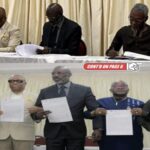



THE TRIAL OF former Vice President Jewel Howard-Taylor on drug trafficking and money laundering charges is, without question, the most consequential criminal case in Liberia’s recent history. It follows the seizure of nearly four tonnes of cocaine — valued at roughly $317 million — in July 2026, described by authorities as the largest narcotics bust this nation has ever seen. The charges are grave. The public interest is immense. And the integrity of the entire prosecution now rests on questions that have nothing to do with whether Howard-Taylor is guilty.
THAT IS THE troubling reality laid bare in court documents and legal arguments reviewed this week. Howard-Taylor’s defense team is not mounting a case centered on proving her innocence. Instead, it is challenging the legality of the government’s investigation and the seizure of evidence — at least nine procedural questions that could, at minimum, keep seized evidence out of the trial entirely.
THIS IS NOT a technicality to be dismissed. It is a warning. On Tuesday, September 22, 2026, at approximately 6:17 p.m., sheriff’s deputies and National Joint Security authorities executed a court-ordered search at Howard-Taylor’s residence. The operation followed an interim order from Judge Ousman F. Feika, Resident Assigned Circuit Judge for Criminal Court “C,” authorizing a “comprehensive inspection” of the premises. The order was served on Cllr. Saah Kpadeh, identified as one of Howard-Taylor’s counsels, who signed to acknowledge receipt.
THE SEARCH YIELDED a sweeping array of electronic devices: a complete desktop computer system with accessories, two Orange modems connected to televisions, two personal laptops belonging to Howard-Taylor’s deceased son, and all cell phones in the possession of a personal attendant and Bureau of Corrections Officers assigned to the premises.
The Nine Questions
THE DEFENCE HAS identified multiple areas of potential challenge, each raising legitimate constitutional and procedural concerns:
First, the September 22 order reportedly authorized seizure of “every telephone, mobile phone and communication device” but does not publicly state the specific conduct or probable cause justifying such a sweeping search. The defense argues the order may have been unconstitutionally broad.
SECOND: JUDGE FEIKA’S September 4 house-arrest order imposed restrictions including surrendering travel documents, limiting travel, and monitoring visitors — but according to the defense, it did not expressly prohibit Howard-Taylor from possessing or using phones. This raises the question: what violation justified confiscating communication devices?
THIRD, WHILE ONE of Howard-Taylor’s lawyers received the order at 6:27 p.m., the defense questions whether they had any meaningful opportunity to challenge it before execution. Attorneys could argue a lack of notice and an inability to be heard before an intrusive search.
FOURTH, THE INVENTORY included phones belonging to corrections officers and her attendant, as well as laptops belonging to her deceased son. The defense questions whether property belonging to people who were not accused was lawfully seized.
FIFTH, NO PUBLICLY established evidence connects Howard-Taylor’s late son to the cocaine investigation. The defense could ask why his computers were taken, whether they were specifically identified in the court order, and whether any evidentiary basis linked them to the investigation.
SIXTH, GOVERNMENT OFFICIALS reportedly gave different explanations — one describing the search as a routine security inspection, others claiming it related to violations involving multiple phones. That inconsistency matters because different legal standards apply depending on the search’s true purpose.
SEVENTH, THE SEPTEMBER 4 order reportedly warned that violating house arrest could result in return to custody. No public announcement indicates that happened — raising questions about whether authorities themselves viewed any alleged violation as established.
EIGHT, THE ORDER reportedly directed that devices be held at the courthouse. The defense could question why they were not merely inspected and whether indefinite retention was legally justified.
NINTH, THE DEFENSE is seeking to determine whether prosecutors requested the search or the court initiated it independently — a procedural issue that could matter if evidence from the devices is introduced at trial.
IF A COURT finds the search exceeded the authority granted by the order, lacked sufficient legal justification, or improperly seized third-party property, the defense could ask the court to suppress evidence obtained from those devices, return unlawfully seized property, and challenge the prosecution’s investigative procedures.
LEGAL ANALYSTS CORRECTLY note these are procedural and constitutional questions about the legality of the search. They do not by themselves determine whether Howard-Taylor is guilty or innocent of the underlying cocaine-related charges. But that is precisely the point — and precisely the problem.
MADAM HOWARD-TAYLOR, Liberia’s former Vice President, faces charges including unlicensed importation of a controlled substance, unlicensed sale and distribution, illicit trafficking, criminal solicitation and conspiracy, and money laundering. She was arrested on August 19, 2026, while traveling to Roberts International Airport for a women’s conference in Ghana. Police had linked her to an international drug-trafficking network following a month-long investigation. The government formally charged her under the Controlled Drug and Substance Act of 2023 and the Anti-Money Laundering and Terrorist Financing Law.
THESE ARE SERIOUS allegations. If proven, they represent a betrayal of public trust of the highest order. But serious allegations demand serious process. A prosecution that cuts constitutional corners does not strengthen the case — it weakens it. It hands the defense an escape route. It risks allowing a potentially guilty defendant to walk free because the state failed to follow the law.
THE LIBERIAN GOVERNMENT has every right — indeed, every duty — to pursue drug traffickers relentlessly. The record cocaine seizures of 2026 demand nothing less. But that pursuit must be conducted within the boundaries of the Constitution and the law. The fight against narcotics cannot become a justification for abandoning the very principles that distinguish a democracy from a narco-state.
WE TAKE NO position on Howard-Taylor’s guilt or innocence. That is for the courts to determine. But we take a firm position on this: the prosecution must be able to withstand scrutiny. Every warrant must be properly justified. Every seizure must be lawfully grounded. Every procedural step must be documented and defensible.
IF THE GOVERNMENT’S case is strong, it should not need to rely on questionable searches. If the evidence is compelling, it should have been gathered lawfully. And if mistakes were made, the responsible officials must be held accountable — not as a favor to the defense, but as a service to the nation.