

-Opposition Leaders Say, As They Formalize Partnership to ‘Tackle National Challenges’
By Jerromie S. Walters
MONROVIA, Liberia — Five heads of major Liberian political parties have clarified that their collaboration does not constitute an electoral alliance for the upcoming 2029 general election. Instead, they describe their partnership as a corporation and an alternative approach to leadership aimed at tackling issues threatening Liberia and its people.
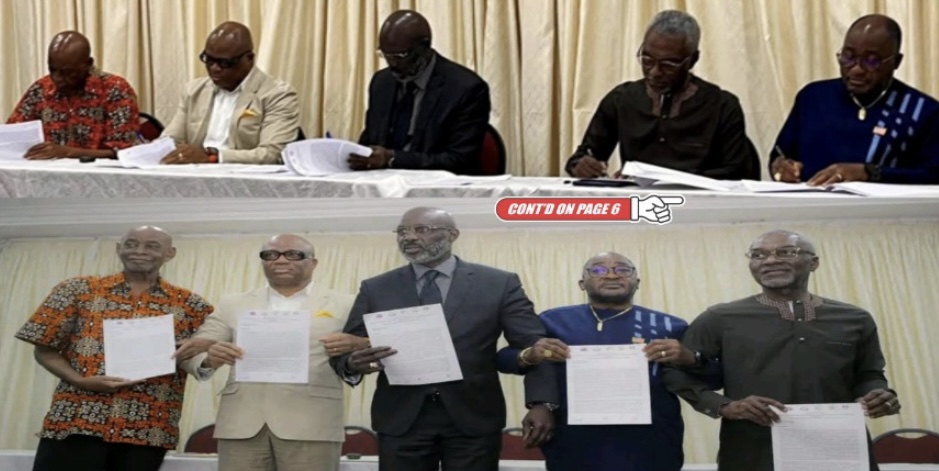
The five political leaders signed a communique at the Sinkor Palace Hotel in Sinkor. The signatories include George M. Weah of the Congress for Democratic Change (CDC), Alexander B. Cummings of the Alternative National Congress (ANC), Simeon Freeman of the Movement for Progressive Change (MPC), Jonathan A. Mason of the Union of Liberian Democrats Party (ULDP), and Dee-Maxwell Kemayah of the Movement for Economic Empowerment (MOVEE).
The political leaders gathered to formalize their commitment to working together while maintaining their individual party identities. They emphasized that their primary focus centers on addressing national challenges rather than pursuing electoral ambitions.
Alexander Cummings, Political Leader of the Alternative National Congress, addressed speculation about the nature of their collaboration directly. “This is not an electoral alliance,” Cummings declared. “I know people want to leap to that. It may become one, but today, it is about how we put pressure on the government to benefit ordinary, common, average Liberians.”
Simeon Freeman, Political Leader of the Movement for Progressive Change, backed this position by explaining the structure of their cooperation. “The identity of each of the parties remains intact,” Freeman stated. “We are not discussing who becomes President or who becomes vice president. We are cooperating to be able to structure an alternative approach to leadership.”
Freeman elaborated on the practical aspects of their collaboration. He explained that the parties would meet together on issues and jointly organize engagements on various matters. Through this process, he noted, the leaders will get to know each other better and work together more effectively.
The document signed by the leaders outlines plans for engaging Liberians through joint activities across different counties. Freeman described the purpose of these engagements as an opportunity to “listen to our people, hear what they want, hear what they want us to do, and how they want us to govern.”
Freeman characterized the collaboration as a structure that enables each party to remain independent while simultaneously working together. He emphasized that this approach allows them to tackle issues they perceive as threatening the country.
Former President George Weah commented on the absence of political leaders who attended previous meetings. “Today we are going forward,” Weah said. “Those that were at that meeting decided to go their way. We decided to stay together. Today we are here to speak with one voice and we signed a document to work together in the interest of our country and our people.”
The signing ceremony brought together several prominent political figures. Former President Weah, who also serves as Political Leader of the Congress for Democratic Change, attended the event. Movement for Progressive Change Political Leader Simeon Freeman, former presidential candidate Jonathan Mason, and Movement for Economic Empowerment Political Leader Dee-Maxwell Kemayah also participated.
The Genesis of Opposition Collaboration
The collaboration traces its origins to September 6, 2026, when Liberia’s opposition leaders concluded two days of high-level talks at former President George Weah’s Jamaica Resort residence. During those discussions, the leaders agreed to establish a steering committee to formalize their collaboration ahead of the 2029 general elections.
The closed-door strategic sessions began on September 5, 2026, and brought together key opposition figures in what participants described as a historic move toward political unity. Former President Weah organized the roundtable, which marked the first comprehensive gathering of opposition leaders since the 2023 elections.
Simeon Freeman struck an assertive tone following those deliberations. He directly addressed criticism that the opposition has been ineffective. “You said the opposition doesn’t have teeth, and we are beginning to make the opposition have teeth so that we can work together and begin to counter issues that are of concern to the people of Liberia,” Freeman declared.
Freeman outlined the concrete outcomes of that earlier meeting. He confirmed that leaders had agreed to establish a working committee to develop a framework acceptable to all participating parties. “We’ve met as political leaders and we have agreed to set up a steering committee that will structure a framework that is acceptable to all of the parties,” Freeman said. “We have agreed to also ensure a communique. We have also agreed to work together, and the structure of what that working together will look like is why this committee is meeting.”
Former President Weah, who hosted the gathering at his Thinkers Village residence, emphasized that national peace remained paramount throughout the discussions. “We spoke yesterday to political actors to let them know that the peace of this country is more important than anyone, and that’s why we are here today,” Weah said. “We had a very good deliberation and we are moving forward in our perspectives on what our country needs to be and how we can work together to make sure that we guide our peace.”
Alexander Cummings stressed that the opposition’s efforts transcend personal ambitions. He framed the collaboration as a mandate to serve the Liberian people. “This is about the Liberian people. It’s not about us as individuals,” Cummings said. “It’s about speaking to and speaking on behalf of the Liberian people.”
Cummings pledged that the unified opposition would hold the governing administration accountable. He called for responsible governance and equitable treatment of citizens. “We will be holding this government accountable because they are in power,” Cummings stated. “They have the control and the resources, and we want them to work on behalf of the Liberian people. We want them to not selectively persecute people. We want them to guide the resources of Liberia in the appropriate way.”
The ANC leader confirmed that the initial meeting represented “the first of many meetings.” He noted that participants agreed on collaborative processes while remaining collectively committed to advocating for Liberian interests. “We have agreed the processes of how we collaborate, but we are collectively committed to speaking and working on behalf of the Liberian people,” Cummings noted.
The gathering featured prominent opposition leaders, including Cummings, Freeman, and Musa Hassan Bility, Political Leader of the CMC. The All Liberian Party was represented by an official delegate on behalf of party leader Benoni Urey.
The previous strategic talks focused on opposition collaboration, political unity, and forming a consolidated strategy ahead of Liberia’s 2029 general elections. This timeline suggests the opposition is already positioning itself for the next electoral cycle.
Examining Boakai’s Performance
An assessment of the Liberian government’s performance under President Joseph Boakai reveals a mixture of macroeconomic stabilization and persistent systemic hurdles. The administration’s governance framework operates under the ARREST Agenda, which focuses on Agriculture, Roads, Rule of Law, Education, Sanitation, and Tourism.
Under the current administration, Liberia’s economy has demonstrated strong indicators of recovery. The International Monetary Fund and local financial records noted that economic growth reached 5.1% in 2025 and is projected to remain strong through 2026.
Additionally, inflation dropped significantly to around 4%, marking the lowest rate recorded in over two decades. The administration successfully cleared historical debt arrears with the World Bank, unlocking frozen international development funds.
Liberia’s election to a non-permanent seat on the United Nations Security Council for 2026-2027 is viewed as a major diplomatic milestone. Progress has been made on key transport corridors, including the Ganta-Saclepea and Saclepea-Tappita highway connections. The Executive Mansion reported an increase in total paved national roads from 12% to 20%.
The General Auditing Commission stepped up its compliance protocols, completing dozens of rigorous institutional audits. The commission rejected over US$704 million in unsupported domestic debt claims to protect public coffers. The administration achieved a monumental step toward the rule of law by formally establishing the War and Economic Crimes Court, a move praised by human rights defenders to end decades of wartime impunity.
Despite positive high-level economic numbers, ordinary citizens continue to struggle. One of the biggest blows to the government’s credibility involved the premature announcement regarding the acquisition of 285 pieces of earth-moving equipment for rural road rehabilitation. The deal triggered massive national blowback, legislative scrutiny, and accusations of weak initial planning and executive overreach.
In August 2026, President Boakai openly expressed frustration at his own cabinet. He issued warnings to officials over implementation delays, institutional bottlenecks, and administrative failure under the ARREST Agenda. Critics highlight that up to 80% of the national budget is still consumed by government operational costs rather than direct public services.
With young people making up roughly 65% of the population, opposition figures point out that the administration has failed to execute a swift national employment strategy. The informal sector still dominates, leaving few professional paths forward for graduates.
The Rule of Law and Allegations of Political Witch-Hunt
The intersection of the rule of law and allegations of a “political witch-hunt” is currently one of the most volatile flashpoints in Liberian politics. The administration of President Joseph Boakai maintains that its actions are strictly about restoring the rule of law and ending a decades-long culture of impunity.
In response to opposition outrage over high-profile indictments, President Boakai bluntly stated that his administration “owes no apologies to anyone who considered our efforts a witch hunt because only witches are being hunted.”
The state insists that prosecutions, such as the legal proceedings against former Finance Minister Samuel Tweah and former Vice President Jewel Howard-Taylor, are based entirely on institutional findings from the General Auditing Commission, the Liberia Anti-Corruption Commission, and other bodies.
Former President George Weah and the broader opposition coalition argue that the anti-corruption drive is a coordinated, selective campaign designed to decapitate the opposition ahead of the 2029 elections.
The CDC contends that the judiciary is being weaponized against Weah-era officials while current administration allies suspected of ethical or financial infractions enjoy systemic immunity. They point to high-profile acquittals, like Samuel Tweah’s court victory, as evidence that the state’s indictments are legally hollow and politically motivated.
During his recent September addresses, Weah accused the government of undermining the rule of law by bypassing institutional acts, purging civil servants along party lines, and utilizing heavy-handed police actions against peaceful protests.
Opposition figures have actively written to global bodies, including ECOWAS and the United Nations, urging them to intervene against what they term a “democratic backsliding” and the “persecution of opposition figures” in Liberia.
The 2023 Election Context
October 10 and November 14, 2023, were separate days when eligible voters in Liberia had to reelect Mr. Weah or elect current President Boakai as the nation’s 25th President. At the climax of the November 14, 2023, runoff election, Weah had to step aside after current President Joseph Boakai won with 50.64 percent of the vote, while Weah accumulated 49.36 percent of the votes.
Boakai won with only a 20,567-vote margin. Weah had already conceded defeat days before the final results based on the results of more than 99.98 percent of the polling stations. President Boakai was inaugurated on January 22, 2024.
However, the immediate past president, George Weah, is still convinced that President Boakai has proven to be unable to do better than he did. Weah thinks Liberians made a severe mistake. He believes President Boakai was never the change they wanted.
The next time Liberians get to make a decision about a new President is in 2029. The opposition’s current collaboration efforts suggest they are already preparing for that contest, even as they insist their immediate focus remains on holding the current government accountable and addressing the needs of the Liberian people.