

Monrovia, Liberia: Peace is not sustained by chance. It is built through careful planning, strong institutions, and the collective commitment of people working together to prevent conflict before it emerges.
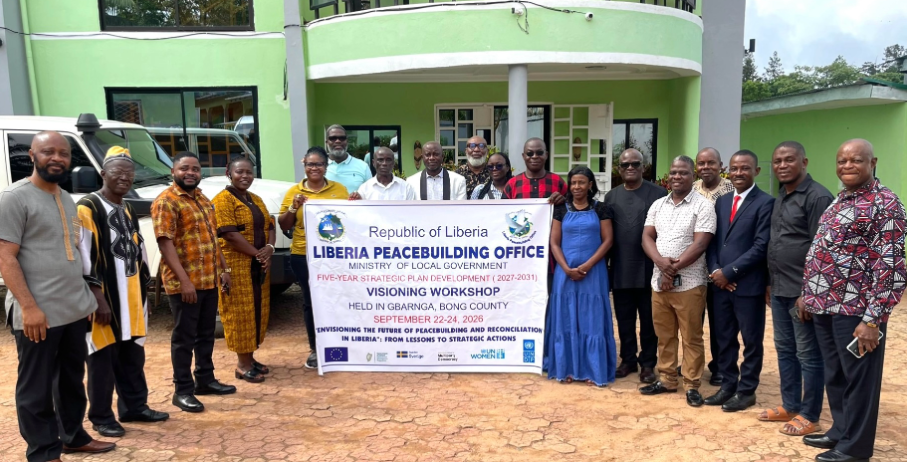
Recognizing that lasting peace requires a shared vision, the Liberia Peacebuilding Office (PBO) in partnership with UNDP concluded a three-day Strategic Plan Visioning Workshop on 24 September in Gbarnga, Bong County, marking an important step toward developing the institution’s first comprehensive five-year strategic plan since 2021.
The Visioning Workshop, implemented under the Liberia Electoral Support Project, which is supported by the European Union, Irish Aid, and Sweden, brought together 25 peacebuilding stakeholders from across Liberia, including the National Peace Ambassador, representatives of the Ministry of Local Government, County Peace Committees, Early Warning Monitors, Youth Agents for
Peace, and Regional Peace Hub Coordinators.
Together, they worked to define the Peacebuilding Office’s mission, vision, core values and strategic priorities that will guide the institution’s work over the next five years.
Participants drew upon years of experience supporting conflict prevention, mediation, early warning and community dialogue across Liberia, ensuring that local realities shape national priorities.
The workshop was built upon earlier technical preparations, including a desk review, contextual analysis and internal consultations. The outcomes from Gbarnga will now inform broader stakeholder consultations across the country before the strategy is finalized.
These will be held in Zwedru and Tubmanburg, allowing regional stakeholders to contribute to the strategic planning process, before further consultations with different institutions and agencies in Monrovia.
Opening the workshop, PBO Executive Director Sheikh S. S. Kamara emphasized that the Peacebuilding Office remains focused on strengthening early warning, conflict prevention and community peacebuilding while responding to emerging challenges, including cross-border security, youth unemployment and gender equality. “Peace is everyone’s business,” he told participants.
Representing the Ministry of Local Government, Assistant Minister Hon. D. Emmanuel Wheinyue highlighted recent national discussions on reconciliation and transitional justice as further evidence of Liberia’s commitment to building sustainable peace.
J. Roosevelt Zayzay of UNDP, representing the Liberia Electoral Support Project, emphasized that a resilient early warning system is built on three essential pillars: trusted information flowing from communities, strong coordination between local and national actors, and a Peacebuilding Office with the clear mandate, shared vision, and institutional capacity needed to lead conflict prevention efforts nationwide.
For National Peace Ambassador Eric Quaqua, the strategic planning process reflects Liberia’s continued investment in peace and stability. “This exercise speaks for itself,” he said. “A five-year plan tells us where we are heading.”
Additional contributions from Regional Hub Coordinator Moses Sah and Early Warning Monitors’ Representative Jenneh Kemokai underscored participants shared commitment to strengthening local peace infrastructures and ensuring that communities remain at the heart of Liberia’s peacebuilding efforts.
For the Liberia Peacebuilding Office, the workshop represents the beginning of a broader national conversation on how best to strengthen the country’s peace infrastructure over the next five years.
By bringing together those who work daily to identify emerging tensions, mediate disputes and build trust within communities, the process ensures that the new strategic plan reflects both local experience and national ambition.
As the consultation process continues across the country, one message remains clear: sustainable peace is built not only through policy, but through the voices, partnerships and collective action of the communities it serves.
Supported by the European Union, IrishAid and Sweden through the Liberia Electoral Support Project, which is managed by UNDP and implemented in partnership with UN Women and the Netherlands Institute for Multiparty Democracy, the initiative demonstrates a shared commitment to strengthening institutions that prevent conflict, promote social cohesion and safeguard Liberia’s democratic gains.
_END_
LNTA Launches Tourism Website
-To Draw Visitors, Investment
MONROVIA — The Liberia National Tourism Authority launched a new website Monday, which it hopes will raise the country’s profile as a travel destination and connect visitors with local tourism businesses.
The platform, UnforgettableLiberia.com, went live in Monrovia during World Tourism Day activities. It is intended to serve as a centralized hub for listings of beaches, parks, cultural and historical sites, festivals, hotels and travel services across all 15 counties, and to link tourists, tour operators, event planners and investors with tourism operators nationwide.
Acting LNTA Director General Melvin Nye said the platform supports the government’s ARREST Agenda for Inclusive Development, which names tourism as a driver of job creation and economic growth. He urged Liberians abroad to return and take advantage of opportunities in the sector.
“We invite all Liberians at home and in the diaspora, and friends of Liberia, to explore, invest and protect our destinations,” Nye said.
Warning on AI-Generated Content
Entrepreneur Paul Sackie Wungko, the keynote speaker, described the site as “a trusted, verified digital front door” to tourism experiences in all 15 counties — but warned against using artificial intelligence to fabricate promotional material.
Wungko said influencers and content creators should prioritize authentic images, video and storytelling, cautioning that AI-generated substitutes could misrepresent Liberia’s cultural heritage and natural attractions to international audiences.
Nathaniel Barnes, dean of the Graduate School at Cuttington University, praised the LNTA’s outreach to young Liberians and pledged the university’s partnership in the sector’s digital transformation.