


-Liberia’s Food Security at a Crossroads
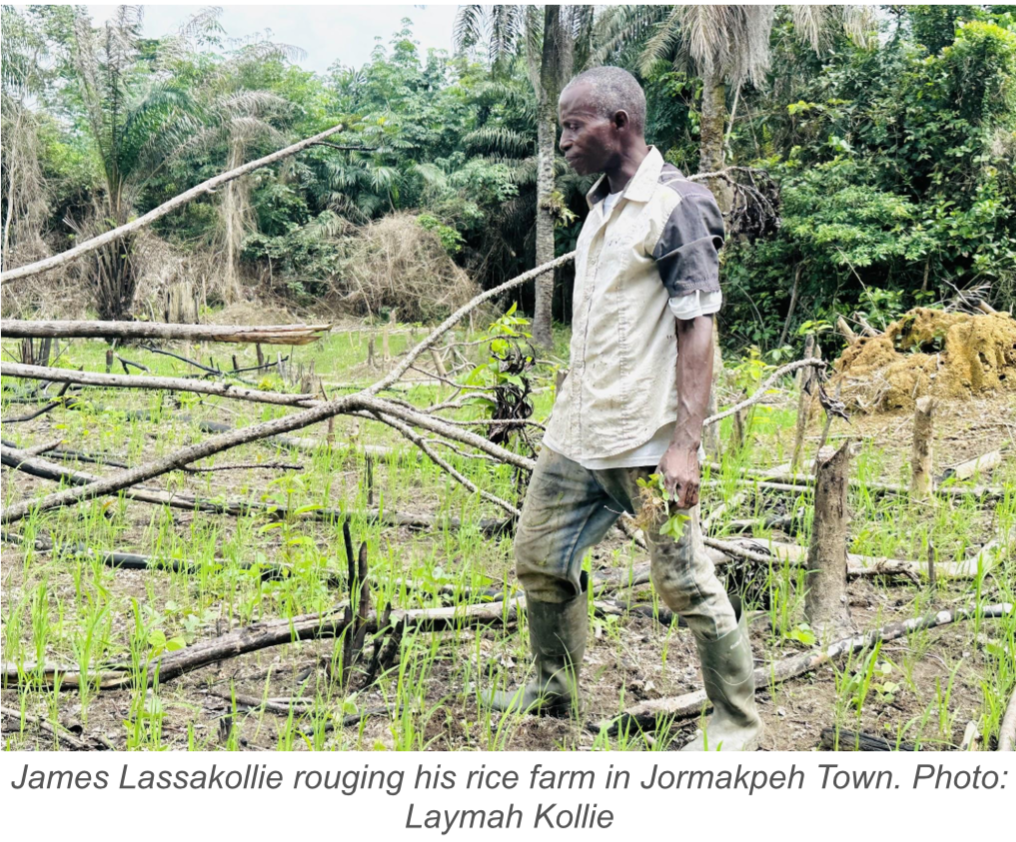
By: Laymah Kollie
In Jormakpeh Town, farmer James Lassakollie once stored enough rice to carry his village through the hunger season. Today, silted swamps, erratic rains, creeping rubber plantations and a shortage of machinery have thinned his harvest, and his story mirrors a national struggle in a country that imports about 61 percent of its staple.
It is 5:00 a.m. on a Monday in Jormakpeh Town, and James Lassakollie is already awake. He pulls on his dirty-gat, the worn clothes Liberian farmers keep for working days, takes up his boots and cutlass, and heads into the bush to drive birds off the little rice his cou, or work group, has broadcast on his farm. It is a routine he has known since childhood.
Jormakpeh lies in Kpaai District #1, Bong County, in north-central Liberia.
At the farm, what he sees troubles him. The rice is no longer yielding as abundantly as it did decades ago. Weeds are germinating faster than the broadcast rice, which raises the cost of maintenance and cuts the harvest.
“When we plant rice these days, it can’t grow well. The small farm I made seh na looking like it will produce plenty of rice for us this year,” the farmer says.
The once-proficient farmer and hunter now struggles to fend for his family. Life was not always like this.
When the Barn Was Full
In the 1990s and early 2000s, Lassakollie’s farms produced tons of rice that stayed in store, in large quantities, until the next harvest. During the rainy season, widely regarded as the lean season, neighbors came to his farm for food. In the Lassakollie household, food was never a problem; there was enough meat and rice in the kitchen all year round.
“When we used to farm, the rice used to grow so well. Sometimes, the eddoes used to grow so well in the rice farm, same with cassava. Things were very fine, life was peaceful.”
Recalling his childhood, Lassakollie says growing up with his siblings was fun, nurturing and lovely because they never had to worry about what to eat. Every morning he accompanied his father to the farm to tend the crops, hunt animals and fish in the surrounding creeks and rivers.
His fortunes kept rising into adulthood. In the early 1990s, he started a family and moved into his own household, ready to build a life outside the home of his mother, father and siblings. His first rice farm yielded so well that the harvest lasted into the rainy season, and he sold part of it to neighbors during the hunger season.
“The first farm I made, it gave me two kitchens full of rice, big, big! Yeah, the rice grew.
“Sometimes, 10 or 15 persons will harvest rice and they will harvest 200, 300 bunches of rice per day. We had two kitchens here, one in the town and one on the farm. The one on the farm was what we used to start eating first. By July, August like that, we used to start selling the one in the town, and share some with our family members too.
“But now, when we farm, there is no rice,” James explains.
For the father of nine, life was good. His children were well fed from his rice kitchen and from meat caught in his traps. Now the once-plentiful grain has become precious in his neighborhood. His fields are no longer fertile, and what they yield does not last.
A Hunger Measured in Numbers
Lassakollie’s experience sits inside a wider national picture. In the 2025 Global Hunger Index, Liberia ranked 112th out of 123 countries with a score of 30.0, which falls in the index’s “serious” category (20.0 to 34.9). That is an improvement on the 47.7 the country recorded in 2000, but the report describes progress as slow. Africa South of the Sahara and South Asia remain the two regions where hunger is still serious. The Ministry of Agriculture has questioned the ranking, arguing that it relies on dated data and that more recent national assessments show gains.
Poverty stands at number one on the United Nations Sustainable Development Goals (SDGs) adopted in 2015, which aim to end poverty for all people everywhere by 2030. With four years left, the reports suggest the world may miss that target. The Global Hunger Index likewise projects that at least 56 countries will not reach even a low level of hunger by 2030 if current trends persist.
Why the Granary Is Emptying
Liberia imports about 61 percent of its staple food, rice. The 2025 Comprehensive Food Security and Nutrition Survey (CFSNS) found that 21.5 percent of households are food insecure, and 56.2 percent are only marginally food secure, underscoring high vulnerability across the country.
The numbers behind the rice gap are stark. According to the Food and Agriculture Organization (FAO), Liberia needs an estimated 650,000 tons of rice a year but produces only about 240,000 tons of milled rice. Per capita consumption is about 133 kilograms a year, among the highest in Africa, and national consumption grew by 63 percent between 2008 and 2022.
The crisis did not happen overnight. It crept gradually into the center of the economy and the agricultural landscape, and in some respects it has been aggravated by the farming practices of rural households themselves.
Agriculture remains the backbone of the economy. According to the 2022/2023 Agriculture Census of the Liberia Institute of Statistics and Geo-Information Services (LISGIS), the sector contributes roughly 38 percent of Liberia’s GDP and employs nearly 70 percent of the population, across approximately 499,732 agricultural households. The census shows that smallholder farmers primarily grow rice, cassava, cocoa and oil crops, which also makes the sector highly sensitive to changing climate patterns.
1. Manual Farming on Worn-Out Land
The longstanding farmer names the lack of modern farming tools and techniques as one of the main reasons for the decline on his farm. Farmers continue to cultivate manually in this modern era, he says, even as erosion degrades much of the soil. Swamps are drying up or silting faster than usual because they are cultivated repeatedly, without mechanization or proper water control. A competitive analysis published on the Coalition for African Rice Development platform notes that about 97 percent of Liberia’s rice area is rain-fed.
“Even the swamp we used to make, the swamp rice, you used to harvest it three times, because that place will be full. When you cut it, the rice will re-germinate, so you cut it again.
“But this time, you go in the swamp, because you made the swamp this year, next year you make the swamp, then sand na pack up that place. So, it’s hard, if we say we will make it on our own.”
2. A Calendar Gone Astray
Rainfall patterns have also shifted, leaving farmers without a predictable planting calendar and disrupting crop growth.
“Like before, the only time you used to see rain was around March ending, but this time, there is no special time for rain. Rain season time you see sun shining, dry season time rain falling. So, no special time now,” Lassakollie says.
The Climate Vulnerability Risk Assessment (CVRA) warns that rising temperatures, unpredictable rainfall and extreme weather events threaten crop yields, livestock health and food security (EPA, 2021).
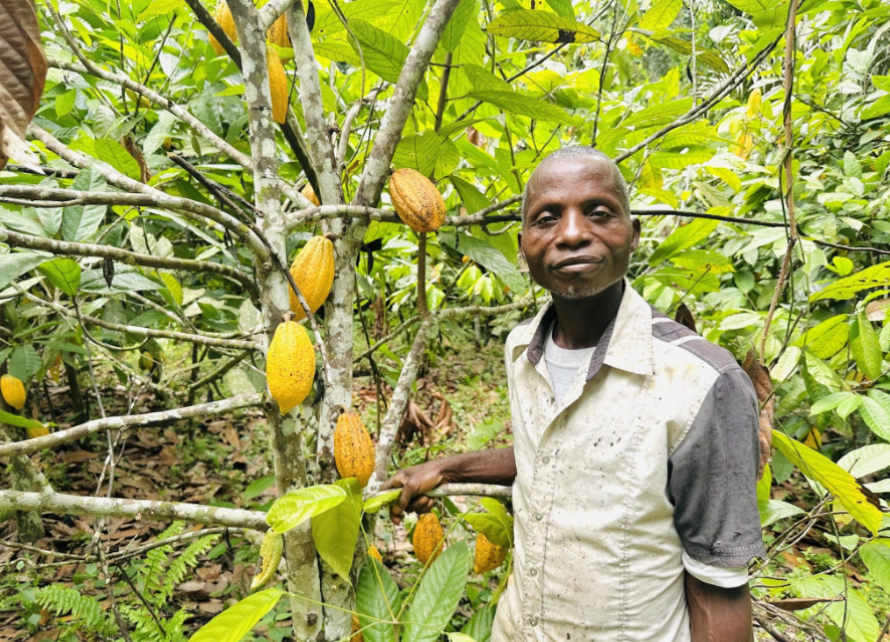
James Lassakollie stands beside his cocoa tree. Photo: Laymah Kollie
3. Cash Crops Closing in on the Rice Fields
Cash crops such as cocoa, rubber and oil palm are steadily claiming the forest. Indigenes of Jormakpeh Town and surrounding villages have made it a practice to plant cash crops on every piece of land where they harvested rice farms and gardens. In Kpaai District, rubber is the most common commodity. Many villagers now depend heavily on cash crops for their daily meals while limiting production of the country’s staple food, and the spread of tree crops is shrinking forest cover and wildlife.
As a result, many farmers in Jormakpeh have stopped cultivating rice and now rely on imported rice and meat to feed their families.
The trade data show how important rubber has become. In 2024, Liberia exported $182 million worth of rubber, making it the 11th-largest exporter of rubber among 127 countries. Within Liberia, rubber was the fifth most exported product out of 379 commodities.
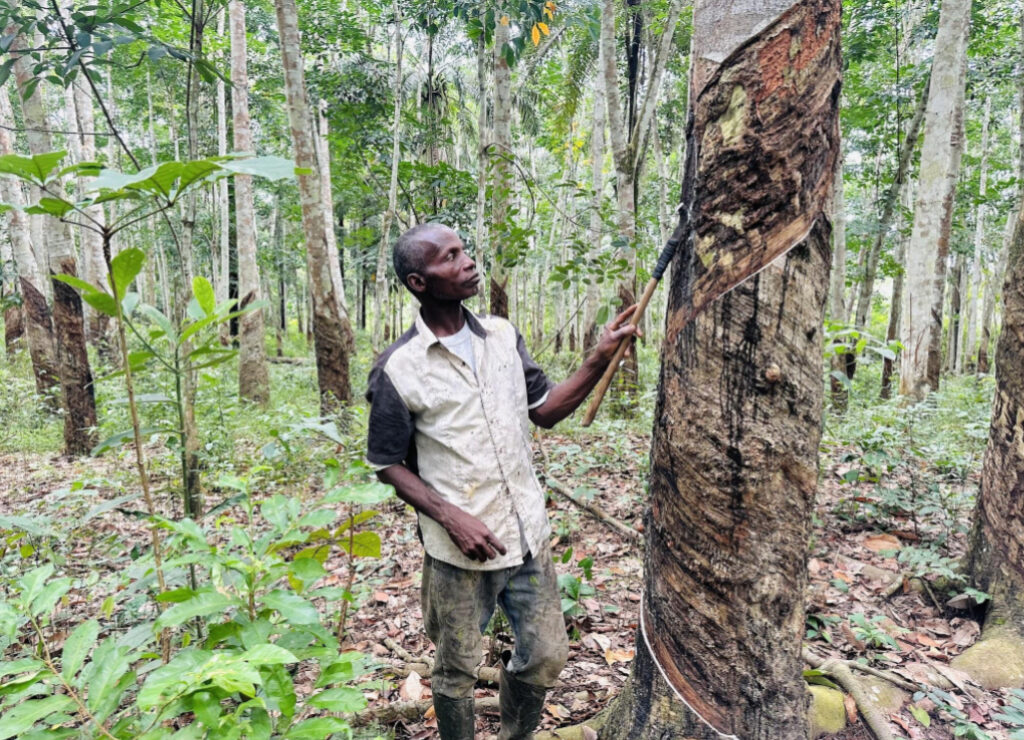
Lassakollie tapping latex on his rubber farm. Photo: Laymah Kollie
Farmers are turning to rubber and cocoa, for now, to meet daily needs. But these crops pose a serious risk to food production, especially rice.
To Lassakollie, the trade-off is plain. The rubber brings income for his family, but it also removes the land on which the family could grow its staple.
“The bush can’t grow back, because the rubber has finished occupying that space. So, no bush will be there again for us to make a rice farm.”
Science supports his worry. A 2026 study in ScienceDirectfound that rubber plantations heavily degrade soil quality over time, creating severe chemical, physical and biological challenges for later or intercropped rice production. Rice fields maintain a higher soil quality index than rubber monocultures, the study notes, yet converting land from rubber back to rice, or trying to grow hill paddy between rubber trees, faces major agronomic hurdles.
Lassakollie believes the dream of Liberia feeding itself is a long way off. Given the scarcity in food production today, he argues, the vision will be difficult to achieve.
“The way things are going now, for Liberia to feed itself will be difficult. It will be hard to stop importation because everyone is buying rice, we are not farming like we used to anymore.”
| THE RICE GAP AT A GLANCE 61% of Liberia’s staple rice is imported (CFSNS 2025) 650,000 tons estimated annual rice demand, against about 240,000 tons of milled rice produced locally (FAO) 133 kg of rice eaten per person each year, among the highest rates in Africa (FAO) 21.5% of households’ food insecure; 56.2% marginally food secure (CFSNS 2025) 112th of 123 countries on the 2025 Global Hunger Index, score 30.0, “serious” hunger $182 million in rubber exports in 2024, the fifth most exported product (OEC) |
Other Farmers, Same Story
The situation is not unique to Lassakollie. Other farmers describe similar circumstances.
Ramcy F. Dolo, a dedicated rice farmer with more than twenty years’ experience in Kopeh’s Town, District Four, Panta, says changing rainfall patterns are hurting his crop yields. He says the government has provided neither opportunities nor equipment to farmers in his region, and he believes that if it extended help to farmers across the country, Liberians would be able to feed themselves.
“Imagine someone making a farm without tools or equipment for agriculture, by ground, but then working on your own to grow this variety. I think if the government of Liberia can put in time for agriculture to provide more equipment, I think Liberia can stand on her own by producing rice and other things.”
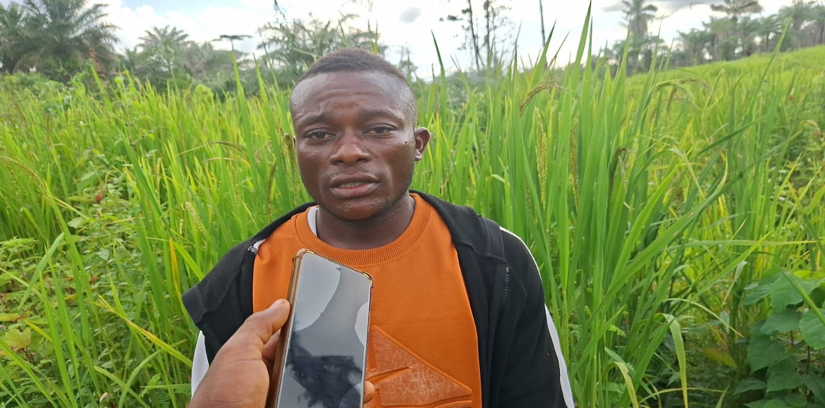
Ramcy F. Dolo in his rice farm.
Winston Porlornor, a vegetable farmer from Galla Town, District Four, echoes those challenges.
“We are seeing a misunderstanding in rainfall patterns. At the time when rain is supposed to fall, there is only sunshine, while at the time when sunshine is expected, rainfall can occur, especially during August and September.”
In Winston’s view, Liberia can feed itself, but only with the help of the national government.
“We can feed ourselves as a nation, Liberia, but it would only happen through supportive efforts from the Ministry of Agriculture, the national government of Liberia, and NGOs,” Winston says.
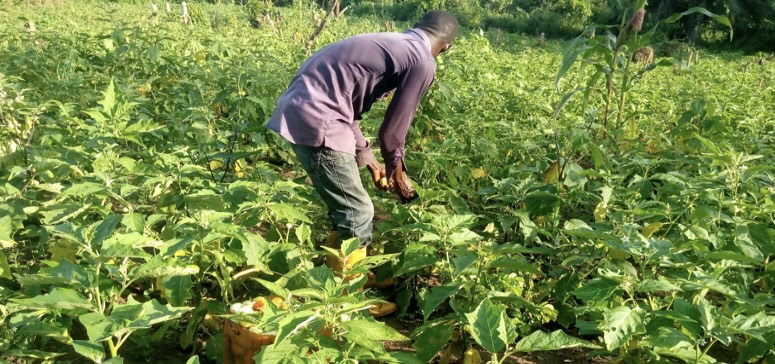
Winston Porlornor in his vegetable garden.
What Are Policymakers Doing?
President Joseph Boakai’s ARREST Agenda for Inclusive Development (AAID), which stands for Agriculture, Road, Rule of Law, Sanitation and Tourism, sets a broad goal of using agriculture to drive food security, employment, income generation, value addition and economic growth. It projects average agricultural-sector growth of 7 percent over the plan period and targets annual production of 630,000 metric tons of food and cash crops by 2029.
Under Program 8, on food and cash crop production, the agenda sets four targets for 2029 that bear directly on this story: raise local seed production by 30 percent; cut imports of food crops by 30 percent in areas where Liberia has a comparative advantage; cut imports of processed agricultural products by 30 percent where it has a comparative advantage; and formalize and strengthen 100 additional farmer cooperatives, including climate-resilient and ecological practices.
To drive this, the President launched the “Liberians Feed Yourself” National Development Plan in 2024 to boost food security and economic growth.
In an interview, Agriculture Minister Alexander Neutah said that from 2024 to date the government has developed 16,825 hectares of lowland with bunds, about a third of its 50,000-hectare target for rice production in hotspot counties such as Bong, Nimba and Lofa.
“Currently, from the data we have, we have 16,825 hectares of lowland developed with bunds and all in place for farmers to carry on continuous production.
“I think for rice production, we have done a major achievement in that. We’ve been able to increase production. We’ve been able to also increase farmers’ access to basic inputs that are needed to enhance their productive capacity,” he added.
The Minister was not specific about how many cooperatives the government is working with so far but said “Liberians Feed Yourself” is empowering farmers to produce rice that can serve the country.
The cash-crop question
Asked about the risk cash crops pose to upland farming, the Minister said these crops earn foreign exchange on the world market, so they should continue to be grown where they are best suited. In his view, not every Liberian has to farm rice for the country to feed itself; cash-crop producers can use their income to buy food and other necessities for their families.
“You don’t have to be producing to be food secure. People can be producing; you buy from them. Once you have income, you are able to purchase food.”
Mechanization and cooperatives
On the lack of technology and equipment for lowland farms, the Minister acknowledged the challenge. He said the government, through the Ministry of Agriculture, is establishing mechanization centers in communities to encourage large-scale production.
He also urged farmers to organize into cooperatives or clubs and work collectively in their regions, stressing that the government does not offer support to individuals and that, while it is working to improve food security, it cannot reach everywhere at once.
“If you are producing a few hundred hectares, you need to have tractors that will help you plough. You need to have the power tiller. You need to have maybe the harvesters that will help you do that. This way now the government is investing in the establishment of the mechanization hubs. So, the farmers in the production regions can have access to equipment for large-scale production.”
On whether Liberia can feed itself, Minister Neutah said the answer depends on citizens taking ownership of production so that the country can reduce food imports.
“If we have to feed ourselves as a nation, it will be Liberians and Liberian farmers to do that. Because the government can make the investment, but it takes citizens to own it”
Fish Ponds, Gardens and a Plea for Support
At 60, the father of nine is not giving up. Rice may be failing him, but he is finding other ways to keep his family out of hunger. He has moved into aquaculture and now runs four large fishponds in his village, which supply protein for his household and income from sales to neighbors. He has also taken up vegetable gardening, growing peppers, okra and garden eggs, among other crops.
“I can fish; I can sell more. Sometimes, when I sell, I can get $50,000, $60,000 Liberian dollars (about USD$333.00), then we eat some, we sell some to family.”
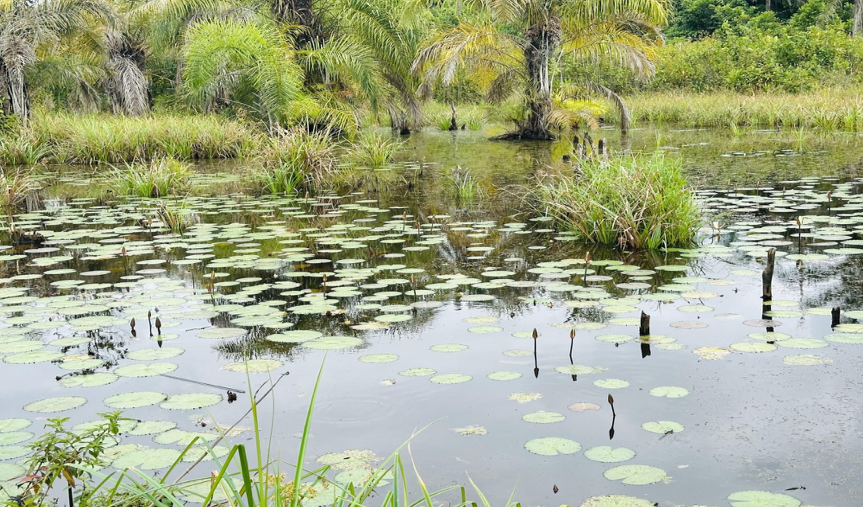
One of Lassakollie’s fishponds. Photo: Laymah Kollie
The ponds have also become an improvised rice plot of sorts. After the fish harvest, he says, water is held in the pond until planting time, and it is the one place that still gives him a little rice.
“If government can provide modern equipment and techniques for us to improve our farms, it will be fine for us. Right now, the only place that can produce little rice for me is the fishpond, because after harvest we can tie the water and it sits there with the fish until we are about to plant.”
Lassakollie is pleading with the government and relevant authorities for modern equipment to raise his output. He also wants materials to raise cattle on the farm. Recounting the fishpond story, he says an NGO visited the town and trained residents in fishpond farming, but many villagers could not build ponds of their own because they lacked basic materials.
“Let the government help us with some wires so we can fence our cattle. Again, what we want the government to help us with is fishpond business. We got the training but no materials. They only told us what to do but no empowerment. That’s why many people failed in creating their own fishpond.”
Credit is another gap. The farmer says loans would help farmers expand their production.
“If there is even a loan that we can take to improve our fishpond and pay back in instalments, we will agree. But nothing like that.”
“We are not giving loans to farmers… the challenge now is access to financing for most of them.” — Agriculture Minister Alexander Neutah
Responding, Minister Neutah acknowledged that financing is a major challenge for Liberian farmers. He said the government does not give farmers loans but supports them by developing their land at no cost.
“We are not giving loans to farmers. We’ve been supporting farmers. I can tell you, the challenge now is access to financing for most of them. Because our financial system does not create sufficient opportunities for those into agriculture to access funding for investment.”
Speaking about the proposed Agriculture Enterprise Development Bank, the Minister said getting investors to put money into it has been difficult. Such an institution would make lending funds affordable and accessible to farmers and cooperatives.
A bill sponsored by Lofa County Senator Joseph Jallah was unanimously passed by the Senate in December 2025 and is now before the House of Representatives for concurrence. Once enacted, the law is expected to address farmers’ limited access to finance by creating a specialized lender that expands credit to agribusinesses and agro-processors.
“So, if it comes to lending, the government has been trying to come up with a financial institution to establish the Agriculture Enterprise Development Bank. We’re still working on that,” Minister Neutah lamented.
Back in Jormakpeh, the question of whether Liberia can feed itself is being tested one pond, one garden and one thin rice plot at a time. Between a farmer who says he cannot do it without tools, credit and training that comes with materials, and a minister who says Liberians themselves must take ownership, lies the gap the country has yet to close.