

-Cllr. Gongloe Urges Pres. Boakai to Reside in the Executive Mansion
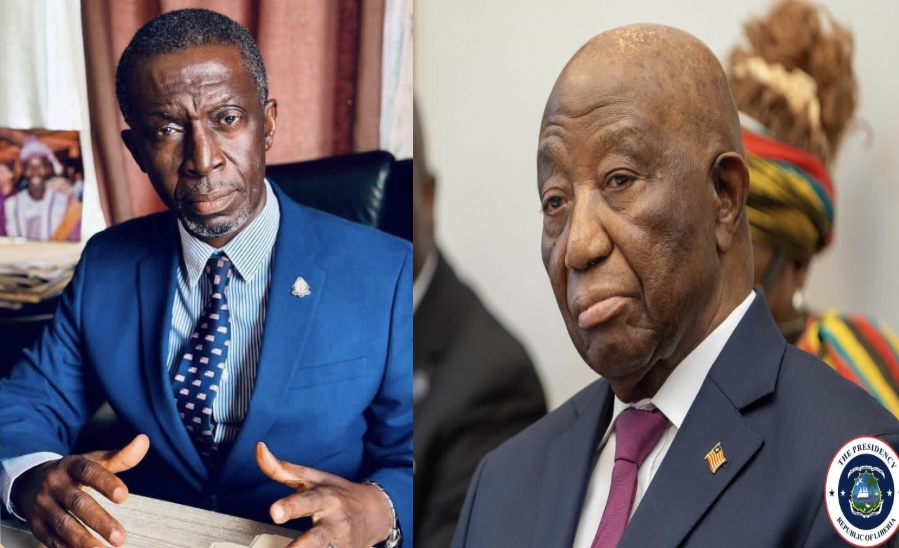
Monrovia: Prominent Liberian politician and advocate, Tiawan Saye Gongloe, is calling on President Joseph Boakai to move into the Executive Mansion and cut back on official perks, arguing that a government asking citizens to endure economic hardship must practice what it preaches.
In a statement released over the weekend, Cllr. Tiawan Saye Gongloe urged the president to relocate to the Executive Mansion to reduce avoidable residential and commuting costs, warning that wasteful spending undermines the government’s own reform agenda. “Stop Wasting Money for Official Comfort.”
“I also urge President Boakai to move into the Executive Mansion to reduce avoidable residential and commuting costs,” Gongloe wrote, noting that Liberia ranks among the 15 poorest countries in the world and that official benefits should meet “reasonable standards of necessity and affordability.”
Cllr. Gongloe’s intervention comes on the heels of the International Monetary Fund’s approval of approximately US$50.16 million in financing for Liberia, accompanied by advice that the government reduce unproductive expenditure and free up room for priority infrastructure projects. While acknowledging the IMF’s recognition of progress in economic management, Gongloe insisted that such praise does not excuse unnecessary or excessive spending.
“We must not continue ‘business as usual’ while seeking external financing and asking citizens to endure difficult conditions,” he wrote. “Expenditure criticized under previous governments deserves the same scrutiny under this one,” he added.
Questions Over Extended U.S. Trip
The advocate zeroed in on President Boakai’s recent United States trip, noting that the president left Liberia on September 13, 2026, addressed the United Nations General Assembly on September 24, and is reported to return on October 6, 2026—a duration longer than that of several counterparts from wealthier African nations.
According to media reports cited by Gongloe, President Duma Boko of Botswana left his country on September 19 and returned on September 26, while President William Ruto of Kenya arrived in New York on September 20 and returned to Kenya on September 26. “These countries are more developed and richer than Liberia. But their leaders seem to be spending their countries’ money more wisely than ours,” Gongloe wrote.
He called on the government to explain the duration of the trip, the size of the delegation, the total cost, and the concrete results achieved. “Extended stays abroad require justification, particularly when the journey is not a state visit. The people have a constitutional right to know.”
Gongloe also rejected the argument that Liberia’s non-permanent membership on the UN Security Council justifies a prolonged presidential stay, pointing out that the Democratic Republic of Congo, a fellow non-permanent member, was represented at UNGA by its prime minister rather than its president.
Turning to spending at home, Gongloe said he had personally counted more than 20 vehicles in President Boakai’s convoy and, on separate occasions, 13, 14 and 15 vehicles in Vice President Jeremiah Koung’s convoy—each including two VIP vehicles. “These observations raise a legitimate question: how many vehicles are necessary for security and official duties?” he asked.
He contrasted the current arrangements with those of the Tolbert administration, recalling that President William R. Tolbert’s convoy had three vehicles, while Vice President D. Bennie Warner had one official vehicle and one police motorcycle escort. Tolbert, he noted, often slept in Bentol and travelled to work at the Executive Mansion despite residing at the mansion.
“Security arrangements must respond to actual risks. Even so, every additional vehicle carries costs for purchase, fuel, maintenance and personnel,” Gongloe wrote, calling on the government to demonstrate why those costs are necessary.
Gongloe argued that money saved from avoiding waste should be redirected toward education, health care, food security and infrastructure, as well as strengthening civil servants’ salaries and benefits and reducing reliance on deficit financing. “Borrowing carries repayment obligations; unnecessary expenditure is a burden for citizens tomorrow,” he warned.
He said the government’s Rescue Mission and ARREST Agenda must be reflected in spending decisions, with major trip costs published, outcomes explained and restraint demonstrated through conduct. “Public money belongs to the people,” Gongloe concluded. “Their needs must take priority over the comfort of those entrusted to serve them.” The government has not yet responded to the claims made in the article.