

–To be Agents of Change
By Jerromie S. Walters
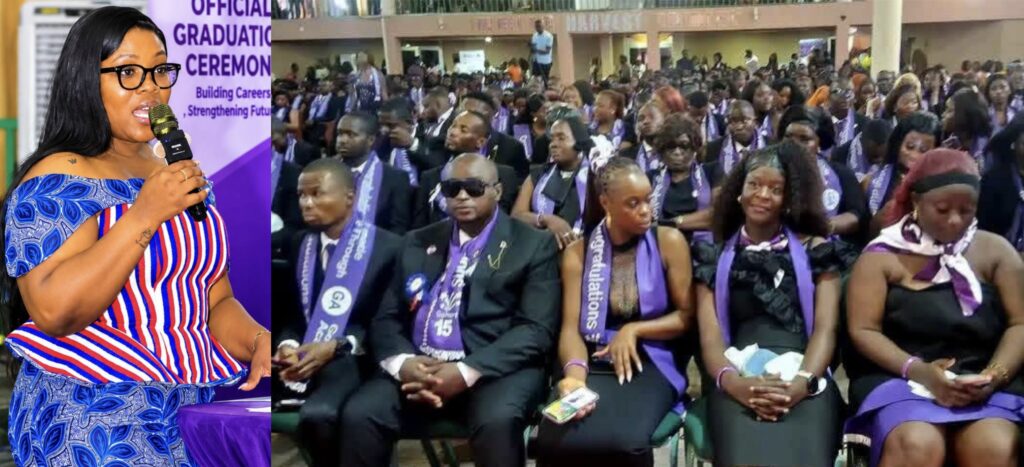
MONROVIA, Liberia — Liberia’s Minister of Youth and Sports Atty. Cornelia Wonkerleh Kruah has challenged 937 graduates of Gonet Academy to become agents of national transformation, declaring them essential to Liberia’s development.
Kruah issued the charge Saturday, October 31, 2026, at the Harvest Intercontinental Cathedral in Congo Town during Gonet Academy’s Cohort 15 Graduation Ceremony, where she delivered the keynote address.
“You are the essential infrastructure of national development,” Kruah told the graduates, citing their training in procurement, project management, monitoring and evaluation, financial management, logistics, and data analysis.
The minister used statistics to illustrate the graduates’ potential impact, noting that Liberia’s approximately 4 million young people represent about three in four citizens.
“One in every 4,400 young people in this country is graduating in this room today,” she said. “I know that sounds small. But the whole Cabinet of this Republic is a few dozen people. As a share of the population, that rounds to zero. And the country still holds us responsible for everything.”
Kruah likened the graduates’ fields of study to essential infrastructure, describing them as “plumbing.” “Nobody admires the pipes, but try running a house without them,” she said. “Every concession that wants to mine our iron ore needs people who can assess its impact, move its cargo and keep its workers safe. A country can sign a hundred agreements. Without people who can plan, buy, hire, measure and manage, they stay on paper.”
Global Lessons Cited
The minister drew on examples of nations that transformed their economies through strategic investment in human capital. She began with Qatar, a nation blessed with some of the world’s largest natural gas reserves. “In 1970 the average Qatari earned under three thousand dollars a year. Today it is above seventy thousand. What interests me is what Qatar did with that fortune. It saved the surplus in one of the world’s largest sovereign wealth funds, and it poured money into universities, research and training at home.
She added, “Qatar studies its own gas, improves how it is produced and sold, and builds new industries around it. The gas made Qatar rich. The people it equipped are how Qatar keeps making the gas go further.” For her, the lesson was that natural resources alone are insufficient; rather it is the strategic investment in people that sustains and extends the benefits of resource wealth. She then turned to the United Arab Emirates, which “found oil, and treated it as a bridge, not a destination. Today about three-quarters of its economy is not oil. It is trade, finance, tourism and logistics.”
Also, she cited Botswana, which “entered independence in 1966 as one of the poorest countries in the world, with only twenty-two university graduates. A year later it found diamonds. As one of its presidents later put it, that money was used to develop not just the roads, but the people. Botswana is now an upper-middle-income country.”
The Minister then pivoted to nations with no natural resources at all. “In 1965 Singapore was a small island with no oil, no minerals, not even enough water. Its income per person was about five hundred dollars, level with Mexico and South Africa at the time. Today it is above ninety thousand. It had a good harbour, and it used it well. But the decisive choice was this: Singapore trained its people for the specific industries it was trying to attract, and it changed the training every time those industries changed. By design, its people became its natural resource.”
She also highlighted Rwanda, which despite being “small, landlocked and with little to mine, has staked its future on skills and services. Its Vision 2050 aims to make it a high-income country by mid-century, on the strength of what Rwandans know and can do.”
Liberia’s Second Inheritance
Her words: “Why does any of this matter on a Saturday morning at 11:00am in Congo Town? Because Liberia has been blessed with natural wealth: iron ore, gold, timber, rubber, fertile land and the sea. How best to turn that wealth into prosperity is a question for our geologists, economists and negotiators. I am an economist by training, but I will not pretend to be one of the others this morning. But I can speak with confidence about our second inheritance, the one that does not need to be mined, but nurtured. Our people.”
This concept of Liberia’s “second inheritance” was the heart of the speech. Other nations had built prosperity on one foundation or the other—resources or people. Liberia, the Minister argued, could build on both. But the human half of the equation would not develop automatically. She then shared a personal anecdote from her early days in office. “When I took office, one of the first things I did was travel to all fifteen counties. I sat with young people in town halls and on football fields. What I found changed how I see this job. In every county I met young people who were sharp, curious and restless to build something.”
But she also confronted an alarming reality. “I came back convinced of something uncomfortable. Physicists use the word entropy for energy that is no longer available to do useful work. It has not disappeared. It has simply scattered. That is what I saw in too many counties: young people with real ability and no structure around them to find them early, develop them properly and carry them into work or enterprise. So their energy scatters. Some of it leaves the country. Some of it turns into frustration. Most of it is left to luck, and no nation should plan its future on luck.”
Kruah: “If some countries can be built on gas and others on people, Liberia can be built on both. But the human half of that equation will not build itself, and waiting has a price. For every year we delay, we pay twice: once in the talent that leaves or sits idle, and again in the skills we end up importing to do work our own young people could have done.” Minister Kruah then addressed Mohammed Kerkulah, Gonet Academy’s Founder and CEO, directly, offering both praise and a challenge.
“Mr. Kerkulah, I will be honest. I do not know every detail of your model. But I have heard, cohort after cohort, as thousands of young Liberians walk through your doors and leave with something they did not have before. People do not keep coming back to a place that gives them nothing. So there seems to be real value here.” She added: “Here’s my challenge: do not be satisfied with how many come. A full hall is a good start, and I can see you have one.”
Her words: The question for your next five years is whether Gonet becomes more than a place where people gather skills and friends. Can it become part of the structure of national development? A model government can look at and say: this works, let us back it and scale it.”
She posed hard questions: “Where do your graduates go? What do they earn a year later? Which skills will Liberia need in 2030, not just in 2026?” These questions, she suggested, would determine whether Gonet evolved from a training provider into a genuine partner in national development.
She then connected her challenge to her Ministry’s own work. “At the Ministry of Youth and Sports, we are asking ourselves the same questions. Our ten-year vision, PATHWAYs: Rooting and Rising Liberia’s Youth, puts evidence, design and foresight at the centre of how we work. Foresight simply means looking ahead on purpose: studying the trends and the jobs that are coming, so we prepare young people for the economy of 2035 while they are still in a classroom in 2026. Evidence means we judge a program by what happens to the young people in it, long after the ribbon is cut. That is why our foresight work wants to partner with institutions like Gonet to follow young people as they move from training into work, so we can see where they land and what they still need.”
Having established the conceptual framework—entropy and coherence, “plumbing” and human capital, global lessons and local realities—the Minister delivered her charge to the graduates with directness and urgency. “So walk out of here and get to work. Immerse yourselves in what you learned, and keep learning it. Be the person in your office whose report is accurate and whose procurement is clean. Start the business you keep talking about. Hire the young person who reminds you of yourself five years ago. And come back to Gonet with ideas to make it better; the people who pass through a model usually see its flaws first and are best positioned to have it fixed.”
The instructions were concrete, actionable, and deeply moral. Integrity in reporting. Clean procurement. Entrepreneurial initiative. Generosity toward the next generation. And the courage to critique and improve the institutions that had trained them. These were not abstractions; they were daily practices that would define the graduates’ professional lives.
She then offered a vision of how change actually happens: not through grand gestures or dramatic pronouncements, but through the accumulated effect of individual integrity. “Most of what changes a country is built in stealth, by people like you, one island at a time. Every one of those islands is a small victory over entropy.”
The Minister closed by reaffirming the government’s commitment to youth development and situating Gonet Academy within that broader effort. “This administration has placed young people at the center of the ARREST Agenda. PATHWAYs is how my Ministry intends to deliver on that over ten years. One of its pillars, the Pathway Framework, is about building the ecosystem that moves a young Liberian from exclusion to agency: from training into work, from an idea into an enterprise. Gonet is already part of that ecosystem.”
Institution’s Growth and Vision
Mohammed Kerkulah, Founder and CEO of Gonet Academy, used his welcome address to highlight the institution’s remarkable growth despite operating with a young team and limited resources. He credited the academy’s progress to a philosophy of reinvesting in programs rather than personal spending—a commitment to mission over self-interest that had allowed the institution to expand its reach and impact.
Kerkulah announced that Gonet Academy had acquired land for a future campus, describing it as an investment in long-term growth. The vision, he explained, was to develop a facility capable of training professionals and welcoming graduates back as instructors—a self-sustaining cycle of knowledge transfer that would strengthen the institution and the nation simultaneously.
He then provided detailed statistics on Cohort 15’s achievements. “With 1,022 learners enrolled, compared to 1,012 in Cohort 14, it ranks as one of the largest cohorts in the Academy’s history. This achievement speaks to the expanding reach of our institution and the confidence that professionals, organizations, and communities continue to demonstrate in our training programs.”
The graduates were distributed across three program categories: “682 graduates from the Foundational Certificate Programs; 208 graduates from the Comprehensive Professional Programs; and 47 graduates from the Professional Diploma Programs.”
Kerkulah also noted that learning assessment results showed significant improvement, demonstrating the effectiveness of structured instruction and practical engagement in helping individuals translate learning into workplace performance.
The Founder articulated the institutional philosophy that guided Gonet Academy’s approach. “At Gonet Academy, we recognize that the real value of education is measured not simply by the credentials earned, but by how effectively knowledge is applied to address challenges and create opportunities.”
He introduced the institution’s 3Es Framework: “Equip – Strengthen individuals with relevant knowledge, technical abilities, and practical competencies. Empower – Build the confidence and capacity of individuals to lead, innovate, and generate meaningful impact. Elevate – Advance communities, strengthen institutions, and contribute to national and societal progress.”
The framework, Kerkulah explained, was not merely rhetorical but shaped the actual experiences of every learner. The academy’s focus on practical, industry-relevant training reflected a conviction that education must translate into tangible improvements in workplaces, businesses, and communities.
Addressing the graduates directly, Kerkulah offered guidance that echoed the Minister’s themes while emphasizing personal responsibility. “As you receive your certificates and diplomas today, remember that your professional journey does not stop here. You now have an opportunity to demonstrate the value of your training through the quality of your work, the decisions you make, and the contributions you bring to your organizations and communities.”
He urged them to embody three virtues: “Let integrity guide your actions, humility shape your leadership, and excellence remain the standard you set for yourselves. Continue learning, remain adaptable, and never underestimate your ability to influence positive change.” Like the Minister, he connected individual achievement to national destiny. “Our country needs professionals who can turn knowledge into solutions, ideas into opportunities, and leadership into meaningful service. May you become ambassadors of these values and active contributors to the Liberia we all aspire to build.”
Kerkulah expressed appreciation to all who had made Cohort 15’s success possible: training specialists, management and staff, institutional partners, families, and supporters. “Your time, expertise, encouragement, and commitment have played an important role in bringing Cohort 15 to this successful conclusion.”
ActionAid’s Partnership Proposal
The ceremony also featured a special remark from Madam Elizabeth Johnson of ActionAid Liberia, who proposed a potential partnership focused on ensuring a gender-transformative curriculum at Gonet Academy. She lauded the women’s participation in the graduating cohort and stressed ActionAid’s readiness to engage with Gonet Academy.
Madam Johnson thanked the CEO of Gonet for the institution’s impact over the years, noting the transformative potential of collaboration in advancing gender equality and empowering women professionals across Liberia. Her remarks signaled growing recognition among international partners that Gonet Academy represents a valuable ally in efforts to build a more inclusive and equitable professional landscape.
Gonet Academy has established itself as a premier institution for professional development in Liberia. Its purpose is transforming Africa through change led by equipped and empowered young people and professionals, with a vision to be a premier hub for practical, accessible, and empowering professional development.
The Academy’s mission is to provide industry-relevant, hands-on, and learner-centered professional development programs that empower individuals to grow in knowledge, improve performance, and create meaningful impact in their careers, businesses, and communities. Since its founding in February 2021, it has produced more than 5,000 alumni.