

–Chinese Ambassador Yin Announces
By Jerromie S. Walters
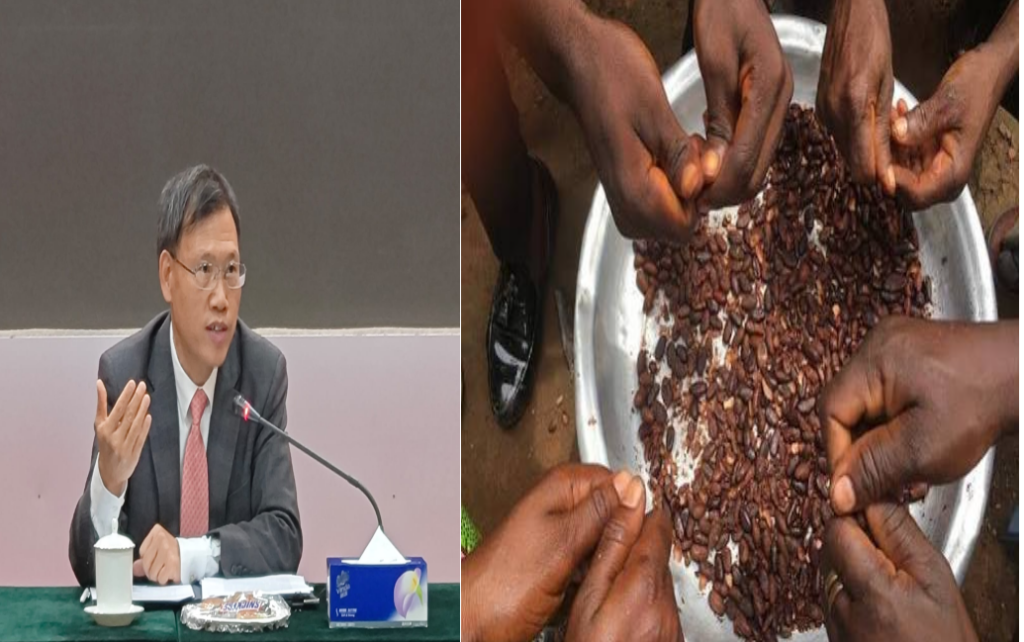
Monrovia: Effective December 15, 2026, Liberian cocoa beans that meet specified quality and phytosanitary requirements will be officially eligible for direct export to China, eliminating the previous necessity for both nations to sign a separate, bilateral phytosanitary protocol specifically for cocoa exports.
This major trade milestone was announced by Chinese Ambassador to Liberia Yin Chengwu during a media briefing, held on Wednesday, November 11, 2026, at the Chinese Embassy in Congo Town, Monrovia. Addressing journalists who recently returned from a capacity-building seminar in China, Ambassador Yin highlighted that this policy change opens a lucrative and direct pathway for Liberian farmers to access the massive Chinese consumer market.
The cocoa announcement arrives as a broader framework of flourishing bilateral ties between China and Liberia throughout 2026, characterized by strengthened political mutual trust and expanded economic cooperation. Ambassador Yin noted high-level exchanges, including Liberian Foreign Minister Sara Beysolow Nyanti’s visit to China in May and Vice President Jeremiah Kpan Koung Sr.’s delegation visit in November to attend the 9th China International Import Expo (CIIE), where he met with senior Chinese leaders.
To further capitalize on these trade avenues, Ambassador Yin encouraged Liberian authorities and agricultural producers to leverage China’s upgraded “Green Channel 2.0” initiative. This streamlined mechanism is designed to facilitate the smooth export of African agricultural and food products into China, with Beijing pledging active support to fast-track market access processes for qualifying Liberian commodities.
On the infrastructure front, China-aid projects across Monrovia are advancing rapidly toward completion.Ambassador Yin reported that the construction of the two China-aid overpass bridges near the EJS Ministerial Complex has reached approximately 50 percent completion, with visible progress daily and an official opening targeted for September 2027.
Additionally, the construction of the China-Aided National Clinical Diagnosis and Treatment Laboratory has concluded in its entirety, with formal handover to the Liberian government scheduled before the end of the year. This facility is expected to significantly bolster Liberia’s national healthcare and diagnostic capabilities.
Agricultural cooperation is similarly yielding tangible results on the ground. Ambassador Yin highlighted the handover last month of 304 units of agricultural machinery and equipment—welcomed personally by President Joseph Nyuma Boakai—alongside ongoing technical assistance in Bong and Bomi counties focusing on bamboo and rattan weaving, fruit and vegetable planting, and livestock rearing.
Humanitarian and health partnerships remain a cornerstone of the bilateral relationship. The Chinese Medical Team in Liberia has conducted four free medical outreach programs and community tours this year, while preparations are actively underway for a new batch of emergency food assistance consisting of 20 million RMB (approximately $3 million USD) worth of rice to support local communities.
Expanding outward to regional partnerships, Ambassador Yin detailed President Xi Jinping’s newly introduced four-point proposition on China-Africa mining cooperation. The framework asserts that African resources belong to Africa, advocates a mutual-benefit approach grounded in friendship and shared interests, prioritizes high-quality industrial value addition, and calls for an open cooperation environment free from geopolitical rivalry.
Furthermore, Ambassador Yin outlined President Xi’s four principles for the constructive participation of all parties in settling African hotspot issues. These principles stress an “Africa-led” approach, upholding UN Charter-based fairness and justice, promoting dialogue and ceasefires over unilateral sanctions, and balancing immediate security measures with long-term development strategies.
Shifting to China’s domestic economic landscape, Ambassador Yin shared resilient figures from the first three quarters of 2026, during which China’s GDP expanded by 4.6 percent to reach 107.11 trillion yuan. Propelled by innovation-driven development, green industrial transitions, and digital intelligence, the economy created 10.52 million new urban jobs while household consumption increasingly shifted toward service-oriented sectors.
As both a “world factory” and a “world market,” China continues to champion high-standard opening-up.Ambassador Yin pointed out that China’s imports grew by 22.3 percent year-on-year in the first three quarters of 2026, reflecting Beijing’s deliberate effort to share its vast domestic market of over 160 key trading partner nations and absorb global exports.
Foreign investment and technological innovation continue to thrive within China’s borders, backed by open-source platforms like large AI models that democratize advanced technologies for developing nations. In 2025 alone, tens of thousands of new foreign-funded enterprises were established, cementing China’s status as a premier destination for global cross-border investment and industrial upgrading.
Global trade platforms continue to bridge economies across the Global South. Ambassador Yin emphasized that zero-tariff policies now cover 63 countries—including 53 African nations such as Liberia—while major exhibitions like the Canton Fair and the 9th CIIE provide dedicated spaces, including free booths for least developed countries, to integrate African agricultural goods directly into global supply chains.
The briefing also detailed the outcomes of the Fifth Plenary Session of the 20th Central Committee of the Communist Party of China (CPC), held in Beijing from October 26 to 29, 2026. The session focused extensively on advancing full and rigorous Party self-governance and adopted a landmark programmatic resolution guided by Xi Jinping Thought on Party Building.
Reviewing the historic achievements of the CPC in the new era, session participants underscored that rigorous self-reform and adherence to communist ideals have enabled the Party to effectively address lax supervision,curb unhealthy tendencies, and secure the political leadership core necessary to guide national modernization.
Looking toward the political horizon, the Central Committee officially announced that the CPC will convene its 21st National Congress in Beijing in the second half of 2027. This upcoming congress will mark a critical milestone for realizing socialist modernization and advancing the Second Centenary Goal under the leadership of the Party.
Turning to international development frameworks, Ambassador Yin celebrated the five-year milestone of the Global Development Initiative (GDI) proposed by President Xi Jinping. Having mobilized over $23 billion and implemented more than 2,000 cooperation projects across over 120 countries, the GDI continues to operationalize the UN 2030 Agenda for Sustainable Development.
The GDI’s practical mechanisms—including the Global Development and South-South Cooperation Fund—have directly benefited more than 40 million people across 70 nations. By prioritizing self-reliant capacity building and human resource training programs, the initiative empowers developing countries to secure tangible improvements in local living standards.
Marking its one-year anniversary, the Global Governance Initiative (GGI) has likewise gained widespread international momentum. Endorsed by over 160 countries and international organizations, the GGI serves as a vital public good designed to reform and improve the global governance architecture amid growing international turbulence and transformation.
Ambassador Yin highlighted the recent opening ceremony of the 2026 Global Governance Forum held in Xiong’an New Area, Hebei, on October 23. A congratulatory message from President Xi Jinping to the Forum called for upholding true multilateralism based on extensive consultation, joint contribution, and shared benefits to tackle global peace and development deficits.
During the Forum, Chinese Foreign Minister Wang Yi announced eight practical actions to implement the GGI.These initiatives encompass leading a successful APEC Economic Leaders’ Meeting, deepening engagement in UN reform, advancing the BBNJ Agreement, prioritizing the right to development in human rights governance, and strengthening cooperation in outer space governance and artificial intelligence capacity-building.
Complementing these global efforts, China has announced the establishment of a dedicated Global Governance Research Center. This academic institution will provide ongoing intellectual support, research insights, and strategic frameworks to assist the international community in refining multilateral institutions and governance models.
As founding members of the United Nations and active participants within the international security framework,China and Liberia share a profound responsibility in shaping a just global order. Ambassador Yin reaffirmed Beijing’s steadfast commitment to working hand-in-hand with Monrovia to champion multilateral coordination and shared prosperity.
Concluding the press briefing, Ambassador Yin expressed deep appreciation for the Liberian journalists’ dedication during their media capacity-building seminar in China. He invited continued dialogue, collaborative reporting, and active participation in upcoming bilateral trade events to further solidify the enduring bonds of friendship between the two nations.
China-Liberia cooperation strategic, diplomatic, and economic partnership dates back to 1977. the bilateral relationship has expanded significantly in recent years across trade, infrastructure, mining, and development aid.