

— Pres. Boakai Vows $5.7 Billion Deal Will Deliver Within Five Years
By Jerromie S. Walters
MONROVIA, Liberia — President Joseph Nyuma Boakai declared Wednesday that the Master Infrastructure Development Agreement (MIDA) “holds more for every Liberian,” assuring citizens that his government will deliver the full $5.7 billion program within five years, with the biomass plant and transmission lines completed in just two years.
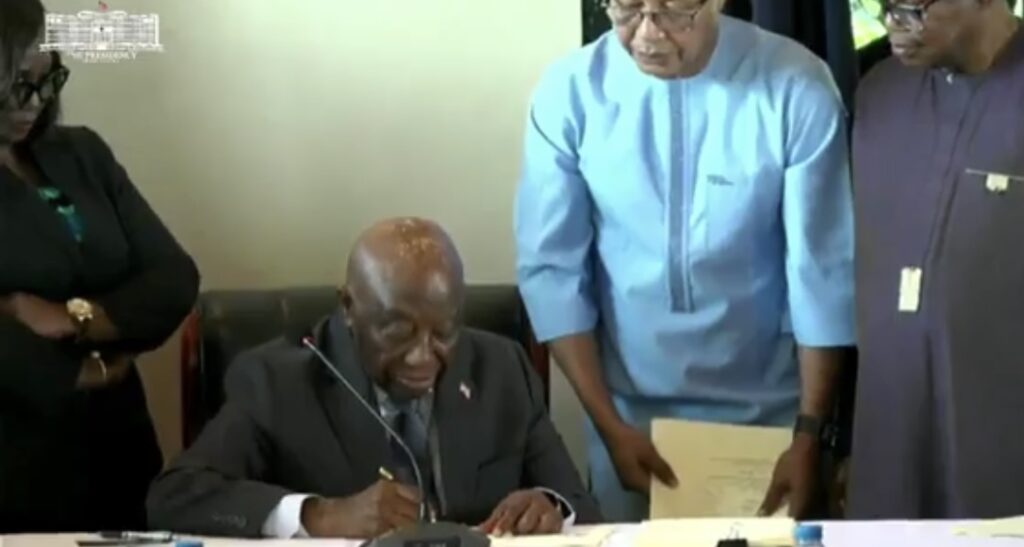
Boakai made the comments on November 25, 2026, at the Executive Mansion in Monrovia, when he signed the agreement at a ceremony attended by government officials and stakeholders. “This Agreement holds more for every Liberian,” he said, explaining that the program will deliver tangible benefits to ordinary citizens — not just large-scale infrastructure. “My promise is this: we will deliver within five years,” he added. “In short, MIDA will build the economic backbone of a modern Liberia.”
The President said the agreement — the largest integrated infrastructure program ever conceived in Liberia — will ensure steadier power at home so children can study at night and families can store excess food; keep clinics and hospitals running their machines to render quality care; power the welder, the tailor, the barber and the shopkeeper without the daily cost of generator fuel; give farmers access to markets alongside thousands of new jobs and skills for young people; help businesses add value to food crops and preserve them; and grow industries producing goods made in Liberia.
270 Megawatts of New Power
MIDA provides for 270 megawatts of new generating capacity through four power plants, with the ability to support over 1,000 megawatts down the road. Hydropower accounts for 210 megawatts — a 100-megawatt plant on the Via River, 100-megawatt SP3 and 10-megawatt SP4 plants on the St. Paul River, and a 60-megawatt biomass plant near the Via dam that will diversify the electricity sources feeding the grid.
The Via and SP-4 dams will serve as the nation’s water reservoirs, holding about 10 billion cubic meters of water to keep the lights on year-round, even in the dry season.
New transmission lines and grid reinforcement — backed by US$230 million — will carry power beyond Monrovia, including a 150-kilometer main line to the Mount Coffee substation, a 150-kilometer line linking the Via plant to Nimba County, and a 5-kilometer line serving Bong County, each with substations.
Fourteen major road and bridge projects are earmarked for support, anchored by the 146-kilometer Liberia Development Road and backed by a further US$1 billion for road networks that will connect all regions of the country.
Addressing debt concerns, Boakai said the government has arranged with Bea Mountain Mining Corporation to ring-fence new revenue streams beginning in 2027 to pay for all projects under the agreement, leveraging the rise in gold prices. BMMC has also agreed to set up a $500 million bridge financing facility to keep projects from stalling during construction, while continuing its regular contributions to the Consolidated Account.
Construction and operation of the projects are expected to create jobs and give Liberians opportunities to develop skills in engineering, construction and power operations.
The agreement has nonetheless drawn scrutiny from many Liberians, including former officials and political figures. Former President Ellen Johnson Sirleaf publicly urged Boakai to bring in an independent technical team from the African Development Bank to audit the financial terms and verify value for money before committing the state.