

-Former Foreign Minister Olubanke King-Akerele Warns of Drug Crisis, Border Threats, and National Security
By Jerromie S. Walters
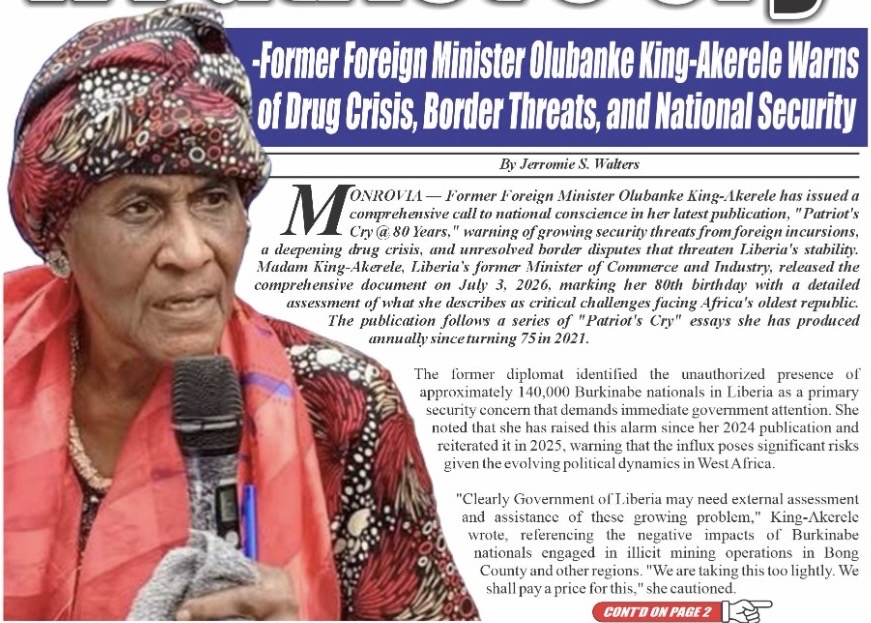
MONROVIA — Former Foreign Minister Olubanke King-Akerele has issued a comprehensive call to national conscience in her latest publication, “Patriot’s Cry @ 80 Years,” warning of growing security threats from foreign incursions, a deepening drug crisis, and unresolved border disputes that threaten Liberia’s stability.
Madam King-Akerele, Liberia’s former Minister of Commerce and Industry, released the comprehensive document on July 3, 2026, marking her 80th birthday with a detailed assessment of what she describes as critical challenges facing Africa’s oldest republic. The publication follows a series of “Patriot’s Cry” essays she has produced annually since turning 75 in 2021.
The former diplomat identified the unauthorized presence of approximately 140,000 Burkinabe nationals in Liberia as a primary security concern that demands immediate government attention. She noted that she has raised this alarm since her 2024 publication and reiterated it in 2025, warning that the influx poses significant risks given the evolving political dynamics in West Africa.
“Clearly Government of Liberia may need external assessment and assistance of these growing problem,” King-Akerele wrote, referencing the negative impacts of Burkinabe nationals engaged in illicit mining operations in Bong County and other regions. “We are taking this too lightly. We shall pay a price for this,” she cautioned.
The former minister also addressed the ongoing Guinea-Liberia border crisis, commending the government’s diplomatic approach while demanding greater transparency with citizens. She questioned whether Guinean forces have withdrawn from Liberian territory and called for regular, clear communication from authorities to prevent speculation and misinformation from filling the void.
King-Akerele particularly highlighted the work of Liberian women peacemakers who conducted an independent assessment of border communities affected by the crisis. The delegation, led by Nobel Laureate Leymah Gbowee and including the Angie Brooks International Centre (ABIC) and other women’s organizations, engaged with more than 1,000 women from 36 villages.
Yet she expressed deep concern that these women leaders have not been afforded an opportunity to formally brief President Joseph Boakai on their findings, despite returning to Monrovia more than a month ago. ABIC has met with National Security Advisor Kofi Woods but has not secured an audience with the President.
“This raises a legitimate question: Why have these women leaders not yet been granted the opportunity to brief the President?” King-Akerele wrote. “At a time when Liberia seeks a peaceful and lasting resolution to the border crisis, every credible voice for peace should be heard.”
The former minister also sounded the alarm on what she described as a growing drug crisis threatening national security, a concern she has raised since her 2021 “Cry @ 75 Years.” She commended recent seizures of narcotics valued at approximately US$19 million at Roberts International Airport while warning that the scale of the operation demonstrates Liberia’s vulnerability to sophisticated international drug trafficking networks.
King-Akerele endorsed recommendations from former Liberian Drug Enforcement Agency Deputy Director Albert Chelly, who called for international partners to help enhance Liberia’s capacity to address drug and security challenges. She also praised President Boakai’s commitment to a thorough investigation of recent drug trafficking cases and his pledge to utilize international expertise.
The condition of Monrovia’s capital city and the national cemetery also drew the former minister’s attention. While acknowledging improvements under the Boakai administration, she described the deterioration of areas including Newport Street and Sekou Toure Avenue as “a disaster and a disgrace,” particularly concerning for tourism development.
“There is a saying to the effect that ‘show me how a people treat their dead and I will tell you what kind of people they are,'” King-Akerele wrote, referencing the condition of the Center Street cemetery. “Africa’s Oldest Republic, where is our pride and dignity?”
The publication represents a continuation of King-Akerele’s longstanding commitment to public service and national dialogue. Her “Patriot’s Cry” series has been compiled into a book, “Patriot’s Cries of 2021-2024,” which President Boakai launched in August 2025 at the Ministry of Foreign Affairs.
At that launch, President Boakai described the work as “a Call to Conscience” and a “living testament to the aspirations and responsibilities of all Liberians.” He ordered 500 copies for distribution to educational institutions nationwide and pledged to use the book as a symbol to address societal ills.
Foreign Minister Sara Beysolow Nyanti praised King-Akerele as “a fearless, principled, and consistent voice that has refused to be silent when the nation needed clarity, direction, and truth,” describing the author as “a woman whose life and legacy are a masterclass in patriotism”.
The former minister’s latest publication also addresses judicial ambiguity, particularly regarding the Supreme Court’s opinion on the House of Representatives leadership crisis. King-Akerele has previously called for clearer guidance from professional legal bodies like the Liberian National Bar Association to help citizens understand the High Court’s position.
Among other concerns, King-Akerele highlighted growing divisiveness in Liberian society and the unresolved killings, murders, and disappearances she has documented since 2022. She noted that her home was attacked after she raised concerns about hate speeches, and she was forced to request protection from the Ministry of Justice.
The author also called for electoral reforms based on lessons from recent elections, increased budgetary allocation to education to reach the international target of 30%, and greater attention to land issues that she warned would become Liberia’s “next major crisis.”
King-Akerele commended positive developments, including the enhanced Liberia Standards Authority (LiSA) launched by the Ministry of Commerce and Industry, improvements in passport administration, the establishment of the Tourism Authority, and Cuttington University’s achievement of Liberia’s first UNESCO Chair for Peacebuilding, Conflict Resolution, and Reconciliation.
She also praised Vice President Jeremiah Kpan Koung’s commencement address at Cuttington University, where he advised graduates to become entrepreneurs and job creators rather than simply seeking employment.
The former minister concluded her “Cry @ 80 Years” by quoting Rabbi Tarfon: “You are not obligated to complete the work but neither are you free to abandon it.” She called on all Liberians to embrace the nation-building process as a shared responsibility, echoing President Boakai’s Unification Day message that national development cannot be achieved by government alone.
“This is not simply a law enforcement issue,” King-Akerele wrote of the drug crisis. “It is a public health crisis, a development challenge, and a national security threat. The future of Liberia depends upon the choices we make today. Time is not on our side.”