

By Jerromie S. Walters
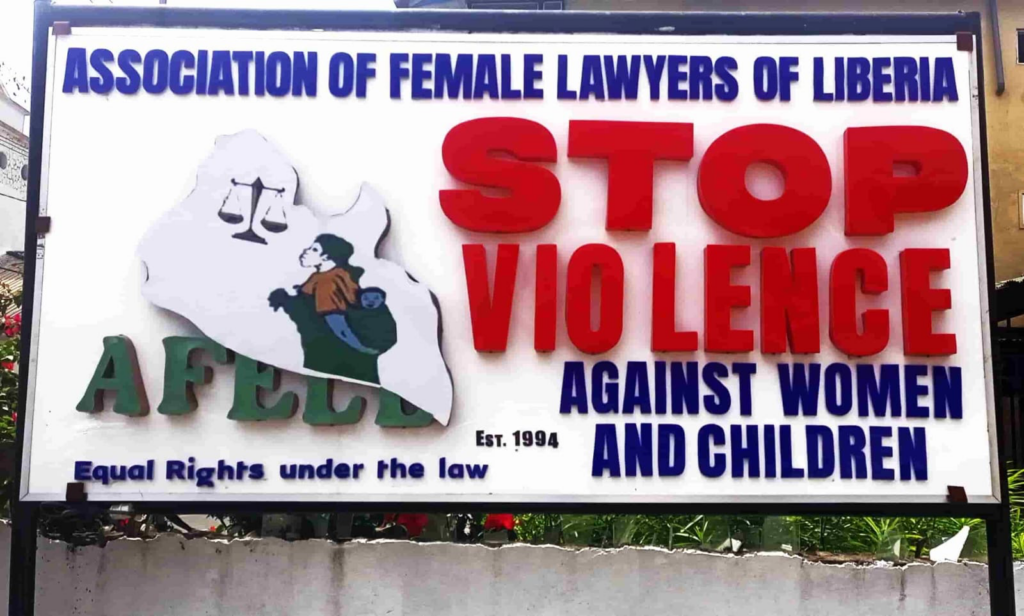
MONROVIA, Liberia — The Association of Female Lawyers of Liberia (AFELL) has called for stringent commitment to due process and constitutional protection in the ongoing drug trafficking case against former Vice President Jewel Howard-Taylor, while reaffirming its relentless stance against illicit drug activities in the country.
AFELL, established in 1994 as a champion for vulnerable women and children, emphasized in a statement dated August 27, 2026, that filing a criminal charge does not constitute a finding of guilt. The body cautioned that every accused person in Liberia is entitled to the presumption of innocence until proven guilty before a court of competent jurisdiction.
The organization stressed that this presumption of innocence is not optional but a binding constitutional guarantee that all state institutions must respect, regardless of the accused individual’s status or profile. AFELL reiterated without equivocation its firm, principled, and uncompromising stance against drug trafficking, drug abuse, and all unlawful activities that facilitate the circulation of controlled and dangerous substances within the Republic of Liberia.
Moreover, the institution condemned the illicit trade, distribution, transportation, facilitation, and use of narcotics, which pose grave threats to families, communities, public health, national security, and the integrity of the rule of law. However, AFELL equally maintained that any action taken against alleged drug trafficking must be executed lawfully, transparently, and strictly within the confines of due process, emphasizing that anti-drug advocacy cannot come at the expense of fundamental constitutional protections.
Demands for Fair Treatment and Due Process
AFELL insisted that Cllr. Howard-Taylor, and all other individuals accused of drug-related offenses, be afforded access to legal counsel, humane and dignified treatment, non-discriminatory treatment, protection against arbitrary detention, prompt appearance before a competent court, and transparent and lawful investigative procedures.
The organization called upon the Government of Liberia, through the Liberia National Police, the Drug Enforcement Agency, and all relevant state institutions to ensure strict adherence to the rule of law, constitutional safeguards, and internationally recognized human-rights standards in the handling of this matter.
AFELL further urged that all proceedings be conducted without unnecessary delay, consistent with due process and applicable evidentiary standards, noting that where the prosecution determines that sufficient admissible evidence exists to sustain the charges, the matter should proceed expeditiously before the appropriate court.
“Where evidence is insufficient, the law requires that appropriate remedies, including dismissal or discharge, be applied without prejudice or delay,” AFELL emphasized in its statement. The association stressed that its anti-drug advocacy remains unwavering, but equally maintained that any action taken against alleged drug trafficking must be executed lawfully, transparently, and strictly within the confines of due process.
AFELL committed to continuing to serve as a strong, consistent, and principled voice against drug trafficking and unlawful drug-related activities in Liberia while defending the foundational principles of due process, presumption of innocence, judicial independence, and the right to a fair and speedy trial.
The Allegations:
The Government of Liberia has accused former Vice President Jewel Howard-Taylor of allegedly maintaining links with a transnational cocaine trafficking network and receiving hundreds of thousands of United States dollars from individuals investigators have identified as members of the alleged organization.
The allegations are contained in a writ of arrest issued in connection with a criminal complaint filed by the Republic of Liberia through the Ministry of Justice, with the complaint alleging that the activities date back to 2021 and continued through 2026, involving foreign nationals and Liberian intermediaries.
The former vice president faces seven criminal counts under three separate legal frameworks: unlicensed importation of a controlled substance, unlicensed sale and transportation, illicit trafficking, criminal solicitation, facilitation, conspiracy, and money laundering, with each count carrying significant prison time upon conviction.
The government alleges that Sheik Bashiru Kante brought Croatian and Ukrainian nationals Taras Zadereiko, also known as “Tony,” and Mihovil Vrovac, also known as “Michael,” to Liberia, with investigators alleging that the men later conspired with Kante and others to import and export cocaine through Liberia, allegedly using the country as a transit point for shipments destined for Europe.
The complaint says that Kante introduced Zadereiko and Vrovac to Taylor in 2022 while she was serving as vice president, with prosecutors further alleging that Taylor subsequently met the two men and Kante at her residence in Congo Town, Montserrado County.
According to the government, the meeting was followed by an invitation for Taylor to travel to Dubai, United Arab Emirates, where she allegedly met Nikola Ivancic, a Croatian national described in the complaint as the alleged kingpin or leader of the cocaine trafficking organization.
The government alleges that discussions in Dubai centered on the alleged use of Liberia as a transit route for cocaine trafficking and claims Taylor agreed to the proposal, with the complaint further alleging that Taylor received US$45,000 from Ivancic while shopping in Dubai in the presence of Kante, Zadereiko, and Vrovac.
Following her return to Liberia, investigators allege that Taylor maintained contact with members of the suspected network, with the government further claiming that Taylor later requested and received US$75,000 through Kante for her organization, the Jewel Star Fish Foundation, while the alleged trafficking operation continued. Investigators also allege that in August 2026, Taylor received an additional US$15,000 through Kante, with the complaint alleging that Taylor later expressed appreciation to Ivancic in an audio recording cited by investigators.
Taylor Denies Allegations
However, the accusations against Taylor remain allegations and have not been proven in court, with the former vice president categorically denying all drug trafficking charges leveled against her and describing the case as a politically motivated witch-hunt and an abuse of state power.
In a statement released Saturday, Howard-Taylor’s office rejected “in the strongest possible terms” all charges read against her by Minister of Justice Cllr. N. Oswald Tweh, stating that “these allegations are baseless, unfounded, and without merit, and Her Excellency will not accept a single word of them.”
Madam Howard-Taylor was barred from leaving Liberia early Wednesday morning when joint security forces intercepted her at Roberts International Airport, with her office stating there had been “no prior notice that she was under investigation and no summons for questioning.”
Authorities were attempting to connect her to individuals allegedly under investigation for transnational criminal activity, “based solely on official engagements carried out during her tenure as Vice President,” her office stated.
“Let us be absolutely clear that contacts and engagements carried out in the course of executing her official duties are not evidence of participation in anyone’s alleged crimes,” the statement emphasized.
The former vice president’s legal team, including former Supreme Court Associate Justice Kabineh M. Ja’neh and Israel Akinsaya, maintained she was prepared to voluntarily report to Police Headquarters, but while traveling to meet her lawyers, her vehicle was intercepted on the Congo Town back road, and she was escorted to police headquarters.
Howard-Taylor’s office has also alleged that unnamed government figures may have contemplated using artificial intelligence to manufacture doctored audio and video recordings intended to implicate her, describing the allegation as “an extremely serious and alarming development.”
Any audio or video material presented as evidence would be subjected to independent forensic examination, her office stated.
A National Drug Crisis
An estimated 13% of Liberia’s population engages in illicit drug abuse, with up to 20% of the country’s youth suffering from substance addiction, driven by post-conflict trauma and a lack of employment, with these usage rates enormously higher than the global average.
President Joseph Nyuma Boakai, Sr. has declared that his administration would pursue the fight against illicit drug trafficking and organized crime with “deliberate, coordinated, and unrelenting” resolve, as Liberia’s immediate past vice president remains under detention while awaiting trial in the country’s drug bust case.
In an address to the nation on Wednesday evening, President Boakai noted that no office, status, or political connection would shield anyone from justice, seeking to quell growing public tension and misinformation by framing the administration’s crackdown not as a political vendetta but as a moral and national security imperative.
“This Administration will enforce the law without fear or favor while protecting the constitutional rights of every person,” Boakai said from the Executive Mansion. “Whether one has held high office, served in government, led a business, or lived as an ordinary citizen, the law must apply equally to all.”
However, the President’s pledge of impartial justice has been complicated by separate allegations that have surfaced against some of his own top security officials, with claims on social media linking Justice Minister Cllr. N. Oswald Tweh Sr. and Liberia National Police (LNP) Inspector General Gregory Coleman to a drug cartel.
Both the IG and Minister have denied any direct cartel links. Also, President Boakai has publicly maintained his confidence in Inspector General Coleman, a stance that has drawn questions about whether the administration’s pledge of “without fear or favor” applies equally to those within its own ranks.
The administration has already taken punitive action against several officials in connection with drug-network operations, with President Boakai dismissing multiple high-ranking personnel at the Roberts International Airport (RIA) and the Liberia Drug Enforcement Agency (LDEA) as part of the ongoing crackdown. Yet critics have pointed to what they perceive as a double standard, noting that no similar action has been taken against Tweh and Coleman despite the gravity of the allegations against them.