

-To Forge Path for Continent’s Christian Future
By Laymah Kollie
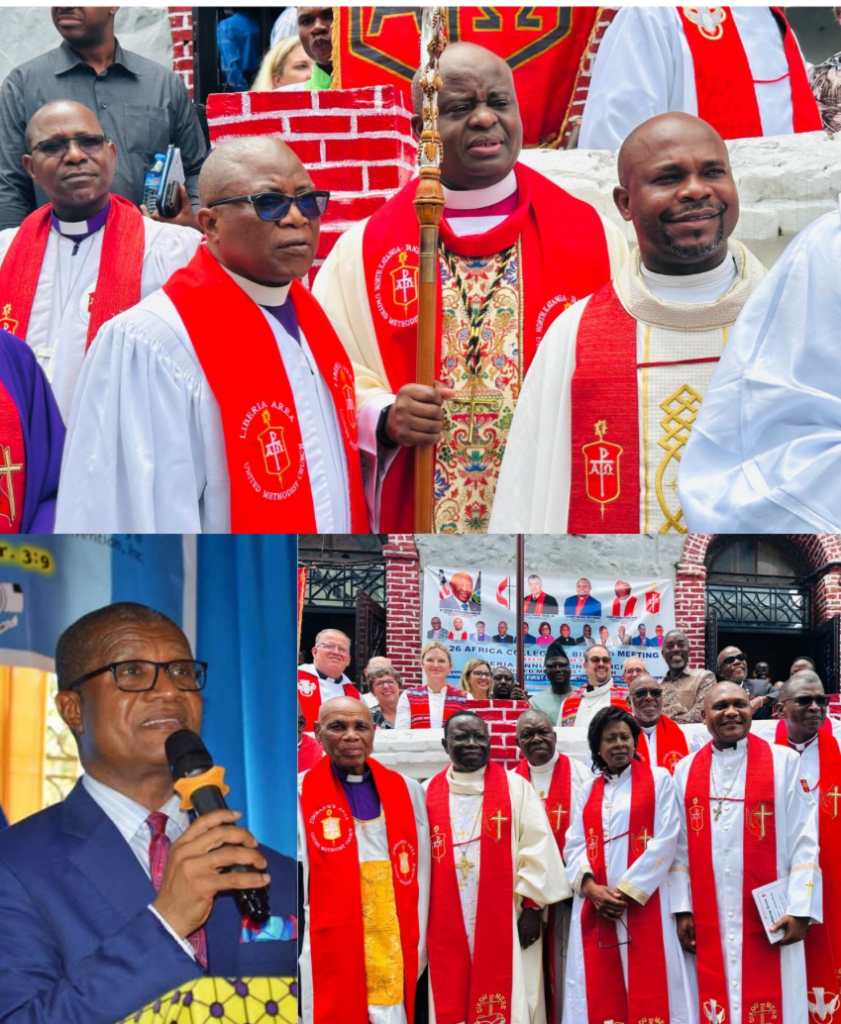
MONROVIA, Liberia — More than 200 bishops, clergy and Christian leaders from across Africa, the United States and Europe have gathered in Liberia’s capital this week for the annual meeting of the Africa College of Bishops, hosted by the Liberia Annual Conference of The United Methodist Church.
The four-day conference, which runs from August 31 to September 4, 2026, is being held under the theme “Deepening Ecumenical Engagement, Expanding Continental Influence and Strengthening Institutional Sustainability.” The gathering brings together representatives from Catholic, Episcopal, United Methodist and other Christian traditions to examine the future role of the Church in Africa amid the continent’s rapidly changing social, economic and spiritual realities.
Keynote Sets Tone for Conference
In his keynote address, Rev. Dr. Samuel B. Reeves Jr., President of the Liberia Council of Churches and the Liberia Baptist Missionary and Educational Convention, delivered a forceful call for African church leaders to move beyond institutional preservation and prepare the Church for a larger, more influential and sustainable future.
Drawing from Isaiah 54:2, Reeves framed his message around three imperatives: Enlarge. Engage. Endure. “Every bishop should eventually face one question: Who will be ready because I served here?”
Reeves asked the assembly, challenging leaders to measure their success not by what they accomplish during their tenure, but by whether they mentor successors, empower young people, open doors for women and leave institutions strong enough to continue their mission. A major theme of the conference has been the need for Christian denominations to move beyond symbolic unity toward practical collaboration.
Reeves argued that challenges confronting African societies — including poverty, violence, migration, climate vulnerability and unemployment — cannot be addressed by individual denominations working alone. “Christian unity cannot and must not remain a beautiful sentence in an eloquent prayer,” he said. “Conversation must lead to collaboration. Collaboration must lead to coordination. Coordination must lead to collective action.”
The conference is exploring concrete ways churches can partner in areas including education, healthcare, peacebuilding, governance and entrepreneurship. Delegates are dedicating significant attention to Africa’s youthful population, with speakers urging the Church to treat youth development as central to its mission rather than an occasional program.
Associate Justice Jamesetta Wolokollie, addressing the gathering, warned that a society that fails to provide love, care and leadership for its young people risks creating deeper problems for the next generation. “Let’s focus on the young people. They need love and leadership,” she said.
Reeves echoed the call, saying the Church must prepare young people not only for worship but also for vocation, leadership and public life, equipping them to think critically, govern effectively and innovate responsibly while remaining grounded in Christian values. Women, he added, must have meaningful opportunities to lead, and lay professionals should be treated as full partners in the Church’s mission.
Building Sustainable Institutions
The conference is also examining how African churches can build stronger internal financial capacity to reduce dependence on outside resources. Reeves called for improved financial transparency, strategic planning, responsible investment, entrepreneurship and endowment development.
Greater reach, he said, must be matched by stronger governance and institutional discipline, particularly as the Church confronts technological and social changes reshaping Africa — including artificial intelligence, digital education, migration, urbanization and climate change. “We need both roots and reach,” Reeves said.
The Archbishop of Monrovia, Most Rev. Dr. Gabriel Blamo Snosio Jubwe, reinforced the conference’s emphasis on impact and sustainability, telling delegates that bishops have a responsibility to create systems capable of producing long-term change. He reaffirmed the Catholic Church’s willingness to work with other Christian traditions, stressing that the Church’s strength is greater when Christians work together.
As the conference continues through September 4, delegates are grappling with a central question: whether the African Church can build the partnerships, leaders and institutions strong enough to carry its mission into the future. Reeves’ closing charge to the assembly was direct: “Enlarge the vision with humility. Engage the world with courage. And endure beyond ourselves with integrity.”
He said the Church must be prepared to answer three questions in the years ahead: What did you imagine? Whom did you bring with you? And what did you leave behind?
“The God who carried us through yesterday has not run out of tomorrow,” he said. “The question is whether we will make room for it.”