-At Liberia Marks 179th Flag Day
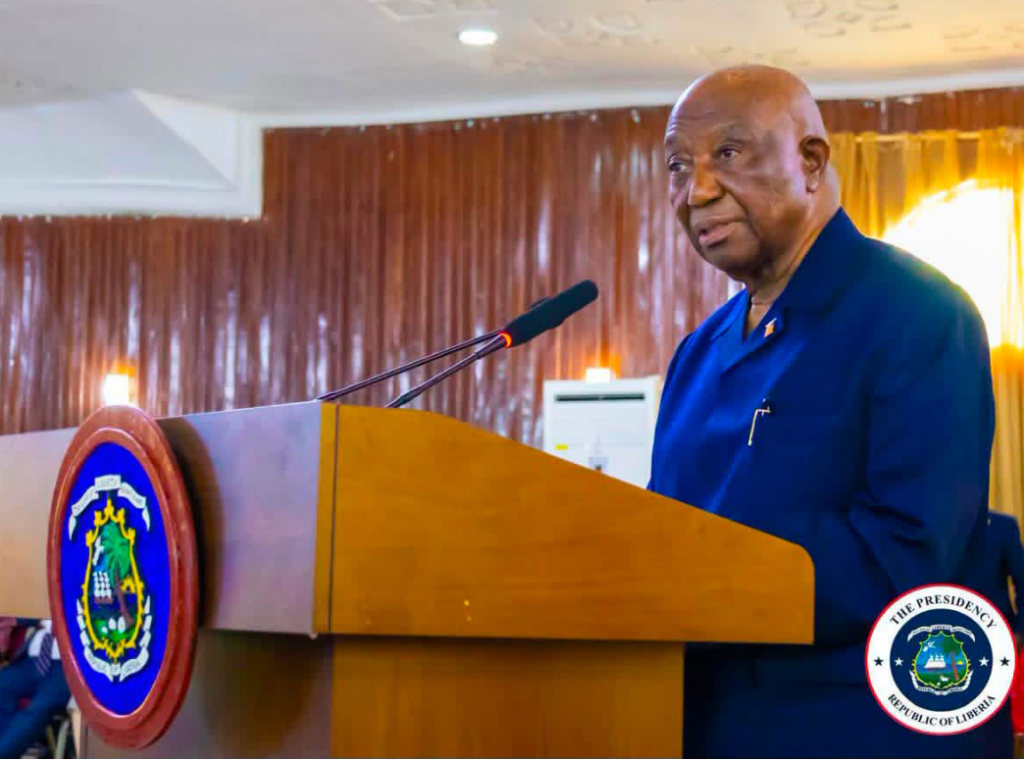
MONROVIA — President Joseph Nyuma Boakai Sr. used the occasion of Liberia’s 179th National Flag Day to deliver a stark message to the nation: commemoration must not become complacency.
Standing before the Executive Pavilion in Monrovia, the President framed the red, white, and blue Lone Star not merely as a symbol of past struggles, but as a “call to action” demanding that Liberians reject division, corruption, and the growing threat of drug trafficking.
“Let us not confuse commemoration with complacency,” Boakai told a gathering that included Cabinet members, the diplomatic corps, legislators, traditional leaders, and hundreds of students who had earlier paraded at the Barclay Training Center. “Our flag calls us to action. It demands that we reject division, hatred, corruption, violence, and every force threatening our national fabric.”
The anniversary follows last month’s 179th Independence celebration, which was themed “Strengthening National Identity Through Liberian-Led Historical Leadership.” Boakai noted the two observances are deeply intertwined: “If Independence gave us the sovereignty to define ourselves as a nation, the flag gives that identity a visible, enduring symbol.”
A Needle, Thread, and a Nation
In a history lesson punctuated with contemporary relevance, the President recalled that the flag was first stitched in 1847 by seven courageous women led by Susana Lewis, as the nation’s forefathers prepared to declare independence.
“Nation-building has never been the work of a few,” he said. “It is the labor of all—men and women, young and old, from every county, ethnicity, religion, and social background.”
‘Say NO to Drugs’
Speaking directly to the student contingents who had marched earlier in the day—and to the young people watching across the nation—Boakai delivered a blunt warning about the resurgence of drug trafficking.
“The renewed efforts by drug traffickers to use our country as a transit and operational center pose a serious threat, especially to our young people,” he said. “Do not let anyone steal your future.”
He urged students to learn the words of the Pledge of Allegiance but “more importantly, understand and live by them,” calling on them to resist the “temptations that can destroy your future” and to stay “focused, disciplined, and determined.”
The President then turned his address to the adults in the room, issuing a challenge that resonated beyond the event.
“We cannot ask our children to love Liberia while we undermine its institutions; to respect the law while we disregard it; or to be patriotic while we place personal, ethnic, religious, or partisan interests above the national good.”
Civics Returns to Classrooms
In a move that officials say could help rebuild national consciousness, Boakai announced the reintroduction of civics education in primary schools and the official launch of standardized civics textbooks across the Republic.
“This is an important step toward restoring understanding of our history, Constitution, national symbols, rights and responsibilities, and the principles of citizenship,” he said.
Pride in the Next Generation
The President praised the 2026 Flag Day commemorations for including early childhood education and special and inclusive schools for the first time, and offered personal congratulations to the schools recognized for Best Salute, Most Disciplined, and Best Dressed.
“I saw discipline, precision, confidence, and patriotism in the eyes of our young people,” Boakai said. “I am very proud of them.”
‘One People, One Nation, One Destiny’
In his closing remarks, the President reminded Liberians that the flag belongs equally to every citizen—the child in Grand Kru, the farmer in Lofa, the fisherman on the coast of Maryland, and Liberians at home and abroad.
“Let us recommit to the identity and values embodied by the Lone Star,” he said. “Let us honor the sacrifices of those who came before us, live responsibly in the present, and build with confidence for generations yet unborn.”
He concluded with the words that have become a refrain of his presidency: “Think Liberia, Love Liberia, and together Build Liberia.”
The 179th Flag Day Anniversary, observed annually on August 24, commemorates the adoption of Liberia’s national flag in 1847, making it one of the oldest national flags in Africa.
Sister-Aid Liberia Equips Women Aspirants -With Political Skills Ahead of 2029 Elections
By Jessica Cox
MONROVIA, Sister-Aid Liberia Incorporated is strengthening the political preparedness of women aspirants through a three-day leadership and candidate-readiness training designed to help them navigate financial, social and political challenges ahead of Liberia’s 2029 General Elections.
The training, held from August 19–21, 2026, in Monrovia, brings together approximately 42 women aspirants from Montserrado, Margibi and Grand Bassa Counties.
The initiative is being implemented by Sister-Aid Liberia with support from UN Women, while the Gender Section of the National Elections Commission (NEC) is participating in the exercise.
The training is being delivered under UN Women’s Political Leadership and Candidate Training (PLCT) approach through the Liberia Electoral Support Project (LESP), with funding from the European Union, the Embassy of Sweden in Monrovia and Ireland.
The broader program is being implemented in six phases and is expected to reach approximately 240 women political aspirants across all 15 counties.
Participants have received practical training in personal and transformative leadership, constituency analysis, political party engagement, public speaking, message development, voter contact, fundraising, team building and electoral politics.
The training also addresses challenges women face in elections, including financial barriers, violence, cultural practices and limited political networks.
Sister-Aid facilitators say financial constraints remain one of the major challenges confronting women who want to contest elections.
One of the facilitators, Mohammed Boakai, an independent consultant supporting Sister-Aid Liberia through UN Women, said participants are being taught how to develop fundraising plans and strategies to mobilize resources for their political activities.
He said the women are also being prepared to recognize and respond to potential violence during elections.
“We run them through transformative leadership, helping them to define themselves. Most importantly, who are you? So you go out to a voter and they ask you, ‘Why should I vote for you?’ How do you answer that question?” Boakai said.
He said the training also prepares participants for challenges that can arise during elections, including violence against women, while strengthening their understanding of electoral politics.
According to Boakai, participants are also being encouraged to remain engaged with political parties and maintain a visible presence in their communities.
He argued that women aspiring to political leadership must be prepared to actively engage with the communities they seek to represent.
Boakai said some women face social expectations that can discourage them from being present in public spaces, but political participation requires candidates to engage voters directly.
Boakai stressed that women should not expect voters to support them simply because they are women.
“Nobody is going to vote for you just because you’re a woman. Everybody wants to put a winnable candidate out there to contest,” he said.
He encouraged women aspirants to remain active within political parties and communities and to demonstrate why voters should choose them.
Boakai also called on Liberians to evaluate candidates based on their qualifications and ability to lead rather than voting solely based on gender, family, friendship or tribal connections.
Using an example, he said voters choosing a pilot would want the safest and most capable pilot rather than selecting someone simply because they are a relative or friend.
For the women participating in the training, the sessions are providing an opportunity to build confidence and develop practical skills for future campaigns.
Sandra Massa-William, a Margibi County aspirant who contested the 2023 elections in Tega Number Two, said the training has improved her understanding of political planning and voter engagement.
“I learned how to plan. I learned how to talk to my colleagues when I go up there to ask them to vote for me. I learned how to do a lot of things and I am prepared for the 2029 election,” Massa-William said.
She said she plans to return to Margibi and encourage women to support female candidates who can effectively represent their interests.
“I am going back to Margibi to talk to my women that we should be able to vote for women. Let us vote for our women,” she said.
However, Massa-William emphasized that being a woman should not by itself determine who receives voters’ support.
She said women should support candidates who are capable of standing for them and speaking on issues affecting their communities.
Reflecting on her experience during the 2023 elections, Massa-William recalled facing skepticism while campaigning and seeking support from voters.
Despite those challenges, she said she remains committed to political participation.
“I am not going there because of the men. I am going there because of the women,” she said.
She urged fellow female participants to remain courageous and determined.
“We should stand strong. We should get the courage and go out there and do our best,” Massa-William said.
Sister-Aid Liberia Founder Miatta Darwolor said the organization wants women to be prepared not only to contest elections but also to understand the political environment and participate effectively in leadership.
“We want the women to be prepared, not only to contest, but to understand the political environment and how they can effectively participate and lead,” Darwolor said.
She noted that women currently occupy only 11 of Liberia’s 103 legislative seats, despite women making up more than half of the country’s voting population.
Darwolor said Sister-Aid Liberia does not provide direct campaign financing to aspirants but instead focuses on technical support, training, mentorship and resource-mobilization skills.
She said the women are also being guided on how to respond to violence, identify potential risks during campaigns and use information from their communities to make safer decisions.
Darwolor further acknowledged cultural practices that can limit women’s participation and said the training seeks to help women navigate those challenges while building support among both women and men.
She expressed hope that early preparation would contribute to more women contesting and winning elective positions in future elections.
UN Women Deputy Country Representative Dr. Oluwayemisi Falayajo said Liberia’s democratic development cannot reach its full potential without women having a meaningful role in political decision-making.
She said women aspirants continue to face limited access to political networks, resources, information, mentorship and leadership opportunities.
Dr. Falayajo said women’s political representation should not be viewed solely as a gender-equality issue, but also as an important part of stronger governance, democracy and inclusive national development.
Meanwhile, UNDP Communications Specialist Mambu James Kpargoi urged women aspirants to make the concerns of marginalized communities central to their political campaigns.
Kpargoi said women have an opportunity to address representation gaps within Liberia’s predominantly male political landscape.
Reflecting on the 2023 elections, he emphasized the importance of building broad-based support by engaging local leaders and diverse groups, including young people and persons with disabilities.
He acknowledged that women face significant challenges in securing votes but urged them to support one another throughout the electoral proccess.
The Gender Section of the National Elections Commission is participating in the training as part of efforts to strengthen women’s participation in Liberia’s electoral processes.
The NEC says the exercise gives women aspirants an opportunity to apply, practice and refine political leadership lessons ahead of the 2029 General Elections.
The six-phase program is expected to reach approximately 240 women across all 15 counties, extending the training beyond the current group of 42 participants.
Facilitators say continued engagement among local civil society organizations, international partners and women aspirants will be important in sustaining political leadership development and civic education ahead of future elections.
Boakai said support for civil society and civic education should be strengthened across the country as Liberia prepares for another electoral cycle.
For the women currently taking part in the training, organizers say the goal is not simply to increase the number of female candidates, but to help women become more confident, prepared and capable of presenting themselves as credible choices to Liberian voters in 2029.