

By Shallon S. Gonlor
shallonsgonlor@gmail.com
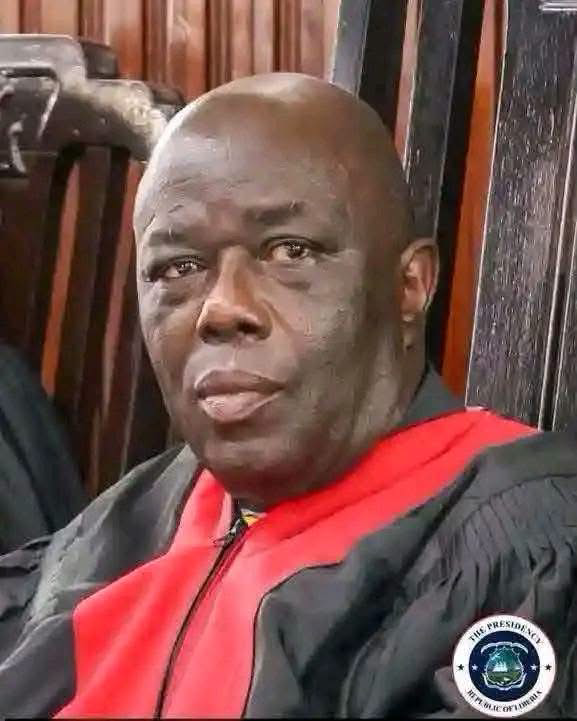
NIMBA COUNTY, Liberia — Liberia’s Chief Justice Yamie Quiqui Gbeisay has rejected attempts to portray the court’s judgment as motivated by tribal considerations, following the Gompa City Magisterial Court’s sentencing of former Gompa City Mayor Amos N. G. Suah to 30 days’ imprisonment at the Sanniquellie Central Prison.
Chief Justice Gbeisay said he is not a “tribal Chief Justice” but the Chief Justice of the Republic of Liberia, stressing that judicial decisions must be based on evidence and law rather than tribal affiliation.
It can be recalled that on Tuesday, September 29, 2026, the Gompa City Magisterial Court sentenced former Gompa City Mayor Amos N. G. Suah to 30 days in jail and fined him US$100 for contempt of court after finding that his recent public remarks demeaned the court and risked inciting members of the public against the Judiciary.
The court also ordered Suah to appear on three community radio stations in Gompa City to retract and debunk his comments concerning the court.
In a summons dated September 24, the court ordered Suah to appear on Tuesday, September 29, at 2 p.m. to “show cause” why he should not be punished for statements he made on the Day Break Gompa program on Voice of Gompa.
According to the court, Suah’s remarks “demeaned, scandalized and lowered the authority of the Court” and could “incite members of the public to defy, resist or violently oppose the lawful order and authority of the Judiciary.”
Dispute Over Ganta Eviction
The contempt proceedings come amid heightened tensions in Gompa City following an eviction at the Ganta Old-General Market area on Wednesday, September 16, 2026, which reportedly resulted in the destruction of numerous houses, business structures and other properties, leaving families, traders and other occupants displaced.
The eviction involved a bulldozer and officers of the Emergency Response Unit (ERU) of the Liberia National Police and was carried out under an order in the summary proceedings involving the Intestate Estate of the Late Musa Toure, through Administrator Mohammed Toure, versus Mohammed Bility and Mr. Dorley.
The eviction subsequently triggered a public dispute between Chief Justice Gbeisay and former Mayor Suah.
Chief Justice Gbeisay defended the magisterial court’s eviction order during an interview on Voice of Gompa.
Suah later responded publicly, referring to Chief Justice Gbeisay as a “secret enemy” and calling on President Joseph Nyuma Boakai to remove him from office.
Suah also alleged, without publicly providing evidence, that Chief Justice Gbeisay is a citizen of Lofa County rather than Nimba County.
Chief Justice Gbeisay subsequently accused Suah of selling public or government-owned land in Ganta during his tenure as mayor. He also said he would inform the President before any enforcement action was taken against persons occupying government land.
Chief Justice Rejects Tribal Allegations
In his latest press release, dated September 29, Chief Justice Gbeisay said his response followed what he described as deliberate attempts by some individuals to inject tribal sentiments into a judgment of the Gompa City Magisterial Court involving a land dispute between the Kalefa Turay family and alleged squatters.
“I wish to speak directly and clearly to the Liberian people,” Gbeisay said, emphasizing his constitutional responsibility to administer justice without fear or favor.
He said he took a “sacred oath” before God and the Liberian nation, as required under Article 70 of the Liberian Constitution, to administer justice and uphold equal rights for all persons.
“The Oath did not say justice for one tribe or against another tribe. It said, Justice for All,” he stated.
Gbeisay stressed that his loyalty is to Liberia’s Constitution and laws rather than to any tribe, county, political party, or party to a case.
“My loyalty is not to a tribe. My loyalty is not to a county. My loyalty is not to any party to the case. My loyalty is to the Constitution of Liberia and to the Laws of Liberia,” he said.
Land Dispute
Addressing the specific land judgment and eviction in Gompa City, Chief Justice Gbeisay acknowledged the emotional nature of land disputes, particularly in communities where land is closely connected to identity, livelihood and family heritage.
“Land is identity. Land is livelihood and land is a heritage,” he said, adding that he understands the “pain and anxiety” surrounding the dispute in Nimba County, particularly in Gompa City.
However, he maintained that such cases must be resolved in court based on evidence and applicable law, rather than through public pressure, social media or tribal considerations.
“This is precisely why these cases must be decided in the courtroom, on the basis of evidence and law — and not in the streets, not on social media and certainly not on the basis of tribal sentiments,” Gbeisay stated.
He emphasized that tribal affiliation would not influence judicial decisions under his leadership.
“Let me be unequivocal: no case under my watch as the Chief Justice of the Republic of Liberia will be decided on tribal affiliation,” he declared.
Turay Family’s Claim
According to Chief Justice Gbeisay, information available to him indicates that the Turay family purchased the disputed property as far back as 1951 through a public land sale deed signed during the administration of former President William V. S. Tubman.
He said a building was subsequently constructed on the property and leased to tenants, including the Government of Liberia, until the country’s civil crisis.
Gbeisay further stated that an action was later filed before the court and judgment was rendered in favor of the Turay family.
He claimed that the judgment was not appealed but that its execution was subsequently resisted, including through arguments involving tribal sentiments and alleged eminent domain.
The Chief Justice did not provide further details in the release concerning the specific legal proceedings or the evidence supporting the judgment.
“One Tribe — Justice”
Chief Justice Gbeisay defended the principle that courts must determine cases based on evidence and law, regardless of the ethnic identities of the parties involved.
“Courts base their rulings only on evidence. Court knows no Kpelle, no Mano, no Gio, no Madingo, no Bassa, or any other tribe,” he said.
“For in the temple of justice and courtrooms in Liberia, there is only one tribe, and that tribe is Justice,” he added.
Gbeisay acknowledged that citizens in a democracy have the right to criticize court judgments and said he welcomes constructive criticism.
“As a Priest of Justice, I welcome constructive criticism,” he said.
However, he condemned what he described as the deliberate use of tribal sentiments to undermine or intimidate the Judiciary.
He warned that attempts to tribalize land disputes could have broader consequences for Liberia’s peace and national cohesion.
“Attempt to tribalize a land case is to put fire on our National House. Liberia has been down that road before, and we all know where it led us. We must not go there again,” he stated.
Chief Justice Gbeisay concluded by reaffirming his commitment to Liberia’s Constitution and the Judiciary, saying he would continue to defend the Constitution and stand by judgments legally rendered by courts across the country.
“As long as I serve as Chief Justice of Liberia, I will continue to defend the Constitution and stand by all judgments legally rendered by all Courts within the Republic,” he said.