

By: Julius Konton
Liberia’s Ministry of Health has launched a three-day free medical screening exercise for employees of the Civil Service Agency (CSA), as the government intensifies efforts to promote preventive healthcare, employee wellness and early detection of common health conditions among public servants.
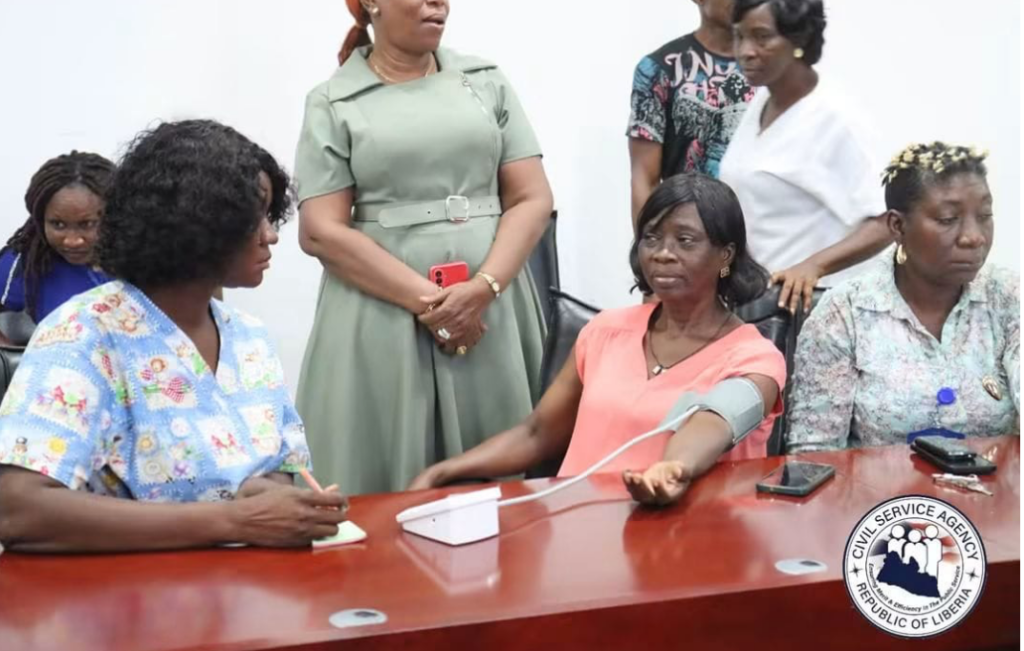
The exercise, which commenced Tuesday, October 6, at the Dr. C. William Allen Conference Room, is being implemented in collaboration with the CSA through its Human Resource and Occupational Health and Safety (OHS) divisions.
Health officials said the initiative forms part of a broader workplace-health effort being extended across government ministries, agencies and commissions.
The program focuses on basic medical assessments designed to give employees an opportunity to understand their current health status and receive professional guidance.
The screening includes vital-sign checks, blood-pressure measurements, blood-sugar testing and other basic health assessments.
Leading the Ministry of Health team at the CSA, Clinical Coordinator and Team Lead Madam Miatta K. Yekee said the exercise is intended to encourage civil servants to make regular health checks part of their routine rather than waiting until symptoms become severe.
Yekee emphasized that simple screening procedures can provide important early indications of health problems and give individuals an opportunity to seek appropriate medical attention, lifestyle guidance or further clinical evaluation when necessary.
Her comments come against the backdrop of a growing global emphasis on preventive healthcare.
Noncommunicable diseases including hypertension, diabetes, cardiovascular diseases and other chronic conditions have become increasingly important public-health concerns across Africa.
Regular screening is widely regarded as one of the tools available to identify risk factors before they develop into serious complications.
For Liberia, where the healthcare system continues to balance infectious diseases, maternal and child health needs and the growing burden of noncommunicable diseases, workplace health programs offer an additional avenue for reaching economically active adults.
The Ministry of Health delegation was received by CSA Director-General Dr. Josiah F. Joekai Jr., who welcomed the initiative and commended Health Minister Dr. Louise Kpoto and her team for extending the screening program to government employees.
Dr. Joekai said the exercise should not be treated as a one-time event. Instead, he called for periodic medical screening across the civil service so employees can monitor their health over time, compare previous results with current assessments and identify emerging health concerns at an early stage.
“A healthy workforce is essential to an effective public service,” the CSA leadership emphasized, stressing the importance of enabling employees to know their health status and take timely action where necessary.
The CSA Director-General further expressed the agency’s willingness to support the coordination of future health initiatives and, where appropriate, facilitate orientation and training for human-resource representatives responsible for workplace health and employee welfare.
The initiative highlights the growing importance of occupational health within Liberia’s public sector.
Civil servants constitute a critical component of the machinery through which government delivers services, implements policies and interacts with citizens.
A healthier workforce can contribute to reduced absenteeism, improved productivity and earlier intervention for medical conditions that might otherwise result in prolonged illness or reduced work capacity.
Internationally, workplace wellness programs have increasingly moved beyond responding to injuries and occupational hazards to include preventive screening, mental well-being, healthy lifestyles and chronic-disease management.
For Liberia, strengthening occupational health programs could provide government institutions with a structured mechanism for identifying health risks among employees while promoting a culture of prevention.
Liberia’s healthcare system has undergone significant transformation since the devastating Ebola outbreak of 2014–2016, which exposed major weaknesses in the country’s health infrastructure while also prompting substantial investments in disease surveillance, emergency preparedness and health-system resilience.
The country has since continued to confront multiple health priorities, including malaria, maternal and child health, infectious diseases and an increasing need to address noncommunicable diseases.
The World Health Organization and other international health agencies have repeatedly emphasized the importance of early detection and preventive interventions as countries confront the growing global burden of chronic diseases.
Against this backdrop, screening government employees provides more than an individual health benefit.
It can also contribute to a broader public-health culture in which regular checkups, early diagnosis and informed health decisions become routine.
The ongoing three-day exercise is therefore being viewed as part of a broader effort to institutionalize employee wellness within Liberia’s civil service.
CSA officials say sustained collaboration between human-resource professionals, occupational-health personnel and the Ministry of Health could help establish more regular health-promotion activities throughout government institutions.
Such a model could include periodic medical screening, health education, referral services, workplace safety awareness and follow-up assessments, allowing employees and institutions to track health trends over time.
As the screening continues at the Civil Service Agency, the initiative represents a practical step toward shifting workplace healthcare from a largely reactive model to one that places greater emphasis on prevention, early detection and employee well-being.
For Liberia’s public service, the message is increasingly clear: maintaining an effective government workforce begins not only with professional capacity and institutional reform, but also with the health and well-being of the people responsible for delivering public services.