

By Vaye A. Lepolu
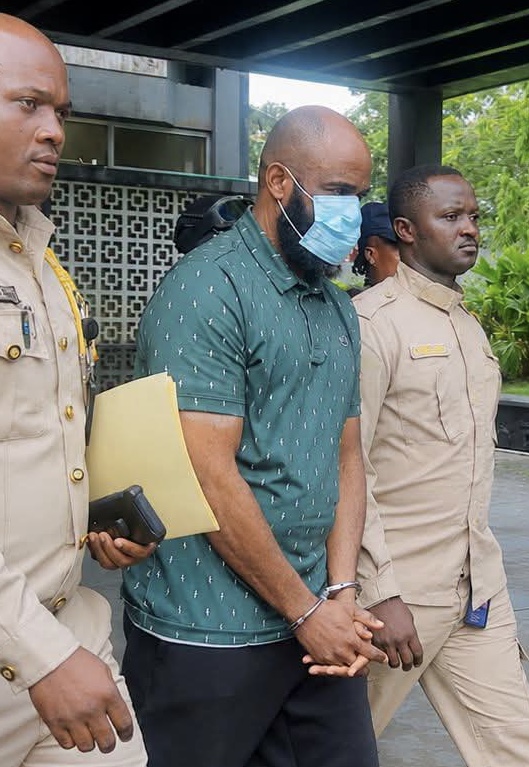
MONROVIA – The Monrovia City Court on Wednesday ordered Paul Jamaal King and his co-defendants to stand trial for their alleged involvement in a $19 million cocaine trafficking operation at Roberts International Airport.
Stipendiary Magistrate Ben Barco ruled that prosecutors presented sufficient evidence during the preliminary examination to establish probable cause against King and his associates. The case will now proceed to Criminal Court “C” for a full trial.
King faces multiple charges, including unlicensed exportation of controlled drugs, illegal trafficking, criminal conspiracy, and criminal solicitation, violations of Liberia’s Penal Law and the Drug Law of 2023.
The charges arise from the June 2026 seizure of 237.6 kilograms of cocaine, worth approximately $19 million. Investigators discovered the drugs concealed inside six boxes at RIA that were falsely declared as containing “Maggie cubes and lappers” destined for England.
Magistrate Barco emphasized that the preliminary examination only determines whether probable cause exists, not guilt beyond a reasonable doubt. He cited Liberia’s Criminal Procedure Law and the Supreme Court’s decision in Wolo v. Republic of Liberia.
“The prosecution has met its burden of establishing probable cause against Co-Defendant Paul Jamaal King and his associates,” Barco ruled.
Prosecutors presented testimony from Colonel Moses L. Meah of the Liberia Drug Enforcement Agency and Superintendent Joseph M. Kaiffa of the Liberia National Police. Both witnesses linked King and other defendants to the drug operation through documentary and physical evidence. King, who served as Operations Manager of Global Logistics Services (GLS), allegedly coordinated the shipment and instructed staff to prepare a false air waybill.
Investigators testified that the six boxes originated from King’s residence before their transport to RIA.
Airport security officers grew suspicious after detecting a weight discrepancy during routine screening. The declared weight of 200 kilograms did not match the actual weight of 237.6 kilograms. A physical inspection uncovered cocaine hidden inside the boxes.
Colonel Meah testified that King later attempted to secure the release of the intercepted shipment. Witness statements, receipts, air waybills, photographs, and drug samples corroborated the investigation. Superintendent Kaiffa told the court that police investigations confirmed King knowingly provided false information on shipping documents and verified that the consignment originated from his residence.
Defense lawyers challenged the investigation, questioned evidence handling, and raised concerns about co-defendant Michael U.S. Brown’s custody status. They also cited U.S. court decisions to argue procedural deficiencies. Magistrate Barco rejected these arguments, stating that the U.S. cases addressed constitutional and civil rights issues with limited relevance to Liberia’s probable cause standard during preliminary examinations.
Defense counsel formally excepted to the ruling and announced plans to seek appellate review. The magistrate ordered the exception entered into the court record. The prosecution must now prove the allegations beyond a reasonable doubt in Criminal Court “C.”