

-Rep. Briggs-Mensah Responds to Gbowee’s Criticism of ‘Honorable’ Title
By Jerromie S. Walters
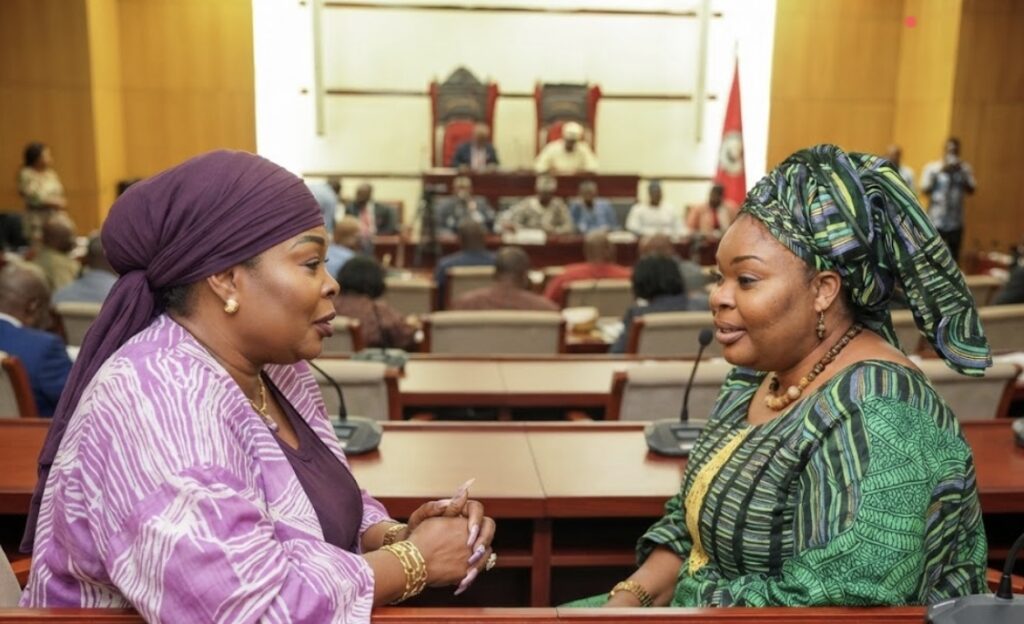
Monrovia, Liberia – Bong County District #6 Representative Moima Briggs-Mensah has pushed back against Nobel Peace Laureate Leymah Gbowee over comments dismissing the use of the title “Honorable” for elected officials. Madam Gbowee had taken to social media following Tuesday’s legislative dialogue with Dr. Robtel Neajai Pailey, expressing frustration with some lawmakers’ conduct.
“What I can’t stand is them introducing themselves, ‘I am Honorable XY’; who give you that name? Who told you that you are honorable?” Ms. Gbowee wrote. “Moving forward we will appreciate you calling the names your parents give you void of honorable. Stop calling those people honorable. Honorable is a title that comes with a lot of responsibilities. It is earned through years of dedicated service with integrity.”
Representative Moima Dabah Briggs-Mensah, who represents Salala Electoral District #6 in Bong County, responded directly to the Nobel laureate’s comments on Thursday, “With due respect, My Noble Laureate, the law confers the title ‘Honorable’ on the office, not on personal opinion,” she said. “We did not name ourselves; the Republic recognizes the office we hold.”
She added: “If an officeholder fails the people, criticize the individual, not the institution. Respect for public offices is essential, even while demanding accountability from those who occupy them. We welcome scrutiny, but not the dismissal of constitutional offices or the respect attached to them.”
The lawmaker concluded: “By the way, my name is not only Moima Dabah Briggs-Mensah, Ellen Fatu Kolley Kromah daughter. I am also: Honorable Moima Dabah Briggs-Mensah, Representative, Salala Electoral District #6, Bong County, Republic of Liberia.”
The exchange followed a legislative dialogue where Dr. Pailey presented findings from her research titled, “Africa’s ‘Negro’ Republics: How Race, Citizenship and Migration Impact Development in Liberia and Sierra Leone.” The session provided lawmakers an opportunity to examine the historical evolution of citizenship laws in Liberia and Sierra Leone, particularly the constitutional provisions commonly referred to as the “Negro clauses,” and their implications for governance, migration, land ownership, and national development.
During her presentation, Dr. Pailey traced the origins of Liberia’s citizenship provisions to the 1847 Constitution, which restricted citizenship to persons of Negro descent. She noted that the provision was subsequently reinforced in the 1973 Aliens and Nationality Law, maintained in the 1986 Constitution, and retained under the 2022 Dual Citizenship Law.
The dialogue didn’t start on a good path as some lawmakers recalled Dr. Pailey’s controversial Independence Day address on July 26, 2024. Some made awkward comments, including, “One rude small lil girl”. In her 2024, oration, she criticized the historical and modern nature of U.S.-Liberia relations, stating “Truth be told, the United States of America has taken more from us than we have received. Liberia is nobody’s stepchild.”
The remarks prompted a walkout by the U.S. delegation led by Chargé d’Affaires Catherine Rodriguez. The U.S. Embassy in Monrovia later released a statement describing her speech as containing “divisive rhetoric and unfounded accusations.”
Dr. Pailey has publicly stood by her comments, stating on national television that she stood by “every word, every sentence, and every paragraph” of her 5,000-word speech and owed no one an apology.
Information Minister Jerolinmek Piah clarified that Dr. Pailey spoke as a private citizen and did not represent the official stance of the Liberian government.
The use of “Honorable” as a courtesy title for elected legislators is a common practice across many democracies. The 1986 Constitution of Liberia uses the formal titles “Senator” and “Representative” when outlining the structure of the National Legislature in Articles 29 and 30.
Both Representative Mensah and Madam Gbowee have been good friends for years.