


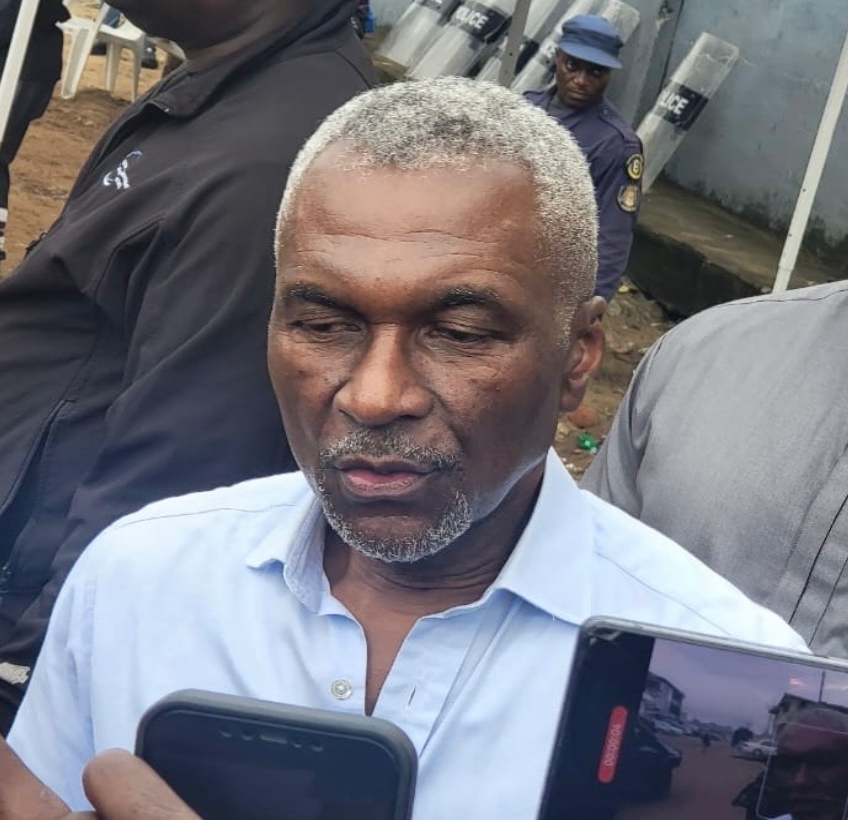
MONROVIA, Liberia — At a time when Liberia is confronting what many consider its most consequential narcotics scandal in recent history, Alternative National Congress (ANC) Political Leader Alexander B. Cummings has thrust himself into the center of a growing national debate over justice, due process, and political accountability.
Cummings on Sunday led a high-profile ANC delegation to the Monrovia Central Prison to visit former Vice President Jewel Howard-Taylor, who remains in pre-trial detention over allegations linking her to a major cocaine trafficking investigation. While presented as a humanitarian and solidarity visit, the symbolism and timing of the gesture have inevitably elevated the case beyond the courtroom and into the political arena.
Howard-Taylor faces multiple criminal charges connected to an ongoing investigation into the seizure of four tonnes of cocaine valued at approximately US$319 million, the largest narcotics interception in Liberia’s history. The scale of the seizure has shocked the nation and intensified concerns that Liberia is increasingly becoming a transit hub for international drug trafficking networks.
Against this backdrop, Cummings’ intervention appears carefully calibrated. On one hand, he stopped short of declaring Howard-Taylor innocent and publicly reaffirmed support for investigations to follow evidence wherever it leads. On the other hand, he openly questioned whether justice is being applied fairly and warned against what he described as selective prosecution.
“The innocent are presumed innocent until proven guilty,” Cummings told reporters after meeting the former Vice President. He further argued that justice must be delivered swiftly and without favoritism, emphasizing that “justice delayed is justice denied.”
His comments strike at the heart of a broader concern increasingly voiced by opposition figures and civil society actors: whether the government’s aggressive handling of the case reflects a genuine commitment to dismantling drug networks or whether political considerations are influencing prosecutorial decisions.
That concern is not entirely without basis. In a case involving one of the country’s most recognizable political figures, public confidence will ultimately depend not only on convictions or acquittals, but also on whether investigators demonstrate a willingness to pursue every individual implicated by evidence, regardless of political affiliation or social status.
At the same time, Cummings’ remarks carry their own political implications. By describing Howard-Taylor as a friend and referring to her affectionately as his “small sister,” he humanized a figure currently facing serious criminal allegations. While supporters may view the visit as a principled defense of constitutional rights, critics could interpret it as an early attempt to shape public perception before the judicial process runs its course.
The ANC leader’s warning that Liberia appears to be drifting toward becoming a “narco-state” is perhaps the most politically damaging aspect of his statement. The accusation directly challenges the effectiveness of the current administration’s security and law enforcement apparatus. If the country’s largest cocaine seizure occurred under the government’s watch, opposition leaders will likely continue using the scandal as evidence of systemic weaknesses in national governance.
Yet the controversy surrounding Howard-Taylor should not obscure a larger reality: the case is bigger than any individual politician. The seizure of narcotics worth hundreds of millions of dollars suggests the possible existence of sophisticated criminal networks with resources, influence, and international connections. Liberians are likely to judge authorities not merely on the fate of a former Vice President, but on whether the investigation exposes the full architecture of the trafficking operation.
In that sense, Cummings’ central argument may resonate with many observers. If the government wishes to demonstrate its seriousness about combating drug trafficking, it must ensure that justice is both swift and even-handed. Selective accountability would undermine the credibility of the entire process, while a thorough and transparent prosecution could strengthen public trust in state institutions.
Ultimately, Cummings’ prison visit was more than a show of solidarity with a former Vice President. It was a political statement, a challenge to the government, and a reminder that in high-profile criminal cases, the court of public opinion often begins deliberating long before the judiciary reaches a verdict. Whether Liberia emerges from this episode with stronger institutions or deeper political divisions may depend on how convincingly authorities prove that justice is being pursued without fear, favor, or political calculation.


