


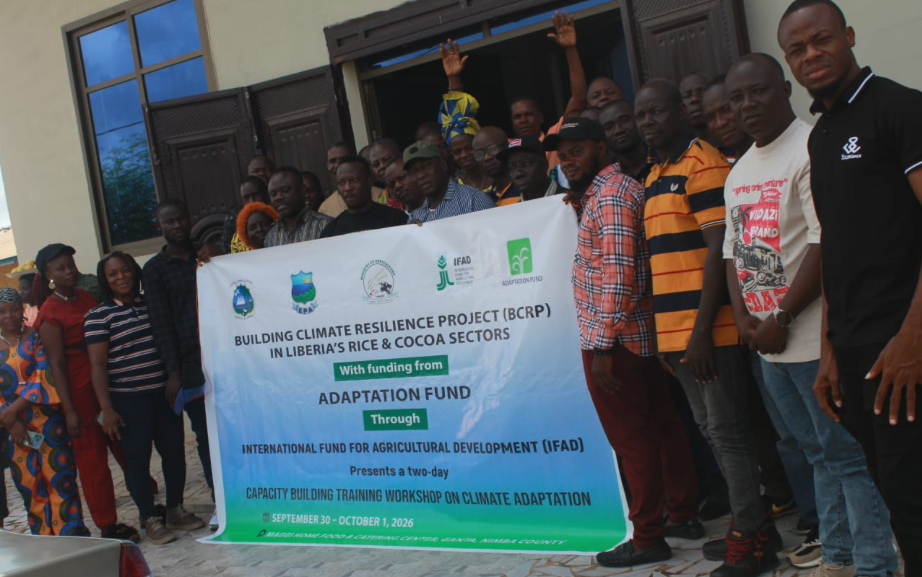
Ganta, Nimba County — The Environmental Protection Agency of Liberia (EPA), in collaboration with the Ministry of Agriculture, Liberia Hydromet Services, Central Agricultural Research Institute (CARI), and the International Fund for Agricultural Development (IFAD), has concluded a two-day capacity-building training aimed at strengthening knowledge and skills in climate adaptation practices and the use of climate information to support climate-resilient agriculture in Liberia.
The training, held from September 30 to October 1, 2026, in Ganta, Nimba County, focused on Climate Adaptation Practices and the Use of Climate Information for Climate-Resilient Agriculture in Liberia.
The initiative is being implemented under the Building Climate Resilience Project (BCRP) in Liberia’s Rice and Cocoa Sectors, with support from the Adaptation Fund through IFAD.
The Ganta training brought together government officials, agricultural experts, technical extension officers, farmers’ representatives, development and implementing partners, civil society organizations, the media, and other stakeholders involved in agriculture and climate resilience.
The training forms part of a broader series of regional capacity-building activities being implemented under the BCRP to strengthen the ability of agricultural stakeholders across Liberia to understand and respond to climate-related risks.
As part of the regional rollout, similar capacity-building trainings were conducted in Saclepea, Nimba County; Zorzor, Lofa County; and Gbarnga, Bong County, bringing the climate resilience initiative closer to agricultural stakeholders in different parts of the country.
The regional trainings provided opportunities for agricultural technicians, extension workers, farmers’ representatives, local authorities, and other stakeholders to examine climate-related challenges affecting agriculture in their respective areas and identify practical adaptation measures.
Together, the regional trainings and the Ganta session are intended to strengthen a network of agricultural actors capable of using climate information, seasonal forecasts, and early warning systems to support better agricultural planning and climate-resilient farming practices.
The approach also supports the BCRP’s broader objective of ensuring that climate adaptation knowledge and tools reach stakeholders beyond national-level institutions and are applied at county and community levels, particularly within Liberia’s rice and cocoa-producing areas.
During the Ganta training, participants were equipped with practical knowledge and tools to strengthen the resilience of Liberia’s agricultural sector against climate-related hazards. The sessions covered climate change and its impacts on agriculture, climate risk assessment, vulnerability of farmers and agricultural systems, Climate-Smart Agriculture (CSA), soil conservation, resilient crop management, seasonal climate forecasts, and early warning systems.
A major focus of the training was the practical use of climate information in agricultural decision-making. Participants examined how climate forecasts and early warning information can help farmers make informed decisions on planting periods, crop and variety selection, farm management, and preparedness for floods, droughts, prolonged dry spells, pests, and diseases.
The sessions also emphasized county-level institutional action planning and stronger coordination among government institutions, agricultural actors, development partners, farmers, civil society organizations, and other stakeholders.
The training followed the four-module curriculum validated during the Phase I Module-Development Workshop held in Kakata, Margibi County, from September 18–19, 2026.
Organizers clarified that although the Ganta training was compressed from the originally planned three-day format to two days, none of the four modules was dropped. The full curriculum was maintained to ensure participants received the key knowledge and skills identified during the module-development process.
The training also included a BCRP technical and Monitoring and Evaluation (M&E) data collection session. Organizers clarified that this project technical/M&E session was separate from, but complementary to, the workshop’s own pre- and post-training assessments. This distinction allowed the project to capture both the effectiveness of the training and the technical information required for BCRP monitoring and evaluation.
Speaking on behalf of EPA Executive Director Dr. Emmanuel K. Urey Yarkpawolo, EPA Project Liaison Officer Desmond T. Thompson said climate change is already having a direct impact on agriculture and farmers’ livelihoods in Liberia.
He cited unpredictable rainfall, changes in the onset of the rainy season, prolonged dry periods, flooding, rising temperatures, soil degradation, and increasing pest and disease pressures as some of the major challenges confronting farmers.
Thompson stressed that climate adaptation in agriculture is not only an environmental concern but also a food security, livelihood, and national development priority.
He said the effective use of climate information can help farmers make better decisions, including when to plant, which crops and varieties to select, and how to prepare for floods, droughts, dry spells, pests, and diseases.
“The knowledge gained from this training should not stay in this room. It should be shared with our farmers, extension services, communities, institutions, and decision-makers so that climate information can support real decisions on the ground,” Thompson said.
He encouraged participants to make the training practical and interactive by sharing their experiences, challenges, and solutions. He also urged them to transfer the knowledge gained to farmers, agricultural extension workers, communities, institutions, and decision-makers in their respective areas.
Representing Nimba County Superintendent Madam Kou Meapeh Gono, County Administrative Officer Hon. Daniel S. Zekpeh welcomed participants to Nimba County and expressed appreciation to the EPA and its partners for bringing the important training to the county.
Zekpeh extended the county administration’s support to participants and encouraged them to take advantage of the training to strengthen their understanding of climate-related challenges affecting agriculture.
Also speaking during the training, Mr. Freeman K. Blackie of CARI welcomed participants and highlighted the importance of strengthening the capacity of agricultural actors to respond to changing climate conditions.
He encouraged participants to pay close attention to the sessions and make good use of the knowledge and lessons shared by the facilitators, emphasizing that the ultimate goal should be to ensure that farmers and agricultural communities benefit from the training.
Ms. Rhoda Cassell, District Agriculture Officer, also welcomed participants and expressed appreciation for their presence. She highlighted the importance of agriculture to communities and encouraged participants to remain focused on the challenges affecting farmers, particularly women and other vulnerable groups within the agricultural sector.
At the conclusion of the training, participants had strengthened their understanding of climate adaptation practices and improved their capacity to assess climate risks and use climate information and early warning systems in agricultural planning and decision-making.
The training also reinforced the importance of institutional coordination and county-level action in translating climate information into practical adaptation measures that can benefit farmers and communities.
The EPA reaffirmed its commitment to working with the Ministry of Agriculture, Liberia Hydromet Services, CARI, IFAD, development partners, farmers, civil society organizations, and other stakeholders to strengthen Liberia’s capacity to adapt to climate change and build a more resilient agricultural sector.
The regional and national-level capacity-building activities are expected to contribute to the broader goal of strengthening climate resilience in Liberia’s rice and cocoa sectors, while ensuring that agricultural actors have the knowledge and practical tools needed to respond to current and emerging climate challenges.