

By Jerromie S. Walters
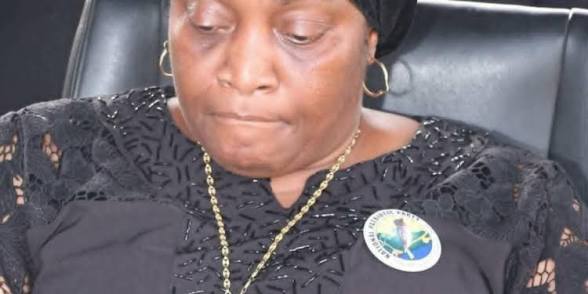
MONROVIA, LIBERIA — Former Vice President Jewel Howard-Taylor has been formally charged with drug trafficking and money laundering, marking the most significant political figure to be implicated in Liberia’s escalating narcotics investigation.
Minister of Justice and Attorney General Cllr. N. Oswald Tweh announced the charges on Wednesday, August 19, 2026, at a news conference at the Ministry of Information.
Howard-Taylor was barred from leaving Liberia early Wednesday morning and is currently undergoing questioning at the Liberia National Police (LNP) Headquarters. Information Minister Jerolinmek Matthew Piah confirmed that joint security forces intercepted the former Vice President at Roberts International Airport while she was preparing to travel to Accra, Ghana, to attend a women’s forum.
The government has officially declared Howard-Taylor a suspect in the ongoing investigation regarding Liberia’s massive cocaine seizures. She entered the LNP headquarters accompanied by her legal counsel, including former Supreme Court Associate Justice Kabineh M. Ja’neh, and Israel Akinsaya, a ranking official of the Congress for Democratic Change (CDC).
The recent development comes amid two massive cocaine seizures that have shaken the nation. In June 2026, authorities intercepted roughly 238 kilograms of cocaine valued at US$19 million hidden inside commercial cargo, including seasoning cubes, at Roberts International Airport.
In July 2026, security forces seized nearly 4 metric tons of cocaine worth approximately US$317 million along the airport highway in Duazon. This operation marked the largest drug bust in Liberia’s history. Law enforcement publicly burned approximately 4.2 metric tons of the recovered cocaine in a dramatic display of the government’s commitment to the anti-drug campaign.
In response to the record-breaking seizures, President Joseph Boakai dismissed approximately 12 government and law enforcement officials, including the airport’s deputy director for operations, the police criminal intelligence chief, and National Security Agency (NSA) deputy directors, for administrative negligence or direct indictment. The President also removed the former Liberia Drug Enforcement Agency (LDEA) heads and nominated retired Major General Daniel Dee Ziankahn, a former Defense Minister and Chief of Staff, as the new Director General of the LDEA to overhaul anti-narcotics enforcement. Indicted individuals and specific lower-level security employees were handed over to the Ministry of Justice for criminal prosecution.
The Kante Connection
Investigators are examining Howard-Taylor’s relationship with Sheik Bassirou Kante, a figure previously arrested by U.S. authorities for money laundering and wire fraud. U.S. investigators discovered emails involving Kante and then-Vice President Howard-Taylor.
Under Liberia’s Controlled Drugs and Substances Act of 2023, drug trafficking and money laundering offenses carry severe penalties. The Act, which amends Chapter 14 of the Liberian Penal Code, classifies the importation, exportation, trafficking, and sale of controlled drugs as first-degree felonies.
According to the Act:
· Unlicensed importation of controlled substances (Section 14.83) is a first-degree felony, carrying a sentence of up to 20 years in prison and, if involving trafficking, is ineligible for bail
· Illicit trafficking (Section 14.93) involving Schedule I and II chemicals is a second-degree felony, with punishment not less than five years consistent with Sections 50.5 and 50.6 of the Penal Law of Liberia
· Unlicensed sale, trading, administration, dispensation, delivery, distribution, dispatch in transit, and transportation (Section 14.85) is a second-degree felony when involving Schedule II, III, and IV substances for trafficking purposes
The Act mandates the forfeiture and sale of assets used in the commission of drug-related offenses, including vehicles, vessels, buildings, and other properties linked to the possession, transportation, or trafficking of controlled substances. Proceeds from the sale of confiscated assets are distributed as follows: 25 percent to drug enforcement agencies, 25 percent to drug prevention and rehabilitation programs, and 50 percent to the government’s general revenue .