


By: Jessica Cox
The Liberian Government is preparing to complete the deployment of 285 heavy-duty road machines across the country, while recruitment continues for operators, mechanics, electricians, data collectors, and other workers needed to operate and monitor the equipment.
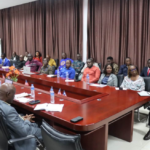
The update was provided Thursday, August 20, during a press briefing at the Ministry of Information by the head of the Special Presidential Coordinating Committee (SPCC) Brownie J Samuai which is coordinating the government’s road equipment project.
According to the official, the government ordered 285 pieces of heavy-duty equipment for road construction and maintenance.
The machines arrived in two batches. The first batch began arriving in February, followed by the second batch between May 4 and June 4.
The equipment is being deployed through road hubs being constructed in counties across Liberia. The hubs are intended to provide locations for housing, repairing, maintaining, and refueling the machines before they are sent to work on roads.
The Armed Forces of Liberia was assigned responsibility for constructing the hubs.
There are expected to be 19 road hubs across Liberia’s 15 counties, with some counties receiving two hubs.
The government began deploying equipment to parts of southeastern Liberia on July 23.
Machines were sent to Grand Gedeh, River Gee and Maryland counties, followed by Grand Bassa on July 26.
The deployment was not completed in all of the counties because some machines require specialized transport equipment and some of the hubs were still being completed.
The government reported that 12 of 15 machines had been deployed to Grand Gedeh, 10 of 15 to River Gee, nine of 15 to Maryland, and 11 of 15 to Grand Bassa at the time of the briefing.
He said the remaining machines are expected to be deployed after the August 24 holiday, with the process expected to continue around August 25 or 26.
Grand Kru is also expected to receive its full allocation as the deployment continues.
The government said deployment will remain linked to the completion of the road hubs, which must be ready to accommodate and maintain the equipment.
Alongside the deployment, recruitment of personnel to operate and support the machines is ongoing.
The official said the recruitment process is about 83 percent complete, with Bong, Nimba and Lofa counties still to be covered.
Recruitment in the three counties is expected to take place after the August 24 holiday, with teams spending about three days in each county.
Available positions include operators for dump trucks, excavators, motor graders, four-wheel loaders and other heavy equipment.
The project will also require mechanics, electricians, tire specialists, data collectors and other technical personnel.
The government estimates that the program could create between 500 and 1,200 jobs once the equipment is fully deployed and operational.
Officials said preference is being given to qualified residents of the counties where the machines will operate.
The government also warned that political recommendations will not qualify an applicant to operate heavy equipment.
The SPCC representative said candidates must have the necessary skills and must pass the required recruitment process.
The government is also putting measures in place to monitor the machines and prevent misuse.
Each county is expected to have a coordinator or assistant coordinator, as well as data collectors responsible for tracking equipment operations, maintenance schedules and the condition of the machines.
Officials said the equipment will also have geospatial tracking capabilities.
Under the system, a machine assigned to one county would not be permitted to operate outside its designated area without authorization.
The government is considering contracting a Liberian company through the Public Procurement and Concessions Commission process to provide the technical services associated with the monitoring system.
The official said several Liberian companies have been approached to compete for the contract.
The government said its policy is to recruit locally wherever qualified personnel are available.
Samukai explained that workers would only be brought in from another county when the required skills cannot be found among qualified applicants in the county where the equipment is assigned.
The initiative is therefore expected not only to improve road maintenance capacity but also to provide employment opportunities for people in the counties where the equipment will operate.
As construction of the road hubs continues, officials said the government expects the remaining equipment to be deployed and the recruitment process completed in the coming weeks.