

By Jessica Cox
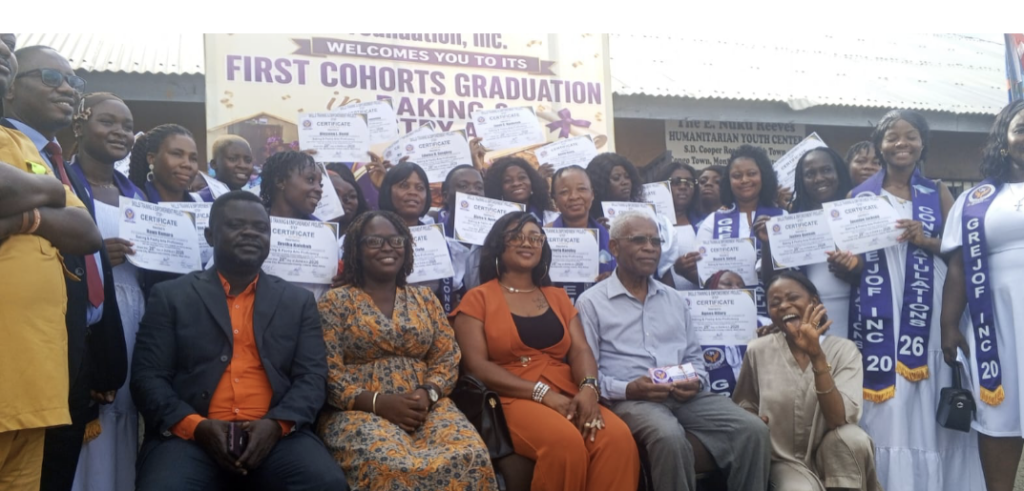
MONROVIA, Liberia – The Geneva Reeves Johnson Foundation Incorporated (GREJOF) has graduated the first cohort of beneficiaries of its tuition free Baking and Pastry Skills Training and Empowerment Program, reaffirming its commitment to equipping young Liberians with practical skills to promote self-reliance, entrepreneurship and national development.
The graduation ceremony formed part of activities marking the foundation’s 11th anniversary and brought together government officials, educators, development partners, community leaders, parents and well-wishers to celebrate the achievements of the graduates and the foundation’s growing impact on youth empowerment.
Speaking during the opening ceremony, members of the Service Management Team described human capital as Liberia’s greatest national resource, stressing that education should fully develop and maximize the potential of every individual.
The team welcomed guests and highlighted GREJOF’s mission of serving vulnerable and disadvantaged people, especially young Liberians, through leadership development, academic and vocational education, mental health awareness, mentorship, scholarships, and the distribution of educational and instructional materials.
“We do not just educate people; we empower them to become professionals, highly skilled individuals and experts capable of transforming their lives and communities,” the foundation said.
According to the foundation, the baking and pastry program forms part of its broader strategy to reduce poverty, unemployment and dependency by providing young people with practical, income-generating skills.
The ceremony also featured exhibitions of products prepared by the graduates, who shared testimonies about how the training had transformed their confidence and inspired them to pursue financial independence.
One graduate told the audience that the skills acquired had given her the confidence to earn her own income rather than depend on others for survival.
Addressing the gathering, Program Director John M. Gray said the Baking and Pastry Skills Training Program was among GREJOF’s key initiatives for 2026 and was offered entirely free of charge.
Gray disclosed that although many participants enrolled in the program, only those who consistently met attendance and performance requirements successfully completed the training.
“Not everyone who started this program is graduating today because we maintained strict standards throughout the training. We monitored attendance and participation to ensure that only committed trainees completed the course,” he explained.
He said participants underwent weeks of intensive practical training, spending several hours each week learning baking techniques, pastry production, food preparation and entrepreneurship.
Gray emphasized that practical skills provide opportunities beyond formal education, noting that graduates can establish their own businesses, support their families or use their skills to finance higher education.
“Our hands can become sources of income. These skills can complement university education or become a direct pathway to employment and entrepreneurship,” he said.
He encouraged the graduates to become ambassadors of the foundation by applying their newly acquired knowledge to improve their communities and create opportunities for others.
The foundation’s Country Director and staff were commended for their dedication to implementing programs that empower young Liberians through education, mentorship and practical skills training.
Delivering the keynote address, guest speaker Neva P. Wesley traced the history of vocational education in Liberia, noting that although missionary schools played a significant role in expanding formal education, practical and technical training received limited attention during the country’s early years.
She recalled that Liberia established its first vocational institution, the Booker Washington Institute (BWI), in 1929 to prepare middle-level technicians to contribute to national development.
According to Wesley, additional vocational training initiatives were introduced in 1977 to address the growing number of secondary school graduates who could not be absorbed by higher education institutions.
However, she observed that Liberia’s civil wars devastated much of the country’s technical and vocational education infrastructure, creating challenges that persist today.
She noted that although more than 60 percent of Liberia’s population is between the ages of 15 and 35, many young people remain trapped in vulnerable informal employment because of limited access to quality Technical and Vocational Education and Training (TVET).
“Today Liberia stands at a crossroads,” Wesley said. “We have a youthful population with enormous potential, yet we continue to face a significant skills gap.”
She praised the Geneva Reeves Johnson Foundation Incorporated (GREJOF) for complementing government efforts by creating opportunities for young people to acquire practical skills that promote entrepreneurship and economic independence.
Wesley also paid tribute to the late Mrs. Geneva Reeves Johnson, describing her as a dedicated classroom teacher who devoted her life to education and community service despite having modest means.
“My grandmother believed education was not a privilege reserved for a few but the birthright of every child,” Wesley said. “She understood that every person deserves the opportunity to learn, grow and thrive regardless of their circumstances.”
She noted that Mrs. Reeves Johnson’s legacy continues through the foundation established by her son, Mr. Emmanuel Nukuweez, whose philanthropic vision focuses on empowering disadvantaged Liberians through education, mentorship, skills development and humanitarian service.
Describing the baking and pastry initiative as more than a vocational course, Wesley said the program represents a pathway to entrepreneurship, dignity and self-reliance.
“This is not simply about baking cakes and bread,” she told the graduates. “It is about creating value with your own hands, building businesses, supporting your families and contributing to national development.”
She encouraged the graduates to maximize the opportunities provided through the program and challenged government and development partners to increase investments in Technical and Vocational Education and Training across Liberia.
“Skills are something no one can ever take away from you,” she said. “Whether you choose employment or entrepreneurship, use these skills to transform your lives and empower others.”
Established in the United States in 2015 and legally registered in Liberia in 2022, the Geneva Reeves Johnson Foundation Incorporated (GREJOF) was founded in honor of the late Mrs. Geneva Reeves Johnson, who died in Georgia, United States, in 2013 following complications associated with Alzheimer’s dementia.
The non-profit organization works to preserve her legacy through programs focusing on education, youth empowerment, mentorship, mental health advocacy, Alzheimer’s dementia awareness, women’s empowerment, poverty alleviation, support to disadvantaged families and community partnerships.
GREJOF currently implements several flagship initiatives, including the Skills Training and Leadership Program, Youth Empowerment and Mentorship Program, Christian Youth Enlightenment Program, Alzheimer’s Dementia Awareness Program and scholarship support for deserving students.
According to the foundation, its vision is to improve lives through charity, practical education, skills development and community partnerships that empower individuals to become productive and responsible citizens.
As the ceremony concluded, graduates pledged to use the knowledge and skills acquired through the program to build sustainable livelihoods, uplift their families and contribute meaningfully to Liberia’s development.
The event ended with practical demonstrations and exhibitions showcasing the graduates’ baking and pastry products, highlighting the impact of skills training as an effective tool for youth empowerment and economic transformation.