

-As Pres. Boakai Steps In Amid Liberians Mixed Views
By Jerromie S. Walters & Sampat JMB Kpakimah
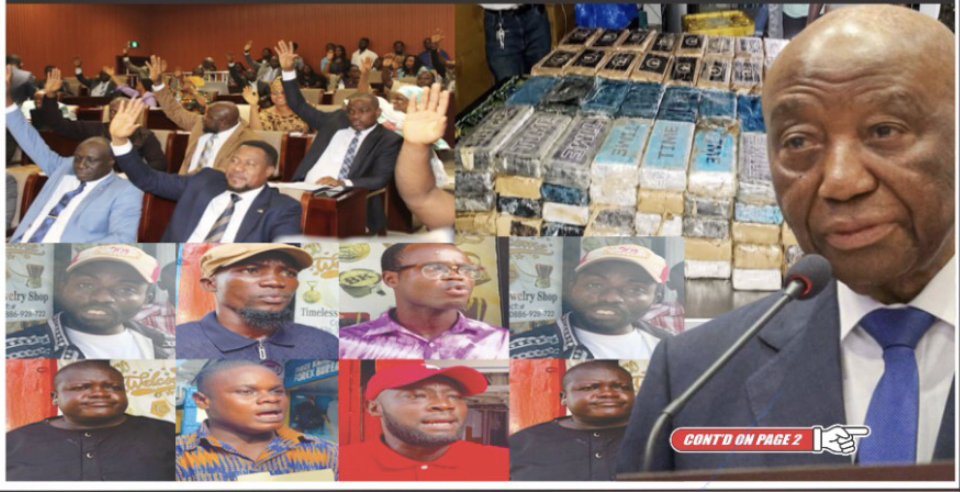
MONROVIA — The House of Representatives has ordered a closed-door security briefing on the ongoing investigation into the $19.2 million cocaine seizure at Roberts International Airport, as public pressure mounts over authorities’ refusal to name six arrested suspects.
The case stems from a June 8, 2026 interception of 198 compressed cocaine plates—weighing approximately 237.6 kilograms—hidden inside six cargo boxes destined for Europe via Brussels Airlines. The Liberia Drug Enforcement Agency (LDEA) announced arrests on June 9 but has withheld all identifying information about the suspects.
On Tuesday, top officials including LDEA Director Fitzgerald Biago and Justice Minister Cllr. N. Oswald Tweh appeared before lawmakers but requested an executive session rather than an open hearing. The House granted their request, despite objections from some members including Bong County District #6 Representative Moima Briggs-Mensah.
After less than an hour behind closed doors, the lawmakers returned to open session and entertained the officials’ presentations, and cross-examination. At the climax, the plenary ordered that the top law enforcement officials appear before its leadership on June 29, 2026, as the case expands beyond Liberia’s borders.
Investigators Link Fugitive to Airport Delivery
Appearing before lawmakers, Liberia Drug Enforcement Agency (LDEA) Officer in Charge Fitzgerald Biago revealed that investigators have elevated the matter to the National Security Council level. He identified one Emmanuel Zeon as the individual responsible for transporting the illicit shipment to Roberts International Airport (RIA).
Biago told the plenary that Mr. Zeon departed the airport shortly after delivering the cargo and remains at large, with law enforcement actively pursuing his arrest. CCTV footage retrieved from the airport has corroborated his movements and confirmed his role in transporting the consignment to the cargo warehouse, he added.
John Buway, Deputy Managing Director of the Liberia Airport Authority (LAA), detailed how airport screeners first detected the suspicious shipment. He explained that anomalies in weight and X-ray imaging prompted immediate action. “For example, you have hair, human hair, in the cargo. The images in the X-ray machine are showing paint,” Buway testified.
“So, it’s sufficient to tell the screeners that we are not satisfied with this, therefore we put it one side. We put that goods one side, that cargo, and inform the authorities. We immediately ask the national security apparatus to investigate. That is where our responsibility stops.” He stressed that the LAA’s regulatory role concluded with notifying national security agencies, who have since taken over the matter.
From his end, Minister of Justice Cllr. N. Oswald Tweh disclosed that the case carries significant transnational dimensions, with connections to organized criminal networks operating across multiple countries.
Cllr. Tweh urged caution in publicly releasing names and sensitive details, arguing that premature disclosure could alert suspects and lead to the destruction or concealment of critical evidence. He further raised alarming questions about the cocaine’s entry into Liberia, noting that the quantity seized for export clearly indicated the narcotics had first crossed into the country—prompting urgent scrutiny of border security vulnerabilities.
Pres. Boakai Steps in
Meanwhile, President Joseph N. Boakai has promised to hunt down and dismantle the criminal network behind a record cocaine seizure at Roberts International Airport, and he has ordered a full joint security investigation into one of the largest drug interdictions in Liberia’s history.
In a Tuesday evening address to the nation, Boakai announced that authorities had seized about 247.6 kilograms of cocaine, with an estimated street value exceeding $19 million. He called the seizure a stark reminder that transnational criminal enterprises continue to view West Africa as a transit corridor for dangerous drugs and illicit proceeds.
“Though I maintain that Liberia is open for business, Liberia is not open for business of drug trafficking,” Boakai said. He stressed that the country would not become a safe haven, transit point, warehouse, financial center, or operational base for any criminal network engaged in narcotic trafficking.
The president made clear that his government will identify, pursue, and bring to justice any individual, group, or network that seeks to exploit Liberian territory, corrupt its institutions, or endanger its youth.
Boakai directed the National Joint Security to conduct the investigation under the authority of the National Security Council. The Liberia Drug Enforcement Agency and the Liberia National Police lead the probe, with support from the National Security Agency, the Executive Protection Service, the Financial Intelligence Agency, the Liberia Immigration Service, customs authorities, airport security, and the Ministry of Justice, along with other security institutions.
The president outlined a two-front investigation. First, authorities will identify, arrest, investigate, and—where evidence warrants—prosecute every individual directly connected to the shipment. Second, they will work to identify and dismantle the entire criminal enterprise behind the operation.
Boakai emphasized that the government does not seek only to intercept drugs or arrest carriers; it is determined to destroy the networks that finance, coordinate, facilitate, and profit from the trade, whether those networks operate within Liberia or beyond its borders. Private citizens, public officials, financial facilitators, and foreign actors found to be involved will face the full force of the law.
The president has also directed Liberia to strengthen cooperation with international partners. The government is now engaging with international law enforcement and security agencies through intelligence sharing, financial tracking, forensic analysis, and coordinated cross-border investigations. A high-level delegation has already departed to engage key international partners and strengthen operational collaboration.
Liberians Express Mixed Reactions
At the same time, Liberians remain sharply divided over the government’s handling of the narcotics seizure, with some demanding immediate disclosure of suspects’ identities while others urge patience as investigators pursue the case. The record-breaking drug bust has ignited public debate across the capital, fueling demands for accountability and raising questions about the extent of official complicity in the nation’s illicit drug trade.
Ruferson Dixe accused authorities of deliberately shielding those responsible, alleging that security officials possess critical evidence they have failed to act upon. “The issue of drugs is a whole cartel, and the government is not serious about fighting drug smuggling,” Dixe said. “If they were serious, they would review the CCTV footage at Roberts International Airport to determine exactly how the drugs entered the facility. They know who is behind it, but they are shielding them.”
He further described the government as an embarrassment to the Liberian people, arguing that such a large quantity of narcotics could not have entered the country without the knowledge of security authorities. “I mean, over US$19 million worth of drugs in the country and nobody knew? This has been happening for a long time,” he added.
Alex Tamba, however, said the focus should be on conducting a thorough investigation rather than rushing to release names. “It is not just about calling names. We have seen situations in previous administrations where names were released but nothing came out of the investigations. What Liberians want are real results,” Tamba said.
Another citizen praised the government’s approach, expressing confidence that the administration would eventually disclose the names of those responsible.
“This government is serious about fighting drugs. We have seen efforts to dismantle ghettos and address drug-related issues. I don’t believe they will hide the names of those involved in such a major case,” he said.
Teah Inegiatus Teah also commended the government, stating that investigators should be allowed to complete their work before names are made public.
“What the public needs is a satisfactory and credible investigation,” Teah said. “This is not unique to Liberia. Around the world, names are sometimes withheld during high-profile investigations. If authorities rush to identify suspects, the real masterminds may escape.”
He added that investigations require time and due process and expressed confidence that the government would eventually provide a fair and transparent conclusion. Lamie Swaray disagreed, arguing that the names of suspects should already be public unless authorities are withholding sensitive information. “Drug trafficking is destroying the country. In previous cases, individuals accused of drug-related offenses had their names and images circulated publicly. Why should this case be treated differently?” he asked.
Another citizen, identified as Slanta, claimed that authorities focus more on drug users than major traffickers. “The names of drug dealers and traffickers should be released,” he said. “The government has publicly named and shamed end users while demolishing ghettos, but now there appears to be hesitation when it comes to those allegedly involved in this major drug case.”
Slanta also questioned why the naming-and-shaming approach used in previous cases was not being applied in the current investigation. Like others, George Diaquae called on the Liberia Drug Enforcement Agency (LDEA) to disclose the identities of those involved. Diaquae claimed he had overheard discussions suggesting that prominent individuals could be linked to the case.
“I heard information indicating that some well-known people may be involved, but I am not here to mention names because it was intelligence discussed during a high-level security meeting,” he said. For his part, Prosperous Varney Fahnbulleh urged Liberians to remain calm and allow investigators sufficient time to complete their work. “The government should not be rushed,” Fahnbulleh said. “Whether it takes six months or even longer, investigators should be allowed to do their job and follow the evidence wherever it leads.”
In January 2024, President Boakai officially declared the drug crisis a national emergency, forming a Multisectoral Steering Committee to lead inter-ministerial efforts. National Anti-Drug Action Plan (2025–2030). Formally launched in late 2025, this five-year, $200,000 initially budgeted framework unifies public health, security, and education initiatives.
The seizure, which occurred on June 8, 2026, involved 198 compressed plates of cocaine weighing approximately 237.6 kilograms concealed in six cargo boxes being processed for export to Europe via Brussels Airlines. The LDEA announced the arrests of six suspects on June 9, 2026, but has not released their names, nationalities, or any identifying information.
Several prominent individuals, including Montserrado County Senator Abraham D. Dillon questioned the agency’s (LDEA) reported withholding of the names of “Persons of Interest” connected to the shipment. “Further, your reported ‘withholding’ of the names of ‘Persons of Interest’.
The LDEA issued a press release on June 13, 2026, acknowledging the heightened public interest surrounding the seizure. “In recognition of the magnitude of the seizure, its potential transnational dimensions, and possible links to organized criminal networks, the National Security Council has elevated the matter to a Joint National Security Investigation,” the agency stated.
The investigation involves the Liberia Drug Enforcement Agency, the Liberia National Police, the National Security Agency, the Executive Protection Service, the Financial Intelligence Agency, the Liberia Immigration Service, Customs Authorities, Airport Security, the Ministry of Justice, and other relevant security institutions. The LDEA addressed growing calls for the immediate publication of suspect names, explaining that operational and evidentiary requirements must take precedence.
Despite the LDEA’s identification of Emmanuel Zeon as the individual who delivered the cocaine shipment to the airport, many Liberians have expressed skepticism about his connection to the product given its substantial value and his appearance. Public speculation continues to circulate on social media platforms, with many questioning whether a low-level courier could be the primary operator behind a US$19.2 million transnational drug trafficking operation.