

-Former Vice President Howard-Taylor Faces Dual Ordeal
By Jerromie S. Walters
MONROVIA, LIBERIA – Former Vice President Jewel Howard-Taylor spent her second consecutive night under armed state security watch Thursday, an experience that is the irony of the usual security protection she has received for more than two decades.
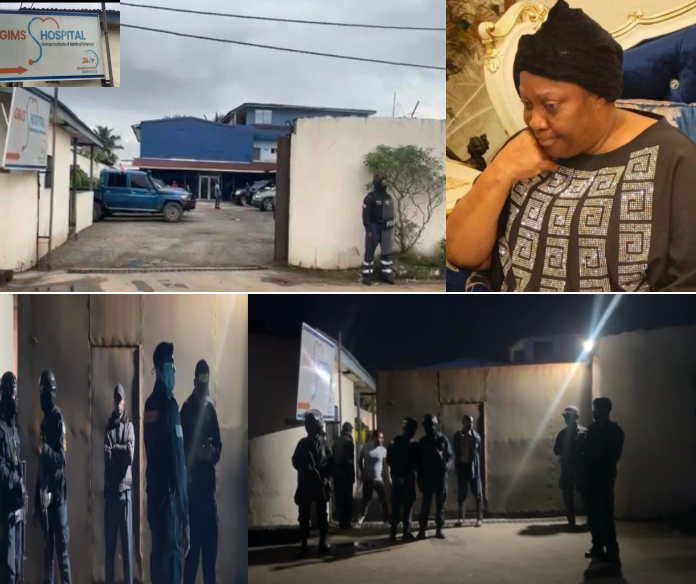
For Thursday night, this psychologically impactful experience was felt in her sickbed, while she had been admitted to a local hospital after suffering a medical emergency during the afternoon hours. This came just a day after she was charged in Liberia’s largest drug bust case.
The 63-year-old former vice president was rushed to the Gomez Institute of Medical Science (GIMS Hospital) in Congo Town on Thursday evening after suffering a medical emergency. State security officials, including Police Inspector General Gregory Coleman and LDEA Director General Daniel Ziankahn, personally escorted her to the facility.
Medical personnel had initially been dispatched to the Liberia National Police Headquarters to attend to Madam Howard-Taylor when her legal team requested urgent care. Doctors are currently treating her for an asthmatic attack and elevated blood pressure.
The former vice president had been scheduled to appear in court Thursday on historic drug trafficking charges, but her deteriorating health condition forced a postponement. The government has stated it remains committed to protecting her constitutional rights throughout the legal proceedings.
The Charges
Howard-Taylor faces seven criminal counts under three separate legal frameworks, making her the highest-profile political figure implicated in Liberia’s escalating narcotics crisis.
Minister of Justice and Attorney General Cllr. N. Oswald Tweh announced the charges Wednesday during a news conference at the Ministry of Information. The case stems from what authorities describe as a transnational drug network that operated in Liberia for years.
Under the Controlled Drug and Substance Act of 2023, the former vice president faces charges including unlicensed importation of a controlled substance, unlicensed sale and transportation, and illicit trafficking. The Penal Law of Liberia adds charges of criminal solicitation, facilitation, and conspiracy.
Additionally, the Anti-Money Laundering and Terrorist Financing Law provides the basis for a money laundering charge against Howard-Taylor. Each count carries significant prison time upon conviction.
Three foreign nationals have been charged in absentia as alleged members of the same narcotics network: Croatian nationals Nikolai Ivancic and Mihovil Vrovac, along with Ukrainian national Tara Zaderieko. The Ministry of Justice has pledged to pursue all lawful domestic and international measures to apprehend them.
The Airport Interception
Howard-Taylor was barred from leaving Liberia early Wednesday morning when joint security forces intercepted her at Roberts International Airport. She had been preparing to travel to Accra, Ghana, to attend a women’s forum.
Information Minister Jerolinmek Matthew Piah confirmed that security forces stopped the former vice president before she could board her flight. She was subsequently taken to Liberia National Police headquarters for questioning under the Joint National Security Investigative Team’s procedures.
Her legal team, including former Supreme Court Associate Justice Kabineh M. Ja’neh and Israel Akinsaya, accompanied her to police headquarters. The presence of such high-profile legal representation underscores the gravity of the case.
The Drug Seizures
The charges emerge from two massive cocaine seizures that have shaken the nation in recent months. In July 2026, authorities intercepted approximately 238 kilograms of cocaine valued at US$319 million along the airport highway in Duazon—the largest drug bust in Liberian history.
Law enforcement publicly burned approximately 4.2 metric tons of the recovered cocaine in a dramatic display of the government’s anti-drug commitment. The three European nationals have been identified as the owners of the seized drugs.
Authorities believe the network operated in Liberia for years before this summer’s headlines. According to investigative sources, the European trio established operations between 2021 and 2022 under President George Weah’s administration, continuing until the end of 2023.
“They suspended their operations and returned to Liberia in 2025,” a source familiar with the investigation told reporters. “At that time, they had established local operators to provide security and protection. In addition to low-level government actors, they also had mid-level non-state actors operating cover businesses.”
The Dubai Connection
Investigators are now tracing how Howard-Taylor became connected to the alleged drug network. According to sources, it was Sheikh Bassirou Kante who introduced the then-vice president to the Croatian-Ukrainian trio in early 2022.
Kante reportedly told Howard-Taylor he knew of investors interested in putting US$250 million into the Liberian economy. She met the group in Dubai later that year and told them they were welcome to invest, according to sources familiar with the encounter.
Howard-Taylor’s office has previously addressed questions about her relationship with Kante. While she explicitly denied ever recommending him for a diplomatic passport, she acknowledged having interacted with him. Her office noted at the time that public officials meet many people and cannot be held responsible for acquaintances’ private conduct.
When asked about the three foreign nationals, Howard-Taylor stated she has no personal relationship with them. She acknowledged only Kante as the link between herself and the alleged drug network.
The Recorded Call
According to investigative sources, Kante recently struck a deal with investigators to have his own name removed from the probe in exchange for evidence directly linking Howard-Taylor to the case.
Wired with a recording device, Kante placed a call to the former vice president, telling her that the same group he had introduced her to in 2022 had sent her a “gift.” That recording formed the basis for her arrest, authorities say.
The reliability of Kante as a witness, however, raises significant questions. He was arrested in Maryland in April 2022 on charges tied to a multimillion-dollar business email scam and money laundering. He separately faced investigation over an unauthorized diplomatic passport found in his possession at the time of his arrest.
Kante pleaded guilty to federal charges later that year and was placed on supervised release. Federal authorities issued a warrant for his arrest after he went unaccounted for on October 23, 2024. The case remains active, with the U.S. Marshals Service still seeking information on his whereabouts.
The fact that a fugitive wanted on an active U.S. federal warrant is now the cooperating source behind the recorded call is likely to become a central point of Howard-Taylor’s defense strategy. Her legal team will almost certainly challenge the credibility and motives of an informant who fled federal supervision.
Observers note that Liberians will need to weigh carefully the reliability of such evidence as the case moves toward trial. The defense will argue that a deal struck with a wanted fugitive cannot form the basis of a credible prosecution against a former vice president.
The Koung Comparisons
The case has drawn inevitable comparisons to allegations against Vice President Jeremiah Koung regarding links to drug dealers. Critics have used two highly publicized scandals to accuse his office of harboring or protecting individuals tied to illicit narcotics networks.
Following the June 8, 2026, seizure of 237.6 kilograms of cocaine, social media channels began circulating photographs of Vice President Koung alongside an individual identified as “Tony” Deinuka. Commentators alleged that the photos proved Deinuka was a long-time business partner and close associate receiving protection from the executive branch.
Vice President Koung and his allies fiercely rejected the claims, clarifying that posing for pictures with citizens is routine for public officials and does not establish criminal complicity. Crucially, the Joint National Security Investigative Task Force publicly confirmed that Deinuka has never been officially named as a suspect or person of interest.
The Payne Incident
A second wave of allegations emerged after a viral video showed a confrontation between LDEA agents and an official named Clifford Payne. Payne was caught on camera attempting to offer a bribe to shut down an active drug investigation.
During the recorded altercation, Payne explicitly identified himself as an official working for the Office of the Vice President, creating a massive public backlash. Critics questioned whether the Vice President’s inner circle was abusing executive power to shield drug dealers.
The administration quickly moved to handle the fallout, clarifying that Payne was actually the Deputy Public Relations Director for the Group of 77, a government humanitarian agency. Vice President Koung immediately distanced himself, ordered Payne’s suspension, and handed him over to face non-bailable bribery and intimidation charges.
Koung issued a public ultimatum: “Anyone connected to me by whatsoever means, whether by blood, by marriage, by employment, or by friendship, who engages in drug-related activities will face the full weight of the law.” However, many ponder as to why the Jewel’s precedent did not apply in the Koung case.
Government Overhaul
In response to the record-breaking seizures and growing public concern, President Joseph Boakai has taken dramatic action against government officials. Approximately 12 government and law enforcement officials were dismissed, including the airport’s deputy director for operations, the police criminal intelligence chief, and National Security Agency deputy directors.
The president cited administrative negligence and direct indictment concerns. He also removed the former Liberia Drug Enforcement Agency heads and nominated retired Major General Daniel Dee Ziankahn, a former Defense Minister and Chief of Staff, as the new LDEA Director General.
Indicted individuals and lower-level security employees have been referred to the Ministry of Justice for criminal prosecution. The sweeping dismissals signal the administration’s determination to root out corruption and negligence in the fight against drug trafficking.
Penalties Under the Law
Under Liberia’s Controlled Drugs and Substances Act of 2023, which amends Chapter 14 of the Liberian Penal Code, the penalties for drug-related offenses are severe. Unlicensed importation carries a first-degree felony penalty of up to 20 years in prison and is ineligible for bail when involving trafficking.
Illicit trafficking involving Schedule I and II chemicals is a second-degree felony with punishment of no less than five years. Unlicensed sale and transportation involving Schedule II, III, and IV substances for trafficking purposes likewise constitutes a second-degree felony.
The Act also mandates the forfeiture and sale of assets used in drug-related offenses, including vehicles, vessels, and properties. Proceeds are distributed with 25 percent going to drug enforcement agencies, 25 percent to prevention and rehabilitation programs, and 50 percent to government general revenue.
Howard-Taylor’s hospitalization has introduced unexpected complications to the legal proceedings. While the government maintains that the charges remain allegations and she is presumed innocent until proven guilty, her health crisis has effectively delayed the judicial process. State security personnel remain present at GIMS Hospital, maintaining their watch over the former vice president as she receives treatment.