



Research article
First published online September 29, 2026
When Scientific Validity Overshadows Justice: An Analysis of a Liberian Institutional Review Board’s Minutes (2018–2019) Using the Emanuel et al. Framework
Sienneh Zezay Tamba https://orcid.org/0009-0009-8164-8274 sienneht@gmail.com, Marlyn Faure, and HeidiMatisonn https://orcid.org/0000-0002-9765-4654
Abstract
Post-Ebola Liberia experienced rapid growth in internationally sponsored health research, increasing demands on institutional review boards (IRBs) amid constrained oversight capacity. This qualitative single-case study analyzed meeting minutes from 2018–2019 from one Liberian IRB, coding 124 documented ethical concerns using Emanuel et al.’s eight-principle framework.
Scientific validity accounted for nearly half of concerns, while fair participant selection and informed consent formed a second tier, and collaborative partnership and social value were rarely mentioned. These findings suggest that concerns tied to study design, risk-benefit assessment, and consent are raised more frequently than concerns that explicitly address partnership and social value.
We interpret this pattern as a profile of documented deficiencies rather than a hierarchy of the committee’s ethical commitments, since minutes capture objections and requests for change. The results highlight opportunities to strengthen attention to collaborative partnership, social value, and equity-oriented capacity-building in IRB procedures, and training in Liberia and aid-dependent settings.
Introduction
In the years following the Ebola epidemic, Liberia has seen a rapid expansion of health research, much of it sponsored by international partners, placing growing demands on national IRBs (Kennedy et al., 2022; Massaquoi et al., 2016). These boards are expected to ensure that protocols are scientifically sound, socially valuable, collaboratively designed, and respectful of participants and study communities.
In structurally unequal, aid-dependent settings like Liberia, commentators argue that ethical oversight should address individual-level harms and how research agendas, resources, and benefits are distributed between international and local actors (Bhakuni & Abimbola, 2021; London, 2005; Nurmi et al., 2017).
Existing empirical work suggests that, in many African IRBs, documented deliberations tend to foreground concerns about scientific validity and informed consent that are operationalized through questions about study design, sampling, and documentation, while concerns about collaborative partnerships, social value, and benefit-sharing appear less frequently or remain procedurally framed (Kass et al., 2007; Nurmi et al., 2017; Silaigwana & Wassenaar, 2019; Tsoka-Gwegweni & Wassenaar, 2014).
However, little is known about how fairness-related concerns such as partnership and social value are documented in the routine work of IRBs in post-crisis, aid-dependent settings such as Liberia, where external funders and institutions play a prominent role in shaping research agendas. This gap makes it difficult to assess whether IRB practice, as captured in the written record, aligns with justice-oriented expectations that emphasize partnership, local priority-setting, and durable social value.
Emanuel et al.’s (2008) eight-ethical-principle framework is a widely used synthesis of major international research-ethics guidance, developed to organize and clarify the conditions of ethically acceptable research rather than to introduce a hierarchy between different types of principles. It lists collaborative partnership, social value, scientific validity, fair participant selection, a favorable risk-benefit ratio, independent review, informed consent, and respect for recruited participants and study communities as core requirements.
Although dominant international research-ethics frameworks often reflect Northern institutional perspectives and under-specify how questions of justice should be operationalized in practice, particularly in structurally unequal global health settings (Bhakuni & Abimbola, 2021; London, 2005; Nurmi et al., 2017), justice-oriented and decolonial approaches, along with guidance such as CIOMS and the Nuffield Council on Bioethics, place stronger emphasis on partnership and social value (CIOMS, 2016; Nuffield Council on Bioethics, 2020).
Despite these critiques, Emanuel et al.’s framework remains practically tractable and has been applied in empirical studies of African IRBs, allowing cautious comparison across settings and making visible which principles are foregrounded, backgrounded, or absent in committee documentation (Nurmi et al., 2017; Silaigwana & Wassenaar, 2019; Tsoka-Gwegweni & Wassenaar, 2014).
Research ethics committees’ ability to fulfill their responsibilities depends not only on their formal mandates on composition but also on how effectively they can identify and articulate ethical concerns in specific research protocols. One way to gauge this is to examine the ethical concerns they record in minutes and stipulations sent back to investigators. In Liberia, however, there has been no prior empirical evaluation of how an IRB’s written feedback reflects attention to different ethical concerns, particularly fairness-related concerns such as partnership and social value.
Against this backdrop, this study uses the framework as a structured analytical lens to examine how a Liberian IRB documented ethical concerns in its 2018–2019 meeting minutes. It asks four linked questions: what ethical concerns are raised during protocol review; whether these concerns display an observable pattern across the eight principles; to what extent the concerns are consistent with the framework expectations; and whether any principle, such as scientific validity, appears to dominate.
By mapping the pattern of concerns in the written record, the study provides an indirect assessment of which ethical concerns are most salient in research ethics committee practice and where knowledge or training gaps may exist. By focusing on a post-crisis, aid-dependent setting, the study addresses the empirical gap noted above. It offers empirically grounded insight into how principles that are operationalized through questions about design, sampling, risk-benefit assessment, and consent are balanced against those that emphasize collaborative partnership, social value, and the distribution of research benefits in the documented practice of ethics oversight in Liberia.
Methods
This study employed an embedded single-case design, as described by Yin (2018), with the case defined as a local Liberian institutional review board (IRB), that is, a research ethics committee, and the embedded units as individual research protocols discussed at each meeting between January 2018 and December 2019. The 2018–2019 period was selected because it represents the first continuous two-year span of routine post-Ebola operations for which the IRB’s minutes were fully archived in a consistent electronic format and documented using a stable agenda and minute-taking template, allowing systematic analysis across meetings.
The single-site design was chosen to generate analytically transferable insight into how one IRB operating in a post-Ebola, resource-limited, aid-dependent context conducts ethics oversight, rather than to produce statistically generalizable findings across all Liberian or West African research ethics committees. The focal IRB, a multidisciplinary Board hosted by a Liberian research institution, oversees human-subject research across several domains, including a substantial volume of health-related studies, within a national ethics system that has been strengthened post-Ebola but still faces resource constraints and evolving mandates (Franklin, 2021; Kennedy et al., 2022).
The data source comprised formal IRB meeting minutes archived by the board secretariat. These regulatory records summarize protocols reviewed, ethical concerns raised, and decisions or requested modifications at each sitting, consistent with national guidance on IRB documentation and prior empirical studies of IRB deliberations (Trace & Kolstoe, 2017). Entries followed a consistent structure across meetings, suggesting the use of a standard agenda or template, and were expected to emphasize protocol-specific decisions and requested changes rather than the full texture of discussion.
All archived minutes from January 2018 to December 2019 were reviewed. Minutes were eligible for inclusion if they documented at least one protocol-related segment in which members raised, debated, or requested changes on ethical grounds. Within this frame, every meeting in the two-year period that contained at least one ethical discussion was included, rather than a purposive subsample (Gentles et al., 2015). All protocols that generated protocol-specific entries in the minutes were therefore included; none were excluded based on topic, sponsor, or review pathway.
17 protocols met the inclusion criteria. The protocols addressed national-level health issues, including health behavior, reproductive health, health systems governance, and infectious disease prevention. Four protocols (24%) referenced international partners through foreign institutional review board approvals or institutional affiliations, but systematic documentation of funding sources, investigators’ nationalities, or team composition was rare.
14 protocols (82%) involved primary data collection, while three relied exclusively on secondary data; most were observational social science or public health studies, with a smaller subset of interventional or clinical evaluations. Table 1presents descriptive characteristics of each protocol (topic area, primary/secondary data, and broad design category), allowing readers to consider how study complexity may have shaped the volume and granularity of queries about scientific validity (Council for International Organizations of Medical Sciences, 2016; Tripathy, 2013).
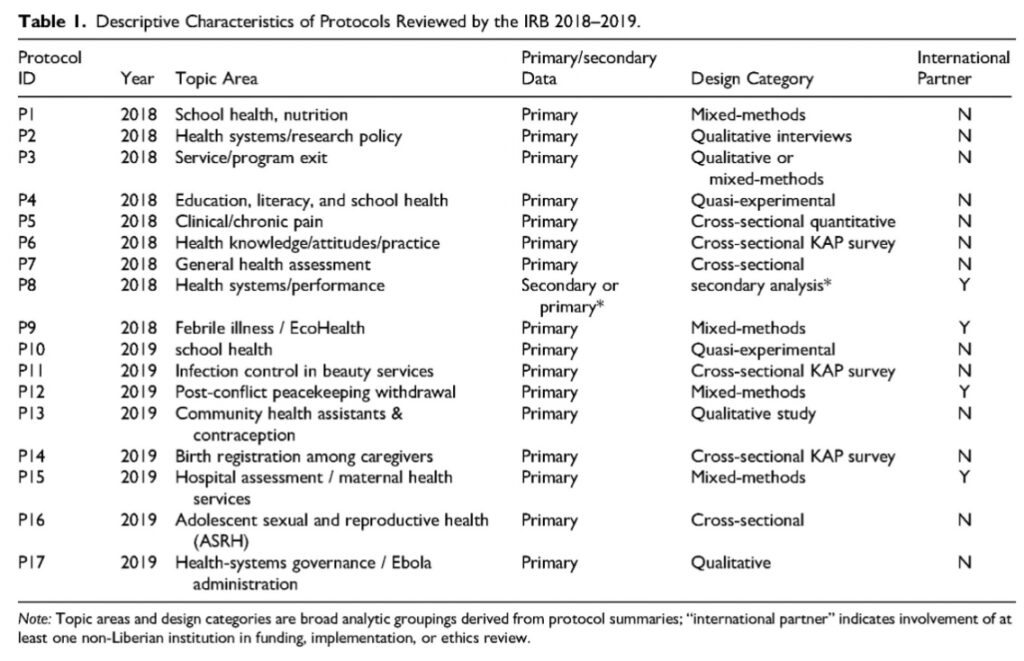
A directed content analysis was conducted, following the approach described by Hsieh and Shannon (2005), using Emanuel, Wendler, and colleagues’ eight-ethical principle framework as the primary analytic lens (Emanuel et al., 2008). The framework distinguishes collaborative partnership, social value, scientific validity, fair participant selection, favorable risk-benefit ratio, independent review, informed consent, and respect for recruited participants and study communities, and links each principle to concrete oversight questions frequently raised in IRB deliberations (Emanuel et al., 2008; Nurmi et al., 2017).
It was selected because it brings together principles that are often operationalized through questions about study design, risk-benefit assessment, and consent with principles that direct attention more explicitly to partnership, social value, and community interests, has been applied in empirical work on African IRBs, and supports comparison of the Liberia IRB’s minutes within a broader research-ethics literature (Nurmi et al., 2017; Silaigwana & Wassenaar, 2019; Trace & Kolstoe, 2017; Tsoka-Gwegweni & Wassenaar, 2014).
In interpreting the pattern of concerns, principles such as collaborative partnership and social value are treated as addressing fairness, benefit-sharing, and local agenda-setting more directly, while principles such as scientific validity, risk-benefit ratio, and informed consent are understood as governing the conditions under which research can justifiably proceed; this distinction is a heuristic for interpreting the data rather than an intrinsic division within Emanuel et al.’s framework, which synthesizes existing research ethics guidance and treats all eight principles as ethical requirements (CIOMS, 2016; Emanuel et al., 2008).
Using a primarily deductive approach, an initial codebook was developed with eight primary codes corresponding to Emanuel et al.’s principles, each linked to operational indicators drawn from the original framework and from empirical applications in African and European IRBs (Emanuel et al., 2008; Trace & Kolstoe, 2017; Tsoka-Gwegweni & Wassenaar, 2014). Each set of minutes was read in full to identify discrete ethical concerns, defined as any comment, question, or requested modification that explicitly or implicitly appealed to participant protection, fairness, community impact, regulatory obligations, or the social value of the research.
A single “discrete concern” was treated as a self-contained issue that prompted the IRB to request clarification, revision, or justification on a specific ethical point. When a concern clearly engaged multiple principles (for example, a design issue with implications for both scientific validity and risk-benefit ratio), it was counted once as a unit of analysis but assigned multiple principle codes.
Concerns were coded to one or more of the eight principles using the codebook definitions. When a concern did not fit any principle (for example, purely logistical matters or procedural clarifications without ethical content), it was allocated to an “administrative/other” category to preserve transparency about the framework’s limits (Nurmi et al., 2017; Trace & Kolstoe, 2017).
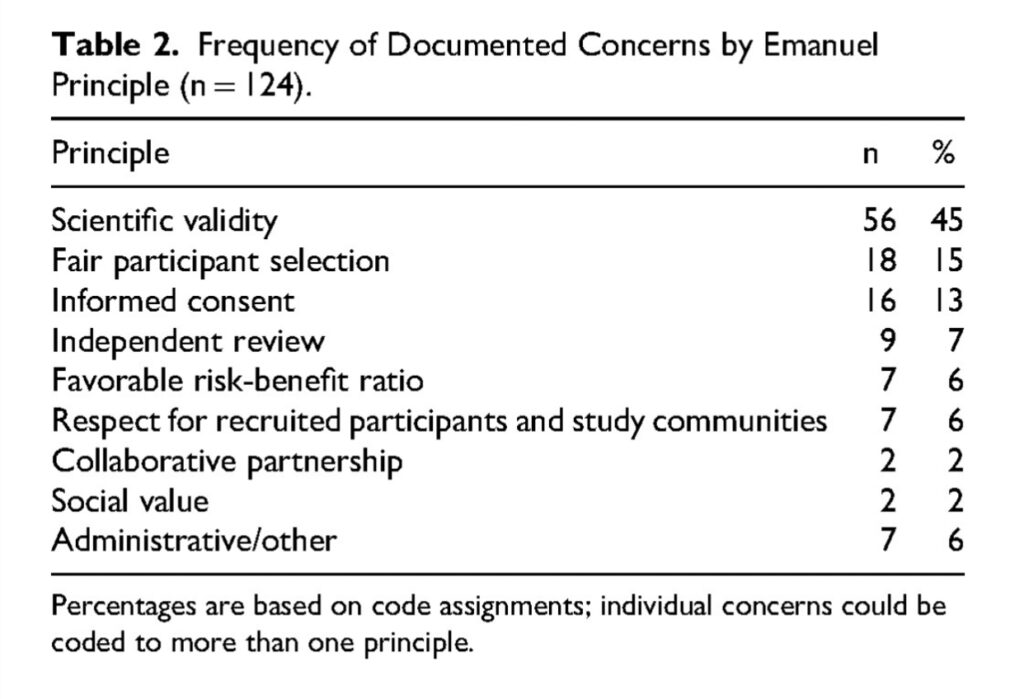
To reduce the risk that procedurally framed but substantively ethical issues were misclassified as administrative, all “administrative/other” entries were re-examined, and items implying questions about collaborative partnership or social value (for example, missing CVs of investigators, repeated requests for a Liberian co-investigator, or requirements to report back to local stakeholders) were re-coded under the relevant substantive principles. Frequency in Table 2represents the number of code assignments to each principle, not mutually exclusive categories of concern, and was used descriptively to summarize the distribution of concerns across principles and meetings.
To enhance dependability, the full dataset of 24 sets of minutes (124 coded concerns) was first coded by the lead analyst and then independently reviewed line by a second analyst familiar with Emanuel’s framework and empirical bioethics.
No formal inter-rater reliability coefficient was calculated; the frequencies should therefore be interpreted as the product of a carefully negotiated consensus process. To enhance the trustworthiness of the analysis, we used an explicit codebook, iterative consensus coding, and re-examination of borderline cases, focusing on dependability and confirmability rather than statistical generalization, in line with Lincoln and Guba’s criteria for naturalistic inquiry (Lincoln & Guba, 1988).
Ethical approval for this study was obtained from both a South African biomedical research ethics committee and a LiberianIRB. Approval reference numbers are withheld to preserve the anonymity of the IRB, and no new data collection or direct contact with individuals was undertaken.
Results
Overall, the IRB documented 124 discrete concerns in its formal minutes across 24 meetings for 17 protocols. Of these, 117 (94%) mapped to one or more of Emanuel et al.’s eight principles, and 7 (6%) were classified as administrative or other issues, consisting of procedural issues such as incomplete forms, missing signatures, or mislabeled IRB names. No ethical concerns fell entirely outside Emanuel et al.’s framework. Scientific validity clearly dominated, accounting for 56 concerns (45%); fair participant selection for 18 (15%); informed consent for 16 (13%); independent review for 9 (7%); favorable risk-benefit ratio for 7 (6%); and respect for recruited participants and study communities for 7 (6%).
Collaborative partnership and social value each appeared in only two concerns (2% each), and seven concerns (6%) related to administrative or other procedural issues. Table 2 summarizes the distribution of documented concerns by principle.
To illustrate how ethical concerns appeared in the IRB’s written record, anonymized excerpts from the minutes are presented for selected principles.
For scientific validity, concerns focused on design and sample size:
“You have suggested to have a sample of 15–25 subjects interviewed. Please explain to this IRB how this sample size will be spread across the selected organizations and institutions from which you intend to select them?” [coded: scientific validity]
“Describe Table 3.1 fully. For example, what does O4, X, etc. mean?” [coded: Scientific validity]
For fair participant selection, the IRB questioned geographic coverage and inclusion:
“Why did you choose 3 counties (Bong, Nimba, and Grand Gedeh) out of 15 counties for this study?” [coded: Fair participant selection]
For informed consent, concerns emphasized content and participant rights:
“The consent/assent script is not indicative as to, for example, participants’ confidentiality, voluntary participation, right to withdraw at any time from the study, etc.” [coded: Informed consent]
By contrast, collaborative partnership concerns appeared rarely and focused narrowly on the presence of a local investigator:
“Do you have a Liberian PI or Co-Investigator collaborating on this study? It is important that you have one. Please send us the CV of that person.” [Coded: Collaborative partnership]
Similarly, social value concerns were infrequently documented:
“Have you written any report on those components of the study that are completed…? If so, you are required to share them with the IRB.” [Coded: Social value]
Discussion
The pattern of ethical concerns documented by the Liberian IRB reveals a marked imbalance between concerns focused on study design, participant selection, and consent, and concerns focused on collaborative partnership and social value. Scientific validity accounted for nearly half of all recorded ethical concerns, fair participant selection and informed consent formed a second tier of attention, and collaborative partnership and social value were seldom mentioned explicitly in the minutes. This should not be taken to imply that scientific validity is merely a “technical” matter, since flawed science may expose participants to inconvenience, risk, or harm without generating socially or personally valuable knowledge, while also producing misleading findings that can adversely affect policy, practice, and communities. Because minutes primarily capture objections and requests for change, rather than the fully deliberative process, this distribution is best interpreted as a profile of documented deficiencies in submitted protocols rather than a definitive ranking of the board’s ethical priorities.
The prominence of scientific-validity concerns likely reflects both the board’s focus and the types of studies under review. Several protocols involved relatively complex designs, for which multiple, itemized comments on design, sampling, and analysis would be expected in any competent IRB, and the emphasis on validity is consistent with frameworks that treat unsound research as ethically unacceptable (CIOMS, 2016; Emanuel et al., 2008). The low frequency of collaborative-partnership comments partly reflects the small number of explicitly international collaborations in the sample, as only four of the seventeen protocols referenced foreign institutional partners, limiting opportunities to raise concerns about cross-institutional role clarity or benefit-sharing.
At the same time, justice-oriented accounts of international research argue that partnership and social value are crucial in structurally unequal, aid-dependent settings, where external sponsors may shape agendas and retain disproportionate benefits (Bhakuni & Abimbola, 2021; London, 2005; Nurmi et al., 2017). Against this backdrop, the relative scarcity of explicitly documented partnership concerns and, more strikingly, the very small number of comments coded to social value raise questions about how prominently these principles feature in the board’s recorded oversight, even while recognizing that some such partnership and social value- related issues may have been discussed without generating recorded stipulations. Similar dominance of scientific validity and informed consent has been reported in South African IRBs, albeit in a more resourced research ethics system, suggesting that attention to methodological issues may be a broader regional pattern that interacts with local institutional histories and capacities (Silaigwana & Wassenaar, 2019; Tsoka-Gwegweni & Wassenaar, 2014).
Under conditions of shrinking and more volatile external funding, these partnerships and social-value elements also function as protective mechanisms. They provide a locus for IRB questions about exit strategies, transition plans, and realistic local benefits if donors withdraw or downsize support mid-course (Molaro et al., 2025; Organization for Economic Co-operation and Development assistance, 2025; P4H Network, 2025). In the Liberian minutes, however, such issues appeared only rarely and usually implicitly, suggesting that either protocols themselves contained limited information on these elements or that IRB questions about partnership and long-term benefit were not systematically recorded in the formal written record. The near absence of such considerations in the Liberian IRB’s minutes, therefore, signals an underdeveloped ethical domain and a missed opportunity to use board review as a forum for negotiating fairer terms of collaboration and more secure social value in a period of global retrenchment.
Liberia’s heavy reliance on externally driven studies and the lack of explicit partnership and social-value prompts in IRB forms and guidance likely contribute to this pattern: in the absence of clear mandates or tools, IRB members are left to focus mainly on scientific soundness, assessment, and autonomy, where expectations are clearer, and decisions are more time-efficient (Bain et al., 2018; Kennedy et al., 2022). Explicitly requiring protocols to include partnership, capacity-building, and social-value plans, echoing Emanuel’s benchmarks for research in low-resource settings and CIOMS guidance, would provide a concrete locus for IRB questions and could gradually normalize more substantive consideration of collaboration and benefit during review (CIOMS, 2016; Emanuel et al., 2008; Ward et al., 2018). This pattern highlights how structural dependence on external sponsors can narrow the practical remit of ethics oversight to questions of study design, risk-benefit assessment, and consent unless institutions deliberately equipped IRBs to ask and record more demanding questions about partnership, capacity-building, and social value.
The findings speak directly to ongoing debates about how ethical frameworks are operationalized, especially in structurally unequal global health settings. They empirically support the concern that Emanuel et al.’s framework, while conceptually comprehensive, is applied unevenly in IRB deliberations, with concerns tied to study design, risk-benefit assessment, and consent carrying more practical weight in the written records than concerns tied explicitly to partnership and social value (Nurmi et al., 2017). In this case, the principles of collaborative partnership and social value are not absent from policy documents, but they are largely invisible in the formal record of oversight, even as highly detailed scrutiny is routinely applied to design and consent (CIOMS, 2016; Emanuel et al., 2008).
In an aid-dependent, post-Ebola research environment, this imbalance is not merely a tec of emphasis; it risks normalizing a model of “ethically acceptable” research in which scientific rigor and individual protection are necessary and sufficient, while questions about who sets agendas, who builds capacity, and who benefits remain peripheral or implicit (Bhakuni & Abimbola, 2021; London, 2005; Nuffield Council on Bioethics, 2020). When partnership and social value are weakly specified in templates and rarely documented in minutes, IRBs lose a key lever for querying unequal terms of collaboration and for insisting on legacy benefits in a context of volatile and declining external funding (Molaro et al., 2025; Organization for Economic Co-operation and Development assistance, 2025; P4H Network, 2025).
The Liberian case, therefore, illustrates how explicit attention to fairness-oriented principles, such as partnership and social value, can be less visible in written record than attention to issues of study design, risk-benefit assessment, and consent, even within systems that formally endorse all these principles.
For policy and practice, the central implication is that rebalancing IRB oversight requires changing the tools and routines through which principles are enacted, not simply resetting principles in guidelines. Embedding concrete prompts on partnership, capacity-building, and social value into application forms and minutes, and training members to use those prompts to frame explicit, recorded questions, would begin to shift concerns about partnership and social value from aspirational background ideals to visible criteria of review (Emanuel et al., 2008; Lavery & Ijsselmuiden, 2018; Ward et al., 2018). In this sense, the pattern documented in the Liberian IRB’s minutes is both a diagnostic of current practice and a roadmap for how IRBs in similar settings can move toward more substantively just oversight while maintaining rigorous attention to scientific validity (Ferguson et al., 2025; Nyika et al., 2009; Ward et al., 2018).
Limitations of the Study
Several limitations should be noted. The analysis is based on formal minutes from a single IRB over two years period and may not capture the full texture of deliberations, including exploratory or politically sensitive discussions that were not recorded. The submitted protocols were not examined, so the relative frequency of comments under each principle reflects both the board’s priorities and deficiencies in submitted applications. Minutes primarily capture objections and requested changes, and the unit of analysis was the discrete concern, so issues related to study design, sampling, and consent that generate multiple itemized instructions may produce more coded units than broader, principle-level comments about partnership or social value. The use of a directed content analysis guided by Emanuel et al.’s framework channels attention through its categories and may miss concerns that fall outside the eight principles (Hsieh & Shannon, 2005; Nurmi et al., 2017). Only four protocols involved explicit international partners, limiting inferences about partnership oversight in cross-institutional collaborations and making it difficult to generalize to other IRBs or time periods, including the post-COVID research environment (Silaigwana & Wassenaar, 2019; Tsoka-Gwegweni & Wassenaar, 2014).
Recommendations
Best Practices
Simple adjustments to IRB application forms and minutes templates, including brief prompts on local agenda-setting, capacity-building plans, and benefit-sharing, could make fairness-oriented concerns more visible in both deliberation and documentation. Building on the institutional tools proposed by Lavery and Ijsselmuiden (2018) and Ward et al. (2018) work on “good collaborative practice,” IRBs might also assign a designated rotating member to lead discussion on partnership, social value, and long-term institutional gains alongside methodological scrutiny, and to periodically review anonymized minutes as a low-cost internal audit tool to identify neglected concerns and training needs.
Research Agenda
Future research on IRB practice in aid-dependent settings should include multi-site comparative studies across IRBs in Liberia and other West African countries to examine whether the strong emphasis on scientific validity and limited documentation of partnership and social value is widespread or context-specific. A mixed-method design that combines analysis of minutes with observations and interviews, as recommended by Gentles et al. (2015) and Nurmi et al. (2017), would help reveal informal reasoning, power dynamics, and unrecorded concerns, particularly around equity and collaboration. Implementation studies could then test whether specific changes to forms, templates, or review procedures, such as explicit partnership and social-value prompts, change the kinds of concerns that are documented over time.
Educational Implication
The documented pattern of concern has implications for ethical education. In line with Nurmi et al. (2017) and Ward et al. (2018), training for IRB members in Liberia and similar settings should prioritize skills in recognizing, articulating, and recording collaborative partnership and social value issues during protocol review, rather than focusing predominantly on methodological topics. Case-based exercises using anonymized protocols and minutes, together with guidance from CIOMS (2016) and tools such as the Research Fairness Initiative, can support IRB members and Investigators to integrate concerns about partnership, capacity building, and social value into proposal development and review more systematically.
Conclusion
This analysis of a Liberian IRB’s minutes in a post-Ebola, resource-constrained context shows that scientific validity dominates the recorded ethical concerns, with fair participant selection and informed consent also receiving substantial attention, while collaborative partnership and social value appear only rarely in the written record. Emanuel et al.’s eight-principle framework captured the vast majority of these documented concerns, but its relatively abstract treatment of partnership and social value, combined with existing templates and routines, may contribute to their sparse appearance in the coded data (CIOMS, 2016; Emanuel et al., 2008; Nurmi et al., 2017).
For IRBs in similar aid-dependent settings, the findings highlight the need to complement rigorous attention to scientific validity with more explicit procedures, templates, and training that foreground collaborative partnership, social value, and the interests of study communities (CIOMS, 2016; Nuffield Council on Bioethics, 2020). Modest but targeted reforms, such as adding structured questions on partnership, capacity, governance, authorship, data stewardship, and benefit-sharing to application and minute-taking tools, would help move oversight closer to the balanced vision of principles that address both study design, risk-benefit assessment, and consent, and fairness-related concerns such as partnership, capacity-building, and social value articulated in contemporary guidance (Emanuel et al., 2008; Lavery & Ijsselmuiden, 2018; Ward et al., 2018).
Without such changes, ethics review in post-crisis, aid-dependent settings may continue to foreground issues of study design, risk-benefit assessment, and consent while leaving partnership and social-value considerations under-documented and under-scrutinized. Whether this documentation gap translates into structurally inequitable research outcomes is an important question for future empirical work, particularly in contexts like post-Ebola Liberia, where research expansion is expected to contribute to more resilient and less dependent health and research systems. Overall, the pattern observed in this Liberian IRB’s minutes illustrates how globally endorsed commitments to partnership, capacity-building, and social value can remain largely aspirational in practice unless IRBs are explicitly equipped and required to surface them in the written record.
Acknowledgments
We are indebted to the leadership, members, and secretariat staff of the participating Liberian Institutional Review Board whose archived minutes formed the basis of this analysis. We particularly acknowledge Mr. Kokulo Franklin, who reviewed the manuscript and offered constructive guidance that helped to refine the presentation of the document. The views expressed in this manuscript are those of the authors and do not necessarily reflect those of the IRB or host institution.
Ethical Considerations
This study involved secondary analysis of de-identified Institutional Review Board (IRB) meeting minutes and did not involve direct contact with human participants. Ethical approval for the study was obtained from the University of KwaZulu-Natal (UKZN) Biomedical Research Ethics Committee(BREC) in South Africa (reference #: BREC/00004860/2022) and the Atlantic Center for Research and Evaluation Institutional Review Board (ACRE IRB) in Liberia (reference #: 23-02-358).
Informed Consent
Not applicable. The study analyzed de-identified IRB minutes and did not involve direct interaction with human participants or access to identifiable personal data.
Declaration of Conflicting Interest
The authors declared no potential conflicts of interest with respect to the research, authorship, and/or publication of this manuscript.
Funding
The authors disclosed receipt of the following financial support for the research, authorship, and/or publication of this article: This work was supported by the Fogarty International Center, (grant number R25TW001599). MCF is supported by the Welcome funded Oxford-Johns Hopkins Global Infectious Disease Collaborative (GLIDE) (320225/Z/24/Z).
ORCID iDs
Sienneh Zezay Tamba https://orcid.org/0009-0009-8164-8274
Heidi Matisonn https://orcid.org/0000-0002-9765-4654
Data availability statement
The data underlying this manuscript consists of confidential IRB meeting minutes that cannot be shared publicly because of institutional and regulatory restrictions. De-identified excerpts may be made available from the corresponding author on reasonable request and with permission from the participating IRB.
References
Bain L. E., Ngwain C. G., Nwobegahay J., Sumboh J. G., Nditanchou R., Awah P. K. (2018). Research ethics committees (RECs) and epidemic response in low and middle income countries. Pan African Medical Journal, 31, https://doi.org/10.11604/pamj.2018.31.209.17076
Web of ScienceGoogle Scholar
Bhakuni H., Abimbola S. (2021). Epistemic injustice in academic global health. The Lancet Global Health, 9(10), e1465–e1470. https://doi.org/10.1016/S2214-109X(21)00301-6
PubMedWeb of ScienceGoogle Scholar
Council for International Organizations of Medical Sciences. (2016). International ethical guidelines for health-related research involving humans. www.cioms.ch
Google Scholar
Emanuel E. J., Wendler D., Grady C. (2008). An ethical framework for biomedical research. In The Oxford textbook of clinical research ethics (pp. 123–135). Oxford University Press.
CrossrefGoogle Scholar
Ferguson K., Adebamowo C., Adejumo A. O., Ogundiran T., Aliyu M. H., Gordon E. J., Iliyasu Z., Agulanna C., Adamu S. U., Adeyemo O., Ezugwu E. C., Adeyemo S. A., Caplan A. L., Ogedegbe O., Moon T. D., Heitman E., Taylor J. C., Bari I., Hyder A. A., …, Ezeome E. R. (2025). Strengthening Research Ethics Capacity in West Africa, 2015–2024. Journal of Empirical Research on Human Research Ethics. https://doi.org/10.1177/15562646251335076
PubMedWeb of ScienceGoogle Scholar
Franklin K. (2021). A forensic review and evaluation of the regulatory and ethical framework governing health-related research in post-ebola Liberia[Master’s thesis, University of KwaZulu-Natal]. https://ukzn-dspace.ukzn.ac.za/handle/10413/20153
Google Scholar
Gentles S. J., Charles C., Ploeg J., McKibbon A. K. (2015). Insights from an overview of the methods literature. The Qualitative Report, 20(11), 1772–1789. https://doi.org/10.46743/2160-3715/2015.2373
Google Scholar
Hsieh H. F., Shannon S. E. (2005). Three approaches to qualitative content analysis. Qualitative Health Research, 15(9), 1277–1288. https://doi.org/10.1177/1049732305276687
PubMedWeb of ScienceGoogle Scholar
Kass N. E., Hyder A. A., Ajuwon A., Appiah-Poku, Barsdorf N., Elsayed D. E., Mokhachane M., Mupenda B., Ndebele P., Ndossi G., Sikateyo B., Tangwa G., Tindana P. (2007). The structure and function of research ethics committees in Africa: A case study. PLOS Medicine, 4(3), e136. https://doi.org/10.1371/journal
CrossrefGoogle Scholar
Kennedy S., Mason G., Sherman L., Tegli J., Taylor C., Morris C., Bolay F., Scaramuzz D. (2022). Strengthening research ethics systems in Liberia: Challenges, prospects and implications. https://doi.org/10.21203/rs.3.rs-1270051/v1
Google Scholar
Lavery J. V., Ijsselmuiden C. (2018). The Research Fairness Initiative: Filling a critical gap in global research ethics. Gates Open Research, 2, 58. https://doi.org/10.12688/gatesopenres.12884.1
PubMedGoogle Scholar
Lincoln Y., Guba E. (1988). Criteria for assessing naturalistic inquiries. Education Communication and Technology, 29(2), 75–91. http://eric.ed.gov/?id=ED297007
Google Scholar
London A. J. (2005). Justice and the human development approach to international research. The Hastings Center Report, 35(1), 24–37. https://doi.org/10.2307/3528214
PubMedWeb of ScienceGoogle Scholar
Massaquoi M. B. F., Kennedy S. B., Tegli J. K., Bolay F. K., Kateh F. N. (2016). Fostering collaboration on post-ebola clinical research in Liberia. The Lancet Global Health, 4, e239. https://doi.org/10.1016/S2214-109X(15)00323-X
Web of ScienceGoogle Scholar
Molaro M., Revill P., Chalkley M., Mohan S., Mangal T. D., Colbourn T., Collins J. H., Graham M. M., Graham W., Janoušková E., Manthalu G., Mnjowe E., Mulwafu W., Murray-Watson R. E., Twea P. D., Phillips A. N., She B., Tamuri A. U., Nkhoma D., … Hallett T. B. (2025). The potential impact of declining development assistance for health on population health in Malawi: A modelling study. PLOS Medicine, 22(8), e1004488. https://doi.org/10.1371/journal.pmed.1004488
PubMedWeb of ScienceGoogle Scholar
Nuffield Council on Bioethics. (2020). Research in global health emergencies: ethical issues – Nuffield Council on Bioethics. https://www.nuffieldbioethics.org/publication/research-in-global-health-emergencies-ethical-issues/
Google Scholar
Nurmi S. M., Halkoaho A., Kangasniemi M., Pietilä A. M. (2017). Collaborative partnership and the social value of clinical research: A qualitative secondary analysis. BMC Medical Ethics, 18(1). https://doi.org/10.1186/s12910-017-0217-6
PubMedGoogle Scholar
Nyika A., Kilama W., Tangwa G. B., Chilengi R., Tindana P. (2009). Capacity building of ethics review committees across Africa based on the results of a comprehensive needs assessment survey. Developing World Bioethics, 9(3), 149–156. https://doi.org/10.1111/j.1471-8847.2008.00243.x
PubMedWeb of ScienceGoogle Scholar
Organization for Economic Co-operation and Development assistance. (2025). Cuts in official development assistance: OECD projections for 2025 and the near term. https://www.oecd.org/en/publications/2025/06/cuts-in-official-development-assistance_e161f0c5.html
Google Scholar
P4H Network. (2025). Official development assistance for health: An expected 40% reduction. https://p4h.world/en/official-development-assistance-for-health-an-expected-40-reduction
Google Scholar
Silaigwana B., Wassenaar D. (2019). Research ethics Committees’ oversight of biomedical research in South Africa: A thematic analysis of ethical issues raised during ethics review of non-expedited protocols. Journal of Empirical Research on Human Research Ethics, 14(2), 107–116. https://doi.org/10.1177/1556264618824921
PubMedWeb of ScienceGoogle Scholar
Trace S., Kolstoe S. E. (2017). Measuring inconsistency in research ethics committee review. BMC Medical Ethics, 18(1), 17. https://doi.org/10.1186/s12910-017-0224-7
PubMedGoogle Scholar
Tripathy J. P. (2013). Secondary data analysis: Ethical issues and challenges. Iranian Journal of Public Health, 42(12), 1478. https://pmc.ncbi.nlm.nih.gov/articles/PMC4441947/
PubMedWeb of ScienceGoogle Scholar
Tsoka-Gwegweni J. M., Wassenaar D. R. (2014). Using the emanuel et al. Framework to assess ethical issues raised by a biomedical research ethics committee in South Africa. Journal of Empirical Research on Human Research Ethics, 9(5), 36–45. https://doi.org/10.1177/1556264614553172
Google Scholar
Ward C. L., Shaw D., Sprumont D., Sankoh O., Tanner M., Elger B. (2018). Good collaborative practice: Reforming capacity building governance of international health research partnerships. Globalization and Health, 14(1). https://doi.org/10.1186/s12992-017-0319-4
Google Scholar
Yin R. K. (2018). Case study research and applications: Design and methods (6th ed.). Sage.
Biographies
Sienneh Zezay Tamba holds a Master’s degree in Social Sciences (Health Research Ethics) from the South African Research Ethics Training Initiative (SARETI), School of Social Sciences, College of Humanities, University of KwaZulu-Natal, South Africa. Her research focuses on research ethics, research governance in low-resource settings, and global health ethics. In this study, she conceived the study and led the design, data analysis, and manuscript drafting.
Heidi Matisonn is a Senior Lecturer in Bioethics at the EthicsLab in the Department of Medicine and Neuroscience Institute at the University of Cape Town, South Africa. Her current research interests include research ethics, global health ethics, and addressing moral suffering among healthcare providers. In this study, she supervised SZT and contributed to the writing and editing of the manuscript.
Marlyn Faure is a post-doctoral researcher at the Ethox Centre, at the University of Oxford, England, United Kingdom. His current research includes research and health equity, international health collaborations in global health, and questions of bioethics, development, and global health. In this study, he contributed to the writing and editing of the manuscript. is a post-doctoral researcher at the Ethox Centre, at the University of Oxford, England, United Kingdom. His current research includes research and health equity, international health collaborations in global health, and questions of bioethics, development, and global health.