

By: Jessica Cox
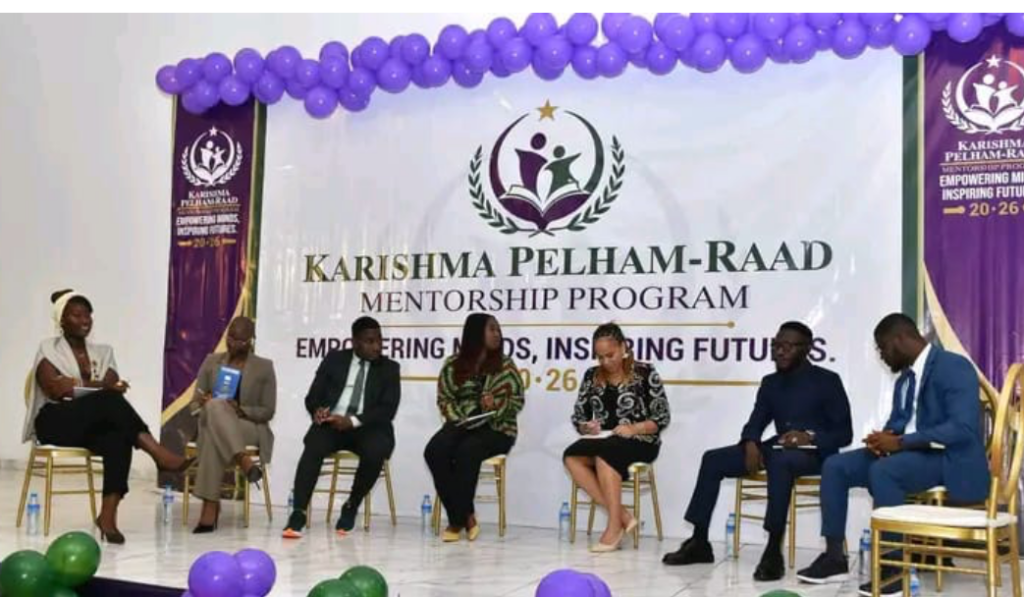
PAYNESVILLE, LIBERIA – For 500 young Liberians gathered at the Paynesville Town Hall this week, the first cohort of the Karishma Pelham-Raad Mentorship Program was not presented simply as a training opportunity, but as a starting point for a longer journey toward leadership, professional growth and service to Liberia.
The two-day program, which concluded Thursday, September 24, brought young people into conversations with professionals and mentors on leadership, career choices, entrepreneurship, communication, technology, public service, personal development and nation-building.
Held under the motto “Empowering Minds. Inspiring Futures,” the initiative was founded by Liberian diplomat and public servant Karishma Pelham-Raad, who told participants that the program was created from her own experiences of adversity, professional growth and the influence of people who encouraged her to keep going.
Pelham-Raad said the initiative was designed to address a gap facing many young Liberians — limited access to professional networks, career guidance, confidence-building opportunities and people willing to share practical experience.
“Mentorship is not about creating followers. It is about developing people who can eventually lead,” she told the gathering.
The program’s five areas of focus include leadership and character; communication and confidence; education, skills and opportunity; resilience and personal development; and tolerance, service and nation-building.
‘Your Circumstances Do Not Have to Determine Where You Are Going’
Drawing from her own journey, Pelham-Raad told the young participants that difficult circumstances do not necessarily determine a person’s future.
Her professional path has included telecommunications and technology, international relations, diplomacy and public service. She previously served as Assistant Minister for International Organizations at Liberia’s Ministry of Foreign Affairs and was involved in Liberia’s campaign for a non-permanent seat on the United Nations Security Council. Public information on her career also identifies her work in international organizations and energy-related stakeholder engagement.
For Pelham-Raad, those experiences reinforced the importance of having people who can guide critical points in a young person’s development.
She recalled mentors who opened doors, shared knowledge, corrected her, challenged her, and encouraged her to continue when circumstances were difficult.
“Sometimes, someone simply said: ‘Keep going,’” she told the fellows.
She urged the 500 participants not to measure their progress against people they see on social media, but instead to read, ask questions, develop skills, build relationships, and learn from failure.
“Failure is an event. It is not your identity,” she said.
A significant part of the program focused on helping participants understand that career development extends beyond simply finding employment.
Sessions addressed professional careers, entrepreneurship, technical and vocational opportunities, public service, creative industries, and energy and climate-related careers.
Participants were also introduced to volunteerism and internships as pathways for gaining experience, developing professional networks and preparing for employment.
The entrepreneurship component encouraged young people to identify problems, develop solutions, understand their customers, build sustainable business models, manage finances and use technology to grow their enterprises.
The approach reflects the program’s broader emphasis on equipping young people with practical tools rather than relying solely on motivational messages. Its application materials describe the initiative as providing leadership and personal-development training, career guidance, networking, communication and critical-thinking skills, as well as civic and community leadership opportunities.
The program also took participants into an area that is often discussed primarily as a national infrastructure challenge — Liberia’s electricity sector.
Hon. Amara M. Kamara, Commissioner of the Liberia Electricity Regulatory Commission (LERC), used the sector to expose participants to career opportunities in energy, regulation, engineering, environmental sustainability, and public service.
His presentation traced Liberia’s electricity sector from government investment in generation during the 1940s, through the establishment of the Liberia Electricity Corporation in 1973, the destruction of much of the country’s electricity infrastructure during the civil war, and subsequent reconstruction efforts.
The presentation also introduced participants to the roles of the Ministry of Mines and Energy, LEC, the Rural and Renewable Energy Agency and LERC, helping them understand that the electricity industry requires professionals working across generation, transmission, distribution, regulation, business and technical services.
For young people considering careers in emerging sectors, the session offered a practical example of how a national development challenge can also create professional and entrepreneurial opportunities.
‘Sometimes, All a Young Person Needs Is Someone to Point the Way’
One of the program’s panelists, Adihamu Shizo Eq Karneh, reflected on the importance of mentorship after engaging directly with the young participants.
Karneh said the discussions went beyond careers and included mentorship, goal-setting, artificial intelligence, social media, Liberia’s cybercrime law, political differences, and personal development.
He cautioned young people against choosing mentors simply because they expect financial assistance or employment.
Instead, he encouraged them to seek people whose experience and wisdom can help them grow.
A mentor, he said, may not be the person who can finance a young person’s dream or secure a job, but may be the person who challenges their thinking, points out mistakes, offers another perspective, or tells them the truth when others only tell them what they want to hear.
He also encouraged young people to distinguish between asking someone to solve a problem for them and asking someone to provide direction.
Rather than asking, “Can you do this for me?”, he suggested asking, “How would you approach this if you were in my position?”
That approach, he said, can create a more meaningful mentorship relationship.
Karneh also addressed political differences, telling participants that they do not necessarily have to share their mentor’s political views.
He said mentorship should not be confused with political sponsorship and that differences in political opinion should not prevent young people from learning from another person’s professional experience, character and wisdom.
The message complements Pelham-Raad’s broader call for tolerance and nation-building.
In her opening address, she reminded participants that Liberia belongs to everyone regardless of county, background, religion, economic circumstances, political affiliation, or social status.
She encouraged the fellows to view diversity as a potential strength rather than a reason for division.
Grand Bassa County Senator Gbehzohngar Findley, who served as keynote speaker, also challenged the young people to take their aspirations seriously.
Reflecting on his own journey from engineering into public service, including service as Foreign Minister and Senate Pro-Tempore, Findley urged participants to seek guidance from experienced people in the careers they intend to pursue.
He also warned that artificial intelligence and digital transformation are rapidly changing the nature of work, making preparation and continuous learning increasingly important.
One of the most significant elements of the program is its emphasis on women’s leadership and the example being presented by its founder.
Pelham-Raad’s own career places a young Liberian woman at the intersection of diplomacy, public service, international relations, and development.
Her public profile describes her as a Liberian diplomat and international-relations professional with experience in multilateral diplomacy and youth empowerment, while the mentorship initiative identifies women’s leadership, governance, public service, and national development among areas of particular interest to her.
The significance extends beyond the founder.
Pelham-Raad told the 500 fellows that when they eventually succeed, they should “reach back” using their positions, networks and opportunities to create pathways for others.
“When you become a professional, reach back,” she said. “When you become an entrepreneur, create opportunities. When you become a leader, develop other leaders.”
For young women in particular, that message speaks to the importance of building networks where professional knowledge and opportunities can be transferred from one generation to another.
Pelham-Raad said her ambition extends beyond the inaugural cohort.
She wants the program eventually to reach thousands of young Liberians and, more importantly, to see today’s fellows become tomorrow’s mentors.
She offered the example of a young woman who could enter the program uncertain about her future, become an engineer or entrepreneur years later, and eventually encounter another young girl who needs the same guidance she once received.
“Let me help you,” would then become the beginning of another mentorship relationship.
That, Pelham-Raad said, is how a movement grows — one person, one opportunity, one conversation and one open door at a time.
As the first KPR cohort concludes its two-day training, the organizers’ larger test will be whether the lessons, connections and confidence built in the room continue beyond the certificate ceremony.
For the 500 young Liberians who participated, the message was clear: discovering one’s potential is only the beginning.
The greater responsibility is to develop it, use it in service of others and, eventually, create a path for someone else to follow.
KPR’s message to the next generation is captured in its slogan: “Be Inspired. Be Empowered. Be the Future.”