By Jerromie S. Walters
WASHINGTON, D.C. — The Millennium Challenge Corporation (MCC) released its Fiscal Year (FY) 2027 country scorecards today. Liberia passed the mandatory benchmarks needed to compete for a five-year grant agreement, known as a compact. However, the country failed critical indicators for women and children, including women in the economy, the Girls’ Primary Education Completion Rate, and Child Health.
MCC’s Board of Directors will meet in December to select new partner countries. The Board reviews scorecard performance, supplemental information, opportunities to unlock economic growth, and available funding. This year, MCC evaluated 104 countries. Thirty-six passed their scorecards, and 68 did not.
Liberia successfully cleared the mandatory “hard hurdles” required for compact eligibility. The country passed the Control of Corruption and Personal Freedom indicators, as well as the overall “Half Scorecard” requirement. These wins reflect continued policy improvements under President Joseph Boakai’s administration.
Despite these governance victories, Liberia failed key indicators in human capital. The country’s lowest scores center on the health, education, and economic empowerment of women and children.
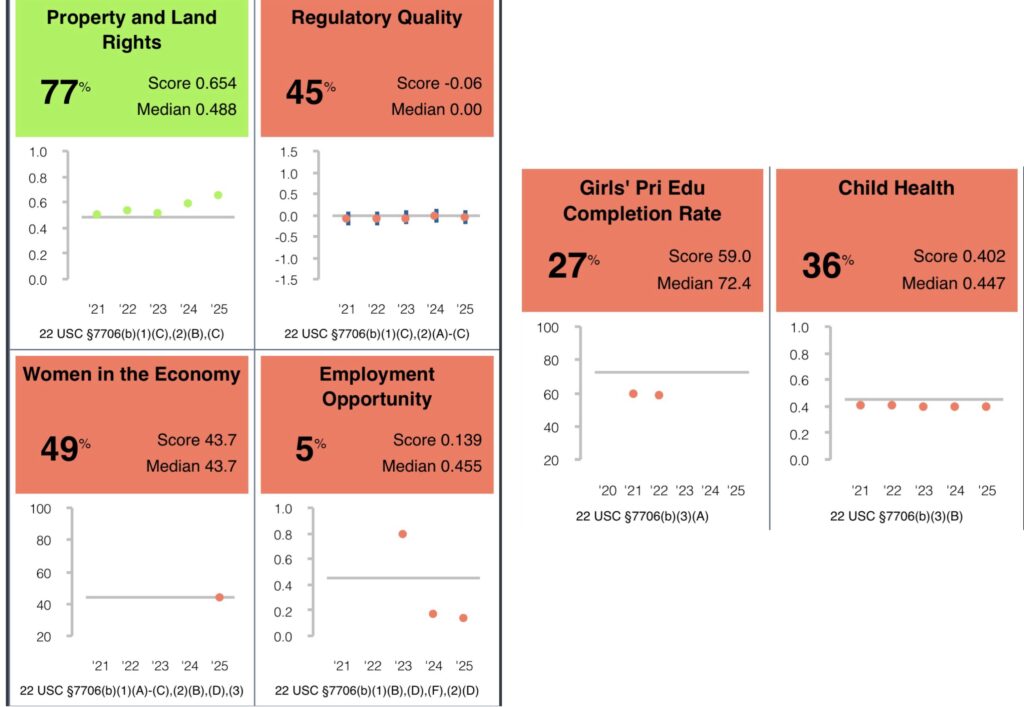
Liberia failed the Child Health indicator with a score of 0.402 (36%). The median score is 0.447. The country also failed the Girls’ Primary Education Completion Rate, scoring 59.0 (27%), which falls far below the median of 72.4. These failures point to structural weaknesses in early childhood development and basic education. MCC marked Workforce Development as N/A, leaving a gap in the country’s human capital strategy.
Liberia failed the Women in the Economy indicator, scoring 43.7 (49%). The score narrowly misses the median of 43.7. This failure shows that legal and regulatory barriers still restrict women’s full participation in the labor market.
The broader economy offers women few opportunities. Liberia failed the Employment Opportunity indicator with a score of 0.139 (5%). The median is 0.455. The country also failed Access to Credit (38%), scoring 0.471 against a median of 0.507. Liberian women rely heavily on the informal sector and small businesses. These failing grades reveal a lack of financial inclusion and formal job creation.
Strong Governance and Economic Reforms
Liberia performed well in governance and economic reforms, giving the MCC Board a strong foundation for partnership. In the “Ruling Justly” category, Liberia passed Freedom of Information (95%), Personal Freedom (37.2 score, 91st percentile), Government Accountability (25.25 score, 84th percentile), and the Rule of Law (61%).
Liberia also performed well in International Market Access (93%), Property and Land Rights (77%), and Market Competitiveness (57%). The country passed the Inflation indicator with a score of 8.3.
The FY27 results highlight a shifting landscape compared to the previous year. In the FY 2026 MCC Scorecard, Liberia passed 12 out of 22 indicators under President Boakai’s administration. During that cycle, Liberia notably excelled in several social and economic sectors, passing Gender in the Economy (84%), Access to Credit (73%), and Health Expenditures (62%).
However, the FY27 scorecard shows a regression in women’s economic empowerment and access to credit, underscoring the volatility of these gains. Deficits in human capital, particularly primary education and child health, have remained a persistent challenge across both fiscal years.
The Millennium Challenge Corporation is an independent U.S. Government agency. It delivers results-driven foreign assistance to unlock economic growth. MCC grants support large-scale infrastructure, strategic reforms, and economic modernization.
The agency advances America’s economic and strategic interests by delivering measurable returns to recipients and U.S. taxpayers—expanding commercial opportunities for U.S. businesses, reducing the influence of competitors, and reinforcing global environments aligned with American values.
For Liberia to secure a new compact in December, it must convince the MCC Board that its strong governance framework can address the critical gender, education, and child health deficits holding back its most vulnerable populations.