– As ECOWAS Opens Key Meeting in Monrovia
By: Laymah Kollie
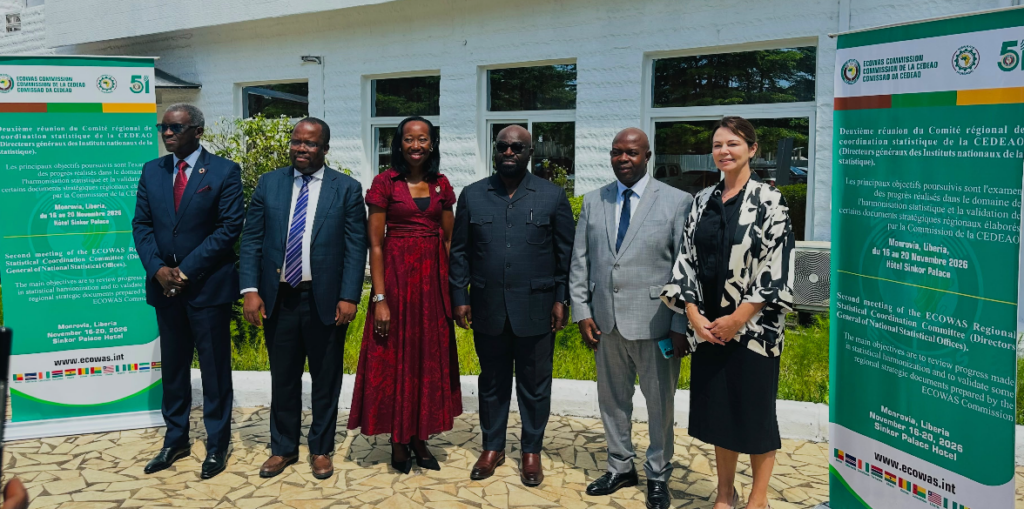
MONROVIA, Liberia — The Director General of the Liberia Institute of Statistics and Geo-Information Services (LISGIS), Richard Fatorma Ngafuan, has called for stronger regional statistical cooperation and harmonized data systems as Liberia hosts the second meeting of the ECOWAS Regional Statistical Coordination Committee, bringing together Directors General of National Statistical Offices across West Africa.
The five-day meeting, which opened Monday, November 16, in Monrovia, is expected to run through Friday, November 20, 2026. It brings together heads of national statistical institutions, representatives of the ECOWAS Commission and development partners to deliberate on strengthening statistical systems and improving the availability, quality and comparability of official statistics across the region.
Speaking at the opening session, Ngafuan, who also serves as Director General of LISGIS, welcomed delegates and emphasized that reliable statistics remain essential to measuring national development, guiding public policies and holding governments accountable.
He said countries seeking to advance their development ambitions must possess credible information to determine where progress is being made, identify persistent inequalities and understand the impact of public decisions on citizens.
Ngafuan stressed that statistical cooperation must extend beyond national boundaries, noting that West African economies are interconnected through trade, services, labour and other economic activities.
According to him, countries pursuing regional integration must also strengthen their ability to measure economic and social developments using common statistical methodologies.
“A region that seeks to act together must strengthen its capacity to measure together,” Ngafuan emphasized, underscoring the importance of statistical harmonization to ECOWAS’ regional integration agenda.
He identified several key areas requiring attention during the meeting, including civil registration and census systems, statistics on the non-agricultural informal sector, supply and use tables, social accounting matrices, merchandise trade, informal cross-border trade, services and tourism statistics.
The LISGIS boss explained that adopting common statistical standards must go hand in hand with accurately reflecting the realities of individual countries.
He called for consistent definitions and classifications, improved data coverage, and transparent documentation of statistical methods and revisions to ensure that information produced by national institutions remains credible and useful.
Ngafuan also urged delegates to ensure that the review of the 2027 Annual Work Programme translates into practical commitments, with clear responsibilities, realistic resources and effective follow-up arrangements.
He further encouraged regional statistical institutions to embrace emerging opportunities in administrative records, geospatial information, digital data collection and new analytical tools, while maintaining professional independence, confidentiality and public trust.
ECOWAS Resident Representative underscores importance of credible data
Also addressing the opening session, ECOWAS Resident Representative in Liberia, Ambassador Mohamed Kenewui Konneh, highlighted the critical role of reliable and harmonized statistics in advancing regional integration and supporting evidence-based decisions.
Welcoming delegates on behalf of the ECOWAS Commission, Konneh commended the Government of Liberia and LISGIS for hosting the meeting, describing it as a reflection of the progress made in regional statistical cooperation and the confidence placed in Liberia’s statistical institutions.
He stressed that without comparable and harmonized data, ECOWAS member states would face difficulties designing, monitoring and evaluating policies that directly affect their citizens.
“Without harmonized, comparable data, our community cannot design, monitor, or evaluate the policies that matter to our citizens,” Konneh said.
He highlighted the importance of statistics in areas such as regional trade, the free movement of persons, food security, inflation monitoring and the convergence requirements associated with the proposed ECOWAS single currency.
Konneh also outlined progress made through regional cooperation, including the advancement of national strategies for the development of statistics, improvements in civil registration and vital statistics, preparations for the 2030 round of population and housing censuses, and efforts to harmonize consumer price indices, national accounts and external trade statistics.
However, he acknowledged persistent challenges, particularly inadequate financing, limited human resource capacity, delays in data publication and the need to safeguard the independence of national statistical institutions.
He reaffirmed the ECOWAS Commission’s commitment to supporting member states through technical assistance, capacity development and stronger coordination.
Ngafuan delivers special statement on behalf of regional statistics chiefs
A major highlight of the opening session was a special statement delivered by LISGIS Director General Richard Fatorma Ngafuan on behalf of the Directors General of National Statistical Offices from across the ECOWAS region.
The statement recognized the contribution of the International Development Association (IDA) and the World Bank through the Harmonizing and Improving Statistics in West Africa (HISWA) Project, describing the intervention as instrumental in strengthening statistical systems across participating countries.
According to the statement, when the HISWA Project was approved in March 2020, several national statistical institutions were struggling with outdated surveys, aging infrastructure and limited capacity to publish information on time.
The COVID-19 pandemic further exposed the consequences of weak statistical systems and the urgent need for timely, reliable data to support public decisions.
The regional intervention, the Directors General noted, has helped rebuild the foundations of official statistics while supporting ECOWAS and the African Union in harmonizing statistical methodologies.
The statement highlighted several measurable achievements, including a statistical capacity score of 74.9 percent across the seven countries covered by the programme, exceeding the target established at its inception.
It further disclosed that more than 85 percent of comparable core economic and social indicators are now openly accessible to citizens, researchers and policymakers, while nearly nine out of every ten statistical products are released in line with international standards and pre-announced publication calendars.
The programme has also supported the production of 75 analytical reports, alongside improvements in household and labour force surveys, demographic data, rebased national accounts, digital data collection and the modernization of statistical infrastructure.
Ngafuan, speaking on behalf of his regional counterparts, emphasized that the value of these achievements extends beyond statistical institutions, as governments increasingly rely on reliable information to prepare national budgets, monitor poverty and employment, target social interventions and assess development priorities.
The Directors General, however, acknowledged that sustaining these gains requires continued investment, stronger national financing and institutional commitment.
They pledged to protect skilled personnel and digital platforms, maintain timely publication schedules, reduce delays between data collection and dissemination, and ensure that reliable statistics are effectively used in national decision-making.
The statement also welcomed plans for a new regional statistical operation building on HISWA and its sister programme, Statistical Capacity Building in Africa (STATCAP-Africa), while encouraging development partners to continue supporting statistics as essential infrastructure for development.
“Every dollar invested in good data improves how many more dollars are spent,” the statement declared.
Background and significance of the meeting
The second ECOWAS Regional Statistical Coordination Committee meeting provides an important platform for national statistical authorities to assess progress, address common challenges and strengthen cooperation in producing comparable official statistics across West Africa.
The meeting comes at a time when regional integration, economic planning and development monitoring increasingly depend on accurate and timely statistical information.
Through the deliberations, participants are expected to examine regional statistical guidelines and methodologies covering population and civil registration, national accounts, informal economic activities, trade, tourism and other critical development indicators.
A central objective is to ensure that statistical standards agreed upon at the regional level translate into practical improvements in the work of national statistical institutions.
For Liberia, hosting the meeting represents an opportunity to demonstrate its commitment to regional statistical cooperation and strengthen LISGIS’ engagement with counterpart institutions and development partners.
As the discussions continue through Friday, participants are expected to work toward clearer priorities, stronger institutional coordination and practical recommendations to improve the production, accessibility and use of official statistics throughout the ECOWAS region.
For Ngafuan and his regional counterparts, the broader message is clear: West Africa’s development ambitions must be supported by credible evidence, strong statistical institutions and a shared commitment to ensuring that no country is left behind in the region’s data development agenda.