

-As LNP Charges Five in $US19.2 Million Drug Case
By Jerromie S. Walters
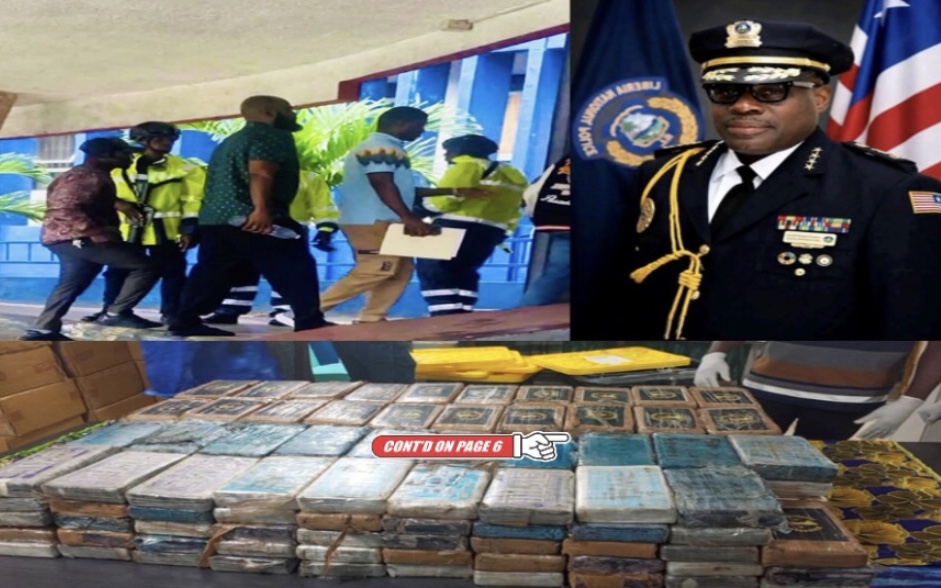
Monrovia, Liberia – The Inspector General of Police has named the principal suspects behind one of the largest cocaine seizuresin Liberian history, with about four persons being charged in absentia. The announcement marks the culmination of a high-stakes Joint National Security Investigation into the attempted smuggling of 237.6 kilograms of cocaine, valued at over US$19 million, through Roberts International Airport (RIA) .
The case, which has gripped the nation and sparked intense political scrutiny, centers on a consignment of six boxes presented for export on June 5, 2026 . Disguised as ordinary commercial cargo—falsely declared as Maggi cubes and Lappas—the shipment was flagged due to weight discrepancies and suspicious screening images, preventing its departure on a Brussels Airlines flight bound for Europe . A subsequent physical inspection on June 7 uncovered 198 plates of the illicit narcotic, concealed within the cargo .
“This was not a paperwork error. This was not a routine cargo discrepancy. This was a serious transnational cocaine trafficking operation using Liberia’s aviation and logistics system as a channel for organized crime,” the Inspector General stated, according to the official press release.
The investigation, ordered by President Joseph Nyuma Boakai and supervised by the Ministry of Justice, has since uncovered evidence of a sophisticated criminal network, including a previous shipment in May 2026 that utilized a similar modus operandi . The probe has now formally charged five principal suspects, with warrants issued for those at large and international cooperation sought for extradition .
The Joint Special Investigative Team has brought charges under the Amended Controlled Drugs and Substance Act of 2023 and the Revised Penal Code of Liberia, citing “Unlicensed exportation of controlled drugs,” “Criminal conspiracy,” and “Illicit trafficking,” among other counts .
The named suspects include:
· Paul J. King and Global Logistics Services (GLS): Charged in connection with facilitating, storing, and transporting the consignment through the airport cargo chain. King, the Operations Manager of GLS, has since voluntarily surrendered and is cooperating with investigators.
Those charged in absentia are:
· Michael U.S. Browne, alias Rahim/Raheem Bah, identified as the organizer of the shipment who used bogus front companies and attempted to recover the cocaine after discovery. Browne, a former RIA IT officer known by the nickname “US Marshall,” is now a fugitive believed to have fled the country . Court records show Browne had previously been arrested in 2024 on a Kush trafficking charge and was released from Kakata Central Prison after his fiancée and sister signed a guarantee for his medical treatment .
· Oscar J. Browne, an RIA security intelligence supervisor, who allegedly scanned and cleared a similar shipment in May 2026 and attempted to secure the release of the seized cargo .
· Emmanuel Kpah, who delivered the cocaine shipment and associated cash for the transaction .
· Usman Ali, identified as the consignee based in the United Kingdom .
While charges have been filed, the challenge of apprehending those at large remains. The Inspector General made clear that all suspects evading the law are being pursued through “every lawful means available to the Republic of Liberia,” including arrest warrants, international law-enforcement cooperation, and extradition requests .
The case has raised significant questions about the effectiveness of Liberia’s judicial system, particularly regarding suspects released from custody. The Senate has launched an inquiry into how Michael Browne, who faced a non-bailable drug felony in 2024, was released and subsequently became a central figure in the cocaine case.
Police Inspector General Coleman told senators that Browne is believed to be at large, and authorities are preparing to request passports and file notices with Interpol to pursue possible arrests and deportations .
“We are not treating this as a closed-file seizure. We are treating it as a network investigation aimed at identifying every participant—financiers, organizers, handlers, couriers, facilitators, insiders, and foreign links,” Coleman stated.
The investigation has drawn international attention, with reports linking the operation to a Sierra Leone-based Dutch fugitive, Jos Leijdekkers, a convicted drug trafficker whom European courts have sentenced in absentia. The Netherlands has formally requested his extradition, while the EU is said to be pressuring Sierra Leone over his presence . Dutch and Belgian authorities have requested meetings with Liberia’s security leadership to discuss his suspected involvement in regional drug operations .
President Boakai has vowed that Liberia will not be used as a “safe haven, transit point, or operational base” for criminal networks, and has ordered investigators to pursue both couriers and the larger networks that finance and facilitate trafficking . The government is actively engaging with international law enforcement and security agencies to support the ongoing investigation .
The fallout from the seizure has already triggered a significant institutional upheaval. The Liberian Senate and House of Representatives have petitioned the Executive to suspend the cargo-handling concession of GLS Menzies at Roberts International Airport, citing vulnerabilities in the air cargo supply chain . President Boakai has already suspended Peter Malcolm King, a board member of the National Oil Company of Liberia (NOCAL) and brother of Paul J. King, pending the outcome of the investigation .
In his address, the Inspector General issued a stern warning against corruption and obstruction of justice: “Any public official, security officer, airport official, private company, or corporate actor found to have knowingly participated in this scheme, attempted to obstruct the investigation, or compromised the integrity of the seizure will face the full consequences of the law.”
The case has been elevated to a matter of national security, with President Boakai previously vowing that Liberia will not be used as a “safe haven, transit point, warehouse, financial centre, or operational base by criminal networks engaged in narcotics trafficking” .
“To the Liberian people: This case should concern every citizen because narcotics trafficking is not a victimless enterprise,” the Inspector General stated. “It corrodes institutions. It finances organized crime. It corrupts public systems. It destroys lives and communities. And it places Liberia’s name at risk in the international community.”
As the investigation continues, authorities are working to tighten cargo-control procedures and safeguard the integrity of RIA. The Inspector General concluded with a resolute message to traffickers and their enablers: “Liberia is closed to drug traffickers. Our airport is not your corridor. Our institutions are not for sale. And anyone who mistakes this Republic for a safe passageway for illicit trafficking will be met with investigation, arrest, prosecution, and the full force of the law.”
last month, Former President George Manneh Weah accused the administration of President Joseph Nyuma Boakai of turning Liberia into a “narco state,” in a public critique of the Unity Party government. Speaking Saturday before thousands of supporters via online in Zwedru, Grand Gedeh County, Weah used the 22nd anniversary celebration of his Congress for Democratic Change (CDC) to allege that drug trafficking networks operate with official protection while democratic institutions are being systematically weakened.
Drug abuse has remained a national health and security emergency in Liberia for years. According to the United Nations Population Fund (UNFPA), an estimated 13 percent of the general population abuses drugs, with approximately 20 percent—over one million—of young Liberians addicted to narcotic substances.
Since taking office on January 22, 2024, President Boakai has declared the drug crisis a national emergency. In January 2024, he formed a Multisectoral Steering Committee to lead inter-ministerial efforts against drug trafficking and abuse. The government formally launched the National Anti-Drug Action Plan (2025–2030) in late 2025, a five-year framework initially budgeted at US$200,000 that unifies public health, security, and education initiatives.
Between 2024 and 2025, the Liberia Drug Enforcement Agency (LDEA) confiscated 9,651.23 kilograms of illegal substances valued at over US$4.9 million in nationwide operations. Several LDEA heads have been relieved of their posts by President Boakai for administrative reasons or failure to produce expected results.
In response to the June 8, 2026, $IS19.2 million drug seizure, President Boakai suspended Peter Malcolm King—one of those identified as persons of interest—from his position on the board of the National Oil Company of Liberia. Despite these efforts, the drug crisis persists, and Weah now appears poised to use the issue against the Boakai administration in the same way the Unity Party used it against him.