

By: Julius Konton
The Government of Liberia has signaled a stronger push for accountability in the education sector, with Finance and Development Planning Minister Augustine Kpehe Ngafuan calling for tighter monitoring of teachers’ classroom attendance and performance to ensure that public funds are reaching students rather than paying educators who are absent from their assigned schools.
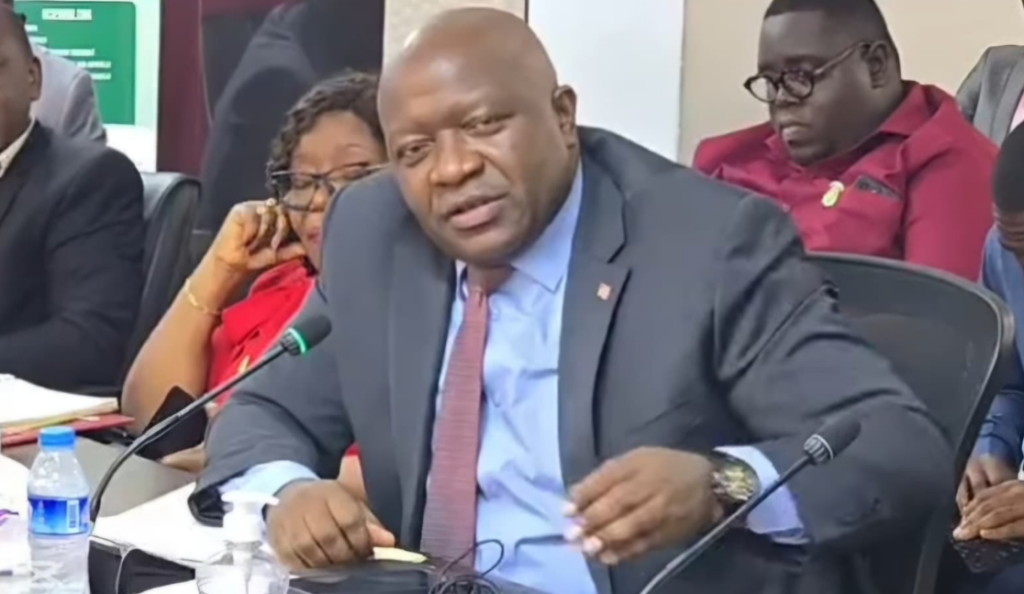
Minister Ngafuan made the call Tuesday during the opening of the Executive Budget Hearings with the Ministry of Education, where concerns over teacher deployment, payroll management and service delivery featured prominently in discussions surrounding the government’s proposed budget priorities.
The Finance Minister said Liberia cannot afford leakages in its education wage bill at a time when public resources remain limited and the government faces competing demands across health, infrastructure, education and other essential sectors.
“We need to track what’s happening in the classrooms,” Ngafuan said, urging the Ministry of Education to strengthen the system used to recruit, deploy and ultimately place teachers on the government payroll.
Ngafuan expressed concern over reports that some teachers assigned to rural and hard-to-reach communities allegedly abandon their posts while continuing to receive government salaries.
He argued that the process through which individuals move from volunteering or entering classrooms into formal government employment must be more transparent and closely monitored.
“We will hope that the normal way to enter the classrooms is emphasized more because it appears to enter the classroom you must volunteer and once you’re there, you’re incorporated on the payroll,” he said.
The minister’s comments highlight a longstanding challenge facing education systems in many developing countries: ensuring that teacher recruitment and payroll systems correspond with actual classroom deployment.
For Liberia, the issue is particularly significant because teacher availability remains closely linked to the quality and accessibility of education outside major urban centers.
Rural schools often face difficulties attracting and retaining qualified educators because of transportation challenges, limited housing, inadequate school infrastructure and other working-condition constraints.
Ngafuan therefore called for stronger verification mechanisms capable of establishing whether teachers listed on the public payroll are physically serving at their assigned schools.
He also called for an updated assessment of Teachers Training Institutes across Liberia, emphasizing that improving teacher preparation must go hand in hand with stronger accountability.
“Because if we pay those who aren’t in the classrooms, they are taking away money from those in the classrooms,” Ngafuan warned.
His remarks point to a broader government objective: improving the efficiency of education spending by ensuring that resources allocated for teachers translate directly into classroom instruction and improved learning opportunities for Liberian children.
While the Finance Minister focused on accountability within basic education, University of Liberia President Dr. Layli Maparyan used the same Executive Budget Hearings to highlight a major government investment in the country’s premier public university.
Maparyan commended the Liberian government for allocating US$6.35 million for the renovation, modernization and beautification of University of Liberia campuses.
Presenting the institution’s infrastructure accomplishments under the FY2026 budget allocation, Maparyan outlined a series of projects designed to improve the physical environment in which students, faculty and administrators study and work.
Among the facilities currently undergoing renovation, modernization and beautification are the Graduate School, Business College and Medical School Academic Building, alongside a number of quick-impact projects.
The University of Liberia president said additional facilities are expected to benefit from the investment, including the Law School Annex at Capitol Hill, as well as three buildings at the Preclinical Health Sciences Campus in Fendall.
The planned works also extend to the university’s Sinje campus, where the Academic Building, Administrative Building, Boys’ Dormitory and Girls’ Dormitory are expected to undergo renovation.
New entry gates are also planned for the Capitol Hill campus.
The US$6.35 million allocation represents a significant public investment in Liberia’s higher-education infrastructure and comes as the University of Liberia continues to grapple with the demands of expanding enrollment, aging facilities and the need to modernize academic and administrative spaces.
Established in 1862, the University of Liberia is one of Africa’s oldest degree-granting institutions and has played a central role in Liberia’s intellectual, professional and public-service development for more than a century and a half.
Its campuses have produced generations of Liberian professionals in medicine, law, education, business, communications, public administration and other fields.
The modernization program therefore has implications beyond physical infrastructure.
Improved lecture halls, laboratories, administrative facilities and student accommodation can strengthen the university’s capacity to provide competitive higher education and professional training.
The investment also comes at a time when Liberia is seeking to strengthen human-capital development as part of its broader national development agenda.
Taken together, the discussions at the Executive Budget Hearings underscore two interconnected priorities for Liberia’s education sector: accountability in the use of public resources and investment in the institutions responsible for educating the country’s future workforce.
Ngafuan’s call for stronger teacher monitoring reflects concerns about ensuring that recurrent government spending produces measurable results at the classroom level. Maparyan’s presentation, meanwhile, highlights the government’s effort to address infrastructure deficits within higher education through targeted capital investment.
The challenge for policymakers will be to ensure that increased spending whether on teachers, schools or universities is matched by effective oversight, transparent implementation and measurable improvements in educational outcomes.
For Liberia, where education remains central to long-term economic transformation and human-capital development, Tuesday’s budget hearings offered a clear message: public investment must be accompanied by public accountability.