-As Liberia Faces 200,000-Home Deficit
By Jessica Cox
The Managing Director of the National Housing Authority (NHA), Hon. Florence K. Geegbae, has appealed for increased government funding to tackle Liberia’s growing housing crisis, warning that inadequate financing remains the biggest obstacle to addressing a national housing deficit of approximately 200,000 homes.
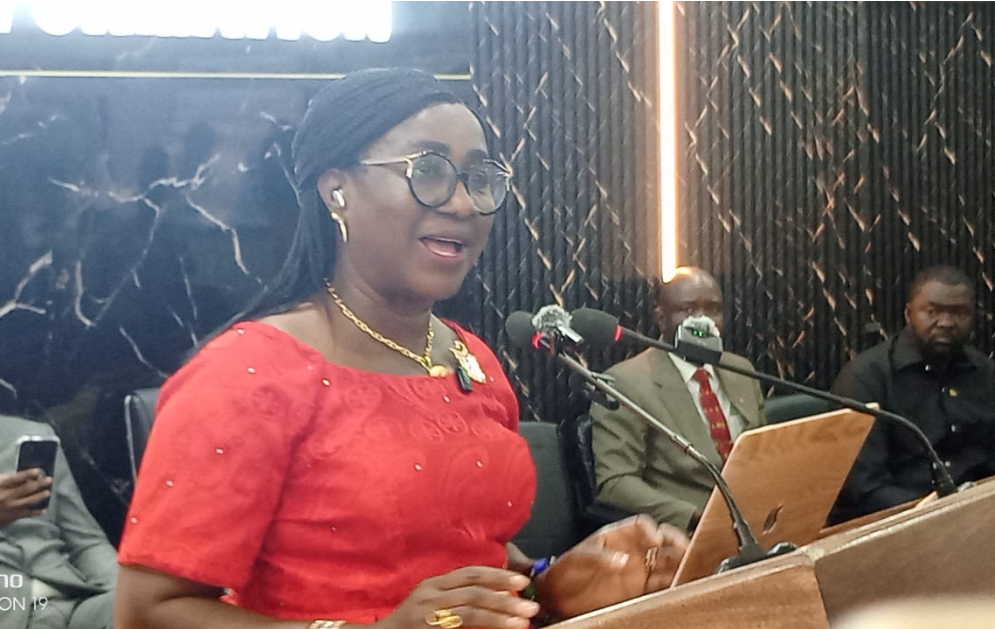
Speaking Tuesday at the Ministry of Information, Cultural Affairs and Tourism’s regular press briefing marking activities leading to Liberia’s 179th Independence Day celebration, Geegbae outlined the Authority’s achievements over the past two years, ongoing reforms, international partnerships and plans to significantly expand affordable housing across the country.
She stressed that while the NHA has completed much of the technical groundwork required for large-scale housing construction, the institution cannot move at the pace Liberians expect without stronger financial support.
“If you give me the funding today, Liberians will begin seeing houses within months,” Geegbae declared, describing financing as the single greatest challenge confronting the Authority.
The NHA is mandated to initiate, plan and implement national housing development programs throughout Liberia. According to Geegbae, the country currently needs about 200,000 new housing units, with approximately 166 additional homes required annually to keep pace with population growth and another 4,809 homes each year to replace deteriorating and unsafe structures.
She said nearly 70 percent of Liberians continue to live in inadequate housing and environmentally vulnerable communities, making affordable housing one of the country’s most pressing national development challenges.
Geegbae reflected on the condition of the institution when she assumed office in 2024, describing it as an agency operating under severe financial and operational constraints.
She said the Authority inherited deteriorating infrastructure, very low employee salaries and an almost non-existent operational budget.
According to her, the minimum salary has increased from approximately US$130 to US$175, while several professional employees who previously earned just over US$200 now receive salaries exceeding US$800.
Despite improvements in staff welfare, she noted that government funding has remained insufficient.
The NHA received only US$24,000 in one fiscal year and US$32,000 the following year, forcing management to rely on personal vehicles for official work for nearly two years. Although the Authority’s allocation has increased to about US$300,000 in the current fiscal year, Geegbae said the amount is still inadequate for an institution responsible for acquiring land, preparing housing sites and implementing national housing projects.
Despite financial challenges, the Managing Director disclosed that the Authority has secured a Special Presidential Housing Project to construct 600 affordable housing units across six counties.
She said environmental impact assessments, engineering designs, site plans, bills of quantities and implementation plans have all been completed, leaving the projects ready for implementation once funding is released.
The first phase is expected to accommodate approximately 2,640 Liberians, based on the national average household size of 4.4 persons.
In addition, four Public-Private Partnership agreements are before the Public Procurement and Concessions Commission (PPCC) for the construction of another 480 housing units, which could provide homes for more than 2,100 additional Liberians.
The projects are expected to be implemented in Bomi, Bong, Grand Bassa, Lofa, Nimba and Montserrado Counties, where land has already been identified and prepared for development.
Geegbae announced that negotiations with Shelter Afrique Development Bank have reached an advanced stage, with Liberia expected to sign a Memorandum of Understanding that will unlock financing for affordable housing development.
She said the Liberia Bank for Development and Investment (LBDI) will host the financing arrangement locally after the agreement is concluded.
The NHA has also negotiated partnerships with private developers and construction material suppliers, including TAC Global and other regional housing firms, to accelerate residential construction once financing becomes available.
She disclosed that one international construction partner intends to establish operations in Liberia to supply building materials through a monitored digital platform aimed at reducing costs and improving transparency.
As part of broader institutional reforms, the Authority has completed a review of the National Housing Authority Act.
The revised legislation proposes establishing a National Housing Trust Fund, which would provide sustainable financing for affordable housing, mortgage programs and housing subsidies.
The draft legislation has been validated and is awaiting Cabinet endorsement before being submitted to the Legislature.
Geegbae said the Trust Fund would align Liberia with international best practices in housing finance and provide the Authority with a reliable source of long-term funding.
The Managing Director also called on ministries, agencies and commissions to enroll eligible employees in the NHA’s Off-Takers Program.
She explained that international financiers require evidence of qualified prospective homeowners before committing funds for large housing projects.
According to Geegbae, the Civil Service Agency has already assessed eligible government workers, but several institutions have yet to submit employee enrollment information.
Responding to public concerns surrounding Doe Estate, Geegbae assured residents that the government’s redevelopment plans would not result in forced evictions.
She emphasized that residents currently occupying homes in the estate would not be arbitrarily removed, adding that any redevelopment would be carried out through lawful and inclusive processes.
“No one at Doe Estate will simply be taken from their home,” she said, explaining that the Authority intends to regularize occupancy while improving infrastructure and living conditions.
The NHA also outlined its policy on informal settlements, emphasizing that Liberia should adopt internationally accepted slum-upgrading strategies rather than indiscriminate demolition.
Geegbae said communities can remain in place while infrastructure is gradually improved through incremental development, or be relocated only after suitable alternative housing has been provided.
She stressed that relocation decisions must be guided by detailed socio-economic assessments to ensure that families are not separated from their livelihoods, noting that fishing communities, for example, should not be relocated away from coastal areas without careful planning.
Geegbae acknowledged that acquiring land for housing remains one of the Authority’s biggest operational challenges.
Working with the Liberia Land Authority, the NHA has found that much of the available land has already been privately acquired or remains under customary ownership.
She said government is negotiating with communities and traditional landowners to secure additional land for future housing projects, but compensation costs continue to strain limited resources.
Concluding her presentation, Geegbae appealed for increased government investment to enable the Authority to acquire land, develop infrastructure, purchase operational equipment and accelerate construction nationwide.
She maintained that reducing overcrowding and improving living conditions will require sustained public investment, stronger cooperation among government institutions and continued support from development partners.
“The only way to reduce overcrowding is to build more homes,” she said. “With adequate financing, the right policies and strong partnerships, Liberia can begin closing its housing deficit and provide decent, affordable homes for thousands of Liberian families.”