

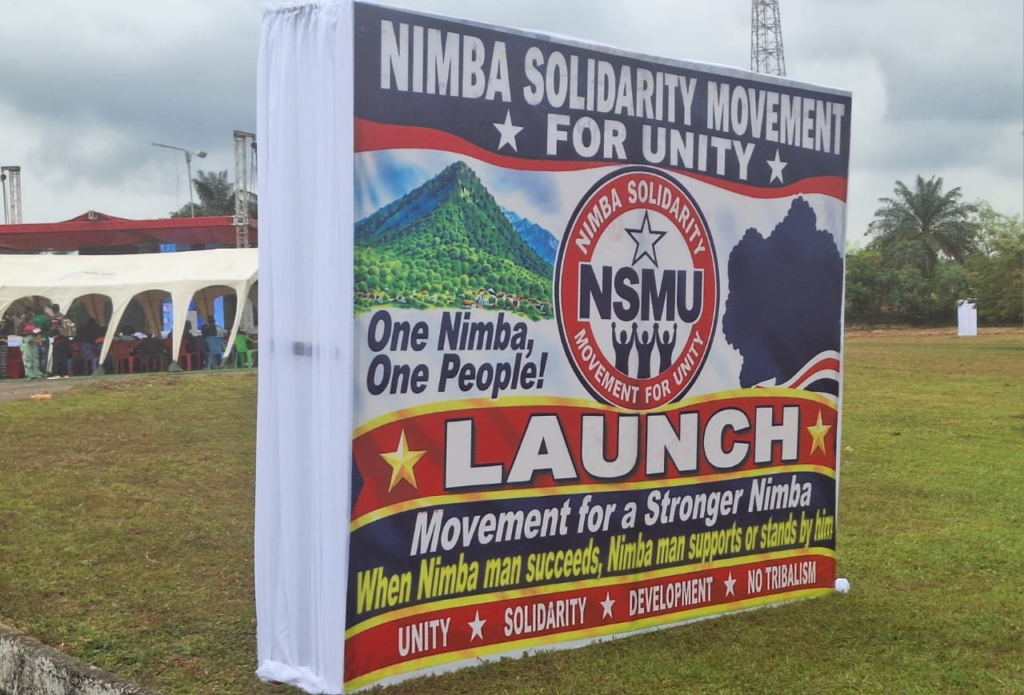
NIMBA COUNTY, Liberia — The launch of the Nimba Solidarity Movement for Unity (NSMU) has deepened political divisions in Nimba County, drawing criticism from ordinary participants and journalists who question the movement’s stated commitment to peace, unity, and development.
Minister of Mines and Energy R. Matenokay Tingban organized the much-publicized launch, which fell short of expectations amid poor public turnout, weak momentum, and mounting political controversy. Organizers projected the event would attract approximately 10,000 participants. Instead, lower-than-expected attendance marred the ceremony, which also started behind schedule.
The movement, established under the slogan “Unity Over Division,” was intended to bring together citizens across political affiliations, social backgrounds, and religious beliefs to promote peaceful coexistence, collective development, and a shared vision for the county’s future.
The event was expected to draw young people, women, county officials, traditional leaders, commercial motorcyclists, and other stakeholders from the county’s electoral districts and administrative subdivisions. However, the turnout and composition of participants fell short of the anticipated countywide representation.
Instead, supporters, partisans, and sympathizers of the ruling Unity Party (UP) predominantly attended the gathering, alongside government officials, traditional leaders, and political journalists from Nimba County.
The event’s political atmosphere and the visible presence of ruling-party supporters have fueled concerns about whether the NSMU genuinely positions itself as an inclusive countywide movement or is gradually evolving into another political platform associated with the ruling establishment.
The development has also raised questions about the movement’s ability to transcend partisan interests and unite citizens who hold different political opinions, particularly as political competition and alliances increasingly shape conversations across Nimba County.
The controversy surrounding the launch carries particular significance given Nimba County’s historical political influence and strategic importance in Liberia’s national electoral landscape. The county has consistently played a consequential role in presidential elections, making political developments within its borders important to the country’s broader political calculations.
With Liberia’s next general and presidential elections scheduled for 2029, the emergence of new political movements, alliances, and grassroots mobilization efforts will likely influence public opinion, reshape political relationships, and potentially redefine the balance of political power in the county.
Against this backdrop, the NSMU faces the challenge of demonstrating that its commitment to “Unity Over Division” extends beyond political slogans and ceremonial gatherings to meaningful engagement with citizens across party lines.
Ultimately, the movement’s credibility will depend not only on the size of its membership or the political influence of its organizers but also on its ability to accommodate opposing political views, encourage genuine participation, and advance development initiatives that benefit Nimba County as a whole.