By Shallon S. Gonlor |
shallonsgonlor@gmail.com
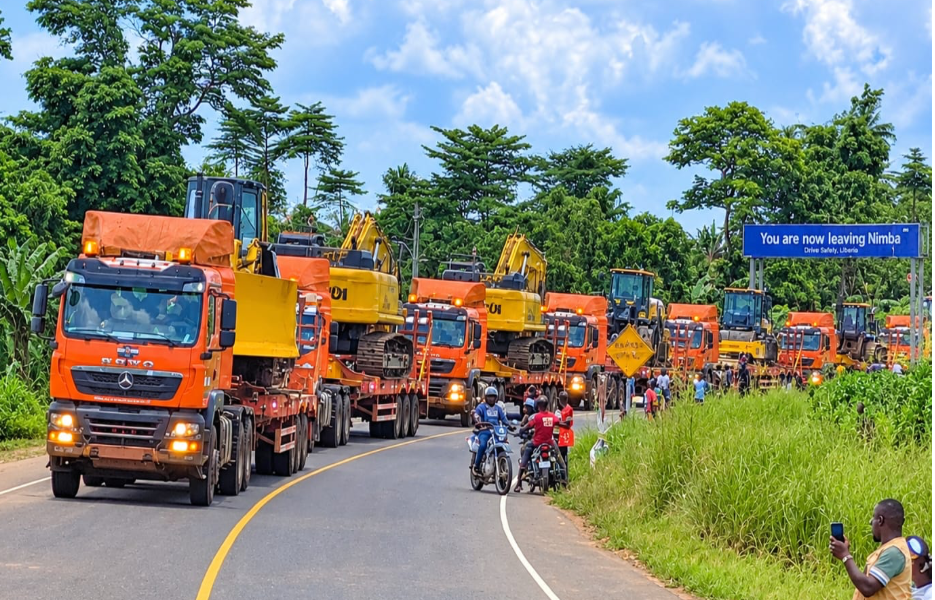
NIMBA COUNTY, Liberia — Nimba County’s infrastructure development has received a significant boost following the arrival of 30 pieces of heavy-duty yellow machines deployed by the Government of Liberia to accelerate road connectivity, improve transportation, and address longstanding infrastructure challenges across the county.
The equipment, officially turned over to Nimba County on Saturday, October 31, 2026, forms part of the Boakai-Koung Administration’s national deployment of 285 pieces of yellow machines across Liberia’s 15 counties aimed at strengthening road construction, rehabilitation, and maintenance throughout Liberia.
The arrival of the equipment triggered widespread excitement among citizens and residents, who lined major highways and communities to welcome the convoy as it made its way into the county.
Nimba County Superintendent Kou Meapeh Gono, accompanied by thousands of citizens, traditional leaders, chiefs, elders, women and youth groups, and members of the Nimba Legislative Caucus, received the machines at the border between Bong and Nimba Counties.
From Beila-Sokopa Town to Sehyikimpa, and from Ganta to Bahn City, residents expressed excitement through cultural performances, dancing, and celebrations, describing the deployment as an important step toward addressing the county’s persistent road infrastructure challenges.
Traditional leaders also welcomed the delegation with a cultural ceremony, presenting kola nuts to the Special Presidential Yellow Machine Project Committee, led by Chairperson Brownie J. Samukai and Co-Chair Roger S. W. Y. Domah.
Under the deployment arrangement, 15 pieces of equipment are stationed at the Sehyikimpa hub, while the remaining 15 will operate from the Bahn City center. The two operational hubs are intended to facilitate road rehabilitation, maintenance, and connectivity interventions across towns, villages, and cities in the county.
Receiving the equipment, Superintendent Kou Meapeh Gono described the deployment as a major development milestone, emphasizing that the equipment would support improvements in farm-to-market roads, access roads to schools and hospitals, and connectivity between towns, villages, and rural communities.
Supt. Gono assured the Government of Liberia and citizens of the county that the 30 yellow machines deployed to Nimba will significantly strengthen ongoing infrastructure development, particularly in the construction and rehabilitation of farm-to-market roads, access roads to hospitals and schools, and other critical infrastructure across rural and vulnerable communities.
Speaking at the formal turnover ceremony held in Sehyikimpa Town Commissioner’s compound, Superintendent Gono declared that the government’s intervention transcends political considerations, describing the arrival of the machinery as the fulfillment of a development commitment made to the Liberian people.
“The people of Liberia are proud. This is not politics, people will say. But you know, the machines got here under somebody’s time, under somebody’s administration, by somebody’s goodwill, by somebody’s fulfilling their words. And I will want to say thank you to His Excellency, Joseph Nyuma Boakai,” Gono stated.
She emphasized that the arrival of the equipment provides renewed hope for transport operators, farmers, and business owners, who continue to face transportation challenges due to poor road conditions in several parts of the county.
According to the Superintendent, the machines will strengthen the county’s capacity to address longstanding road infrastructure challenges, improve mobility between communities, facilitate agricultural activities, and enhance access to essential social services.
On behalf of the people of Nimba County, Supt. Gono expressed appreciation to President Joseph Nyuma Boakai, Sr., Vice President Jeremiah Kpan Koung, the Nimba County Legislative Caucus, and the Special Presidential Yellow Machine Project Committee for ensuring that the county benefits from the national deployment initiative.
She further committed the county administration to ensuring the effective utilization, operation, servicing, and maintenance of the equipment to achieve the intended development objectives.
For his part, the Chairperson of the Special Presidential Yellow Machine Project Committee, Brownie J. Samukai, disclosed that the committee had recruited 42 personnel, comprising skilled operators and technical workers, to manage the machinery and support the government’s road rehabilitation and maintenance program in Nimba County.
Samukai described the turnover as another demonstration of President Boakai’s commitment to fulfilling his administration’s promises regarding road development.
“Madam Superintendent, the President brought to our country 285 pieces of yellow machines, 30 of these machines are for the people of Nimba County to improve their farm-to-market roads, city-to-town roads, and roads leading to hospitals and schools,” Samukai said.
The national initiative is designed to strengthen the government’s capacity to construct, rehabilitate, and maintain roads across Liberia, particularly in rural communities where deteriorating road conditions continue to undermine economic activities and social development.
Speaking on behalf of the Nimba Legislative Caucus, Co-Chair and District #6 Representative Dorwohn Twain Gleekia called on citizens to take collective responsibility for protecting the equipment against theft, misuse, and mismanagement.
Rep. Gleekia specifically warned against the unauthorized sale of fuel and spare parts, stressing that the success of the initiative would depend largely on public vigilance and responsible management.
“Nimba County still has good mechanics and good operators. But also, amongst the good operators and good mechanics, there are bad ones. And it is because of the bad apples that we want you, our people, to serve as security for this machine,” Gleekia cautioned.
He urged citizens to remain vigilant against individuals who might attempt to divert fuel or sell parts belonging to the machinery, emphasizing that community involvement would be essential to protecting the county’s investment.
Addressing members of the media, the lawmaker also called on journalists to amplify the message of public ownership and accountability.
“You, the members of the fourth estate, no one goes to the community more than you. Please help us. Let the message go across the country. Let everybody get to know that, yes indeed, the machine is no longer a government machine. The President has sent his team to turn the machine over to us. It belongs to Nimba. We are the security. The bad mechanics and operators, let them out,” he added.
For his part, the Ministry of Public Works, newly assigned Nimba County Resident Engineer Johnny Erickson Bunah pledged to provide the necessary technical leadership and expertise to support infrastructure planning, design, execution, inspection, and maintenance throughout the county.
Bunah commended the Government of Liberia and President Boakai for procuring and deploying the equipment, describing the initiative as an important step toward improving the living conditions of citizens through enhanced infrastructure development.
“These equipment indicate the willingness of the Government of Liberia to improve the lives of the citizens of Liberia. And I want to commit myself to the authority of Nimba County that I am doing everything possible, with the help of other technicians, to make sure that this equipment will be used and maintained properly. And with the support, we will succeed in improving the infrastructure across the county,” Bunah assured.
The deployment comes amid longstanding concerns over deteriorating roads in several rural communities, where poor connectivity continues to affect agricultural transportation, commercial activities, access to healthcare, and educational services.
With 30 pieces of heavy-duty equipment now assigned to two strategic operational hubs, expectations are mounting that Nimba County will witness accelerated road rehabilitation and improved connectivity.
For thousands of residents, the arrival of the yellow machines represents more than the delivery of heavy equipment; it is a renewed expectation that long-neglected roads and isolated communities will receive greater attention as the county advances its infrastructure development agenda.