


-As MOA Harvests 1.14 Hectares
By Shallon S. Gonlor |
shallonsgonlor@gmail.com
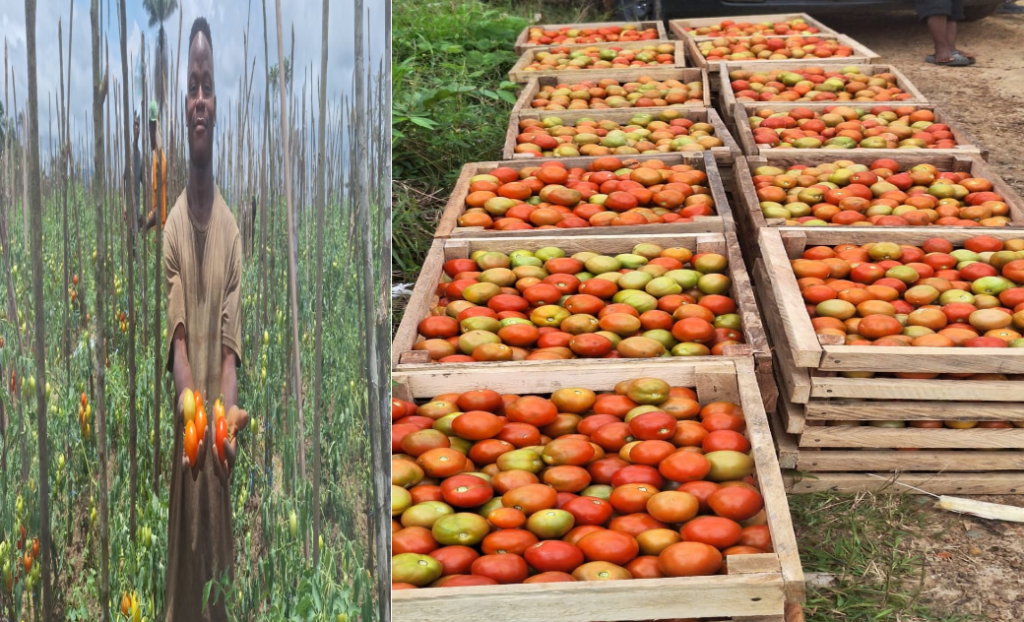
NIMBA COUNTY, Liberia — The Ministry of Agriculture’s local office in Nimba County has unveiled the harvest of a 1.14-hectare tomato farm in Sanniquellie City under the Nimba County Agriculture Project — an initiative funded by the Nimba County Administration and aimed at promoting agricultural production, entrepreneurship, revenue generation, and food self-sufficiency in the county.
Nimba County Agriculture Coordinator Jefferson G. Degon described the harvest as a practical effort to advance the national decentralization policy of the Ministry of Agriculture by bringing agricultural production and economic opportunities closer to communities.
Speaking Tuesday during a press conference held at the farm in Sanniquellie, Coordinator Degon said the initiative was developed to demonstrate that agriculture can be transformed into a viable business enterprise while helping Liberia reduce its dependence on imported agricultural commodities.
According to him, upon assuming leadership of the county’s agriculture program, he began considering how the national agriculture decentralization policy could be translated into tangible programs at the county level.
“When we took over as head of agriculture in the county, we thought of this issue of decentralization meeting us at the county level,” Degon explained. “So, with that, we decided to think of what agriculture can do because it is always said that agriculture is the backbone of the country. But since it is the backbone of the country, how can we make it work for the county?”
He said the Agriculture Office subsequently developed a proposal and presented it to the Nimba County Administration, which, he noted, provided the necessary space and financial support for the initiative.
Degon praised Superintendent Kou Meapeh Gono for supporting the concept and allowing the Agriculture Office to pursue innovative approaches to agricultural development.
He disclosed that the county administration initially provided US$400,000 through the County Development Fund to support the implementation of the project.
Coordinator Degon said one of the major motivations behind the initiative is to help restore Liberia’s agricultural reputation by increasing domestic production of crops that are routinely imported from neighboring countries.
He specifically cited tomatoes, noting that Liberian market women frequently travel to Guinea and other West African countries to purchase vegetables and other agricultural products for resale in Liberian markets.
“One thing that came to my mind was for us to see how we can regain the lost image that we have had in our country,” Degon said.
He explained that it has become common to see Liberian traders crossing the country’s borders in search of tomatoes and other vegetables that could potentially be produced locally.
“It was almost getting like it was impossible for us to grow tomatoes in Liberia because we see them always crossing to go for it,” he said.
According to Degon, local production could help reduce the financial and logistical burden on traders and consumers, particularly by minimizing transportation costs and other challenges associated with importing agricultural commodities.
He said the Nimba County Agriculture Project is therefore intended not only to increase food production but also to contribute to the broader economic development of the county by creating opportunities for farmers, service providers, marketers, and other actors along the agricultural value chain.
Unlike conventional approaches in which government provides support directly to farmers, Degon said the Nimba County Agriculture Project is introducing an entrepreneurship-centered model that involves agricultural service providers.
“We are not supporting the farmers for the farmer to carry the produce; we are bringing entrepreneurship into agriculture,” he explained.
Under the model, service providers receive support to produce agricultural commodities, while marketers are incorporated into the value chain to ensure that produce reaches consumers and markets efficiently.
Degon said the county administration intends to enter the market with sufficient production capacity to strengthen its bargaining position with marketers and contribute to greater stability in commodity prices.
“As a government arm or a government project, we’re going to hit the market well-prepared so that the marketers can have a conversation with us,” he said. “And once we are doing it that way, we ourselves can even regulate the price of those commodities because we are the ones supporting the service provider 100 percent.”
He said the approach is expected to establish a structured agricultural value chain in which production, marketing, monitoring, and evaluation are connected.
“As we speak currently, this is the first farm of the project,” Degon noted.
Four-Pillar Agricultural Program
The Nimba County Agriculture Project is built around four major agricultural pillars: vegetable production, animal husbandry, rice production, and tree crops.
According to the Agriculture Coordinator, the four pillars are intended to create a diversified agricultural system capable of generating regular revenue for the county during both the rainy and dry seasons.
The vegetable component, represented by the newly unveiled tomato farm, is expected to serve as an initial demonstration of the project’s production model, with additional agricultural activities anticipated under the other pillars.
The inclusion of livestock, rice, and tree crops is also expected to reduce overreliance on a single commodity while creating opportunities for farmers and agricultural entrepreneurs across different parts of Nimba County.
Degon said the project also has a monitoring and evaluation component designed to track its implementation and ensure that resources and agricultural activities are properly managed.
He explained that the current structure includes service providers, marketers, and a monitoring and evaluation team, creating a system intended to improve accountability and sustainability.
Support from Ministry, County Administration
Coordinator Degon expressed appreciation to Liberia’s Ministry of Agriculture, particularly Minister Dr. J. Alexander Nuetah, for providing technical support to the county’s agricultural initiative.
He also praised Superintendent Kou Meapeh Gono and the Nimba County Administration for their initial financial backing and willingness to support agricultural innovation.
Mr. Degon said the collaboration between the county administration and the Agriculture Office demonstrates the potential of decentralization when local authorities are given the opportunity and resources to design programs that respond directly to local economic needs.
The initiative comes amid broader calls for Liberia to increase domestic food production, strengthen agricultural value chains, reduce dependence on imported food commodities, and create sustainable economic opportunities for rural communities.
For Nimba County, the Agriculture Office says the tomato farm is only the beginning of a broader agricultural transformation agenda that seeks to position agriculture not merely as a subsistence activity, but as a source of employment, entrepreneurship, food security, and sustainable county revenue.
The Agriculture Office is expected to build on the initial tomato production and expand activities under the project’s four pillars as the initiative progresses.