

–As Steering Committee Adopts Seven Resolutions
By Jerromie S. Walters
MONROVIA, Liberia — Liberia’s national peace and reconciliation museum project is officially underway after the First Steering Committee Meeting of the Liberia Peace, Reconciliation and Memorialization Museum concluded Wednesday, 18 November 2026, at the Executive Pavilion in Monrovia, adopting seven key decisions during three days of deliberations.
The museum project emerges from one of Africa’s most devastating conflicts. The Liberian Civil Wars (1989–2003) were two consecutive internal conflicts that claimed over 250,000 lives and displaced more than one million people. Driven by deep-seated ethnic rivalries, political exclusion, and competition over natural resources, the wars shattered Liberia’s infrastructure and destabilized the surrounding region.
Liberia was governed for over a century by a small Americo-Liberian elite through the True Whig Party, which marginalized the indigenous majority. Master Sergeant Samuel K. Doe, an ethnic Krahn, overthrew the government in a violent military coup in 1980, becoming Liberia’s first indigenous head of state. Doe’s regime soon became marked by corruption, economic mismanagement, political repression, and ethnic favoritism toward the Krahn at the expense of groups like the Gio and Mano.
In December 1989, Charles Taylor—a former government official—led the National Patriotic Front of Liberia (NPFL) into Nimba County from Côte d’Ivoire to topple Doe. In September 1990, a breakaway faction led by Prince Johnson captured and executed President Doe, triggering a chaotic multi-sided war among rival ethnic militias.
The Economic Community of West African States (ECOWAS) deployed a peacekeeping force known as ECOMOG to stabilize Monrovia, though fighting persisted across the countryside amid failed peace accords.
Following the Abuja Accords, disarmament took place and Charles Taylor won the 1997 presidential election.
Many citizens voted for Taylor out of fear that his defeat would trigger a return to war. Taylor’s authoritarian governance, human rights abuses, and support for rebels in neighboring Sierra Leone sparked fresh armed resistance. Liberians United for Reconciliation and Democracy (LURD) attacked from Guinea in 1999, followed by the Movement for Democracy in Liberia (MODEL) invading from Côte d’Ivoire in 2003.
Rebel forces besieged the capital in mid-2003, prompting intense international pressure. In August 2003, Taylor resigned and went into exile in Nigeria. Warring factions signed the Accra Comprehensive Peace Agreement on August 18, 2003, establishing a transitional government backed by a large United Nations peacekeeping mission (UNMIL).
All major factions relied heavily on child soldiers, forced displacement, and sexual violence while looting iron, timber, and diamond resources. In 2012, the Special Court for Sierra Leone convicted Charles Taylor of aiding and abetting war crimes in Sierra Leone, sentencing him to 50 years in prison. Liberia’s Truth and Reconciliation Commission (TRC) recommended a domestic war crimes court in 2009.
While accountability efforts have moved slowly over the decades, the establishment of a War and Economic Crimes Court remains an active political focus in Liberia. Since the war ended, Liberia has achieved successive peaceful transfers of power through the elections of Ellen Johnson Sirleaf (2005), George Weah (2017), and Joseph Boakai (2023).
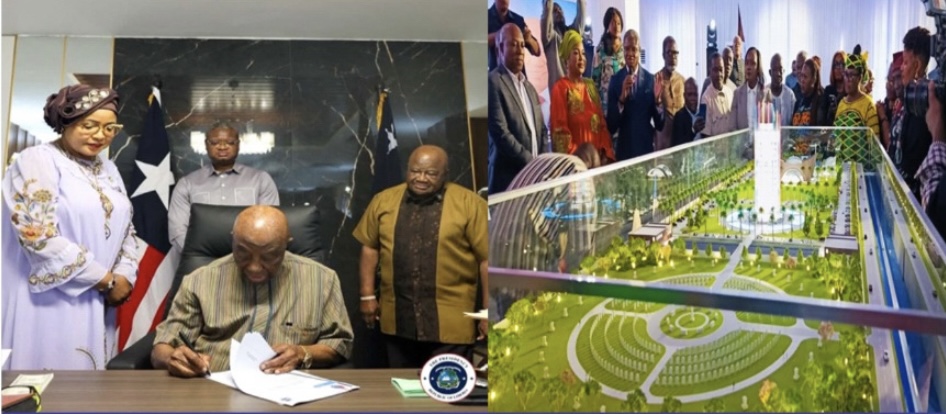
President Joseph Nyuma Boakai, Sr. chaired the inaugural steering committee meeting, which drew 150 participants, including the 35-member Steering Committee, five Technical Working Groups, and delegations from Rwanda and South Africa.
The Committee adopted the Project Charter; the Performance Measurement Baseline Plan covering 16 November 2026 to 31 December 2027; a US420,000 to be released upon approval; the constitution of the five Technical Working Groups; the financing strategy; the 90-day plan; and the partnerships framework. The adopted resolutions and action register will be issued within five working days.
Hon. Hadja Mamaka Bility, Minister of State without Portfolio and Chairperson of the Steering Committee, led the Committee through the Charter, the plan, the budget, and reports from the five Working Groups, which met in parallel sessions on the second day. The Charter was signed by the President, the Chairperson and the Co-Chair on Friday, 13 November 2026.
“We did not come here only to remember. We came here to decide, and we have decided,” Bility said. “This Museum will be a place where every Liberian can find the truth of our history, honor those we lost, and teach our children that peace is something we build together.”
The Museum is a national presidential priority under the National Historical Recovery Initiative, launched by President Boakai in Buchanan in July 2026, and it answers the Truth and Reconciliation Commission’s call for a National History Project. “A nation that remembers honestly is a nation that can reconcile truly,” President Boakai said. “This Museum will keep our history where it belongs, in the open, in the hands of our people, and in the service of peace.”
The President said victims, survivors and their families must help shape the museum from its conception through its operation, warning that overlooking their experiences would undermine the institution’s purpose. “This Museum belongs first to the victims and survivors of our conflict, and to their families. Nothing about them must be done without them,” he said.
President Boakai charged the Committee with finalizing an implementation plan and budget, settling priorities for the five technical working groups, and identifying financing for the first 90 days. “The Liberian people are watching, and they are waiting, not for speeches, but for action,” he reminded them. He also announced that the Government will name a Presidential Committee in the coming days to advise on national history and heritage priorities.
The committee would include the National Historical Recovery and Repatriation Initiative and the revival of the National History Project, both recommended by the Truth and Reconciliation Commission. Ambassador Aliou Mamadou Dia, UNDP Resident Representative in Liberia and Co-Chair of the Steering Committee, led deliberations on the plan, the budget and the financing strategy. “UNDP stands with Liberia in this undertaking, not as an observer, not as a partner, but as a team member.
Rwanda shared its experience in reconciliation and memorialization, and South Africa its experience in transitional justice, museums and nation-building. The Committee will draw on that experience through partnerships it adopted, including cooperation with the Rwanda Cooperation Initiative, South African partners, and the University of South Africa (UNISA).
Ambassador Beng’yela Augustine Gang, Cameroon’s Ambassador to Liberia and Doyen of the Diplomatic Corps, urged the Committee to draw lessons from Rwanda and South Africa while grounding Liberia’s approach in its own history. He also urged the Committee to present a balanced account of Liberia’s history, including evidence and artifacts that may challenge political interests and deeply held views, and reaffirmed the Diplomatic Corps’ support for Liberia’s reconciliation efforts.
The Museum will preserve archives and testimonies, build a national system of historical memory and learning, and serve education and reconciliation across all fifteen counties, guided by five words: Remember, Understand, Learn, Reconcile, Prevent.
Within the first 90 days, by 13 February 2027, the Secretariat and Working Groups will deliver the preliminary Museum Framework, archives and collections mapping, governance and legal options, site assessment methodology, education and reconciliation framework, feasibility-study terms of reference, resource mobilization strategy and Project Management Dashboard, with the first consolidated progress report due to the Steering Committee on 31 January 2027. The Committee will meet again in February 2027 to review that report.

