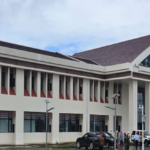


-At second Annual Presidential Media Dinner

MONROVIA — The presidents of Liberia’s two leading media bodies used the second annual Presidential Media Dinner on Saturday to press President Joseph Nyuma Boakai for concrete action on media reform, challenging him to define his administration’s legacy and deliver on pledges that remain unfulfilled more than a year after the first gathering.
Press Union of Liberia President Julius Kanubah called for a national framework to sustain independent journalism, while Female Journalists Association of Liberia President Lisa Tenneh Diasay pressed the President on women’s representation in government and in the press corps.
Speaking before President Boakai at the EJS Ministerial Complex in Congo Town, Kanubah said the government has yet to deliver on concerns the PUL raised at the inaugural dinner on April 10, 2025.
“More than a year later, Excellency, we are yet to see significant progress toward comprehensive ELBC reform, structured support for community radio, improved working conditions for journalists, or a national framework for media sustainability,” Kanubah said.
He proposed the formulation and enactment of a Liberia Media Governance and Sustainability Act to establish what he described as a transparent national framework for supporting independent, ethical, and professional journalism. “The PUL stands ready to collaborate with your administration, because credible journalism remains the lifeblood and oxygen of democracy,” he said.
Kanubah acknowledged what he called notable progress in Liberian media development — including the Freedom of Information Act, the abolition of anti-free-speech offenses through the Kamara Abdullai Kamara Act, and the expansion of community radio — but warned these gains “must be protected and strengthened.”
In one of the evening’s sharpest moments, Kanubah put the question of legacy directly to the President, recounting the media records of his predecessors. “President Ellen Johnson Sirleaf’s administration enacted the Freedom of Information Act, endorsed the Declaration of Table Mountain, and contributed US$100,000 toward the proposed PUL headquarters,” he said.
“President George Weah’s administration enacted the Kamara Abdullai Kamara Act and provided a headquarters for the Female Journalists Association of Liberia.” “Excellency, the question is: What will be the media legacy of the Joseph Nyuma Boakai administration?”
Kanubah also disclosed that the PUL continues to grapple with accountability challenges surrounding the Sirleaf-era US$100,000 contribution, which he said “was a blessing that unfortunately turned into a curse for our Union.” He said the matter was withdrawn from court by a previous PUL administration “in the name of reconciliation,” but that “the quest for accountability for this terribly mismanaged fund persists.”
Despite that history, he said the PUL remains committed to transparency and to constructing its headquarters on land acquired in 1997, and appealed to the administration for support. “As we wine and dine, may this dinner serve as a defining moment of intervention toward the construction of the PUL Headquarters,” Kanubah said.
FeJAL: “Inclusion Is Not a Sentiment, It Is a Count”
Diasay, who said she would make “two points in two minutes,” anchored her remarks in the language of the President’s own agenda.
“You did not call it the ARREST Agenda. You called it the ARREST Agenda for Inclusive Development,” she said. “Those last three words are the ones the women in this room read first.”
She noted that earlier this month, nine of the 19 Cabinet seats were held by women — the most in Liberia’s history — but that the number fell to seven on Friday following the departures of Madam George from National Defense and Madam Dagoseh from Commerce.
“We know both are to be reassigned, and no one here disputes your authority to organize your own government,” Diasay said. “But we count the Cabinet table, Mr. President, because inclusion is not a sentiment. It is a count.” “When a woman leaves that table, a girl in Grand Bassa loses a picture of what she is permitted to become.”
She urged the President to place the two women where “their competence still shapes policy” and to ensure future shortlists “reach your desk with women already on it rather than added to it afterward.”
Turning to the press corps, Diasay said women are not absent from the profession but are underrepresented in decision-making spaces.
“Look at the press delegation that travels with you. Look at who is called on at the briefings, and who gets the sit-down when the story is national,” she said. “The women of this press and media are not missing from the profession. We are missing from the rooms where the questions get asked and the answers get given.”
She argued that greater inclusion would produce different journalism. “Open those rooms and you will hear a different set of questions, about markets, clinics and classrooms, and they are questions your government needs to be asked.”
Diasay also endorsed a structural solution to the media’s economic crisis, proposing an Independent Public Interest Journalism Fund.
“With shrinking donor support declining, government and the media sector should begin discussions on establishing an independent, transparently managed fund to support public-interest journalism,” she said. “The fund must be protected from political interference.”
She tied the proposal to coverage gaps outside the capital, noting the cost of sustaining a reporter in the counties.
“Ask any editor in this room what it costs to keep one reporter filing from Barclayville for a month. That is why your agenda is reported from Monrovia and delivered in the counties,” she said, urging the removal of duties on broadcast and internet equipment and improved connectivity for county bureaus.
“Inclusive development that nobody can verify is only an announcement. Give us the count and give us the reach, and we will report the rest.”
Boakai: Media Not an Institution to Be Muzzled
President Boakai, in his own remarks, renewed his administration’s commitment to press freedom and to the Table Mountain Declaration, and said his government would not seek to control the media. “I encourage you to see this Administration not as an institution to be feared,” Boakai said. “In the same vein, I assure you that this Government will never take the media to be an institution to be muzzled or controlled.”
He called for a partnership built on “mutual respect, openness, professionalism, and a shared commitment to serving our people,” while acknowledging that disagreement is natural in a democracy. “We may not always agree. And in a democracy, we should not always agree. That is not abnormal. But even when we disagree, we must never lose sight of the country we all serve.”
The President urged journalists to balance accountability reporting with positive storytelling about Liberia, while stressing that this should not mean ignoring national challenges. “Being positive does not mean ignoring our challenges. It does not mean abandoning your responsibility to stand upright and question, investigate, criticize, or hold Government accountable,” he said. “It means that, even as we report what is wrong, we must also, with equal measure of honesty, tell the world what is right.”
He also paid tribute to the late Charles Johnson, an ELBC journalist and radio announcer who recently passed away, extending condolences to the Liberia Broadcasting System and to Johnson’s family and colleagues. “Journalism is more than a profession; it is a public service,” Boakai said.