

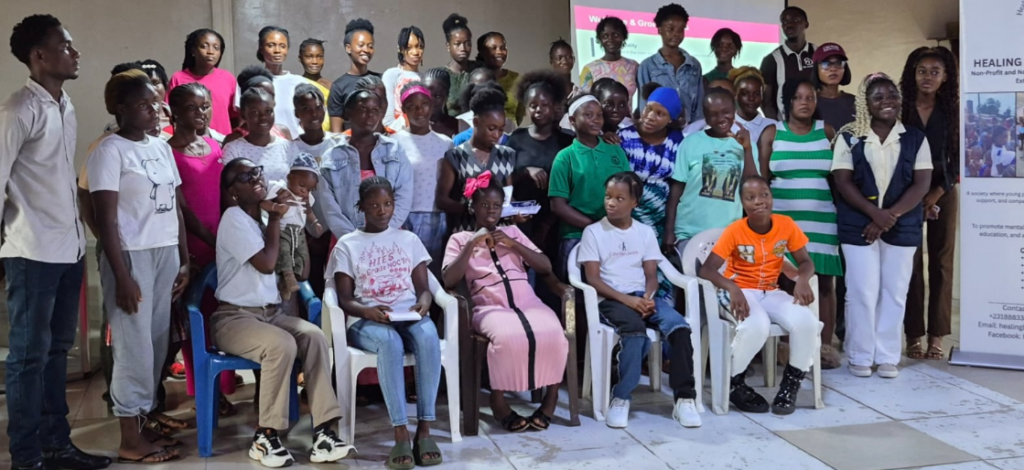
Members of Healing Bridge Liberia’s peer support groups pose for a group photo during an event marking the end of a two-month cycle under the Nurture, Empower, and Protect (NEP) project.
Seventeen-year-old Maxine Lussine used to think talking about her body was something to be ashamed of. Growing up in the Old Road community, she says she never once saw her own father take an interest in anything related to menstruation. “Those are things I’ve seen in movies,” she said, describing her shock the day two male facilitators visited her peer group to explain that men also have a role to play in girls’ health.
That conversation was part of a two-month program run by Healing Bridge Liberia, a community-based organization working across five slum communities in Montserrado County: Old Road, Clara Town, Slipway, PHP Community, and West Point. Under a peer support model, groups of adolescent girls meet regularly to learn about menstruation, reproductive health, gender-based violence, and teenage pregnancy prevention, then carry those lessons back to their friends and neighbors.
Healing Bridge is one of several local organizations implementing this work under the Nurture, Empower, and Protect (NEP) project, a five-year, €7 million initiative funded by the Embassy of Ireland and jointly run by UNICEF and the UN Population Fund (UNFPA).
The program, officially launched in April 2025 at William V. S. Tubman High School in Sinkor, aims to reach more than 107,000 adolescent girls in Montserrado, Grand Gedeh, and Rivercess counties by 2030. UNFPA and UNICEF handle technical support, while the Clinton Health Access Initiative selects and manages community organizations like Healing Bridge to carry the work directly into neighborhoods.
The urgency behind the project is stark. According toLiberia’s 2019/2020 Demographic and Health Survey, 32 percent of girls between ages 15 and 19 are either pregnant or already mothers, a rate that has held steady for decades. That same data shows 15 percent of girls drop out of school because of teenage pregnancy, and adolescent girls make up 60 percent of the country’s obstetric fistula cases.
For Jerome Nea Wlalee, executive director of Healing Bridge Liberia, the organization dedicated to addressing and supporting mental health disorders caused by sexual and gender-based violence, and other health challenges affecting women and children, the numbers explain why the work cannot wait.
“These young girls are growing up in a stage where their brains are still developing,” he said.
“It’s important to give them age-appropriate, accurate information so they can make informed decisions about their bodies.”
Wlalee explained that girls as young as nine or ten are taught what to expect when their periods begin, while older teens many already sexually active receive guidance on preventing unwanted pregnancy.
Healing Bridge recently graduated 25 girls from its first cohort of peer support groups, five from each of the five communities, alongside new members each girl recruited to continue the work. In total, more than 50 girls, along with caregivers and male volunteers, attended a recent graduation ceremony marking the end of the two-month cycle.
Adolescent girls take notes during a peer support group session at the YMCA in Monrovia, part of ongoing efforts by Healing Bridge Liberia to educate girls on reproductive health and rights.
Wlalee said the biggest obstacle has been silence at home. “Most parents believe that when they try to give their children information about sex, it means their children want to go and have sex,” he said. That silence, he explained, pushes girls toward unreliable information from the internet or friends, sometimes with dangerous consequences when it comes to family planning methods or unsafe abortions.
For Maxine, the program cracked that silence open. She says she can now sit and talk with her own mother about topics they once avoided entirely. “I was actually surprised when she was really cool with it,” Maxine said. “She started giving me guidelines and history about her own life.”
Fellow peer educator Florence Y. David echoed that hope for expansion. “More of the other girls out there don’t know, and they’re not free to ask someone,” she said, urging Healing Bridge to bring the program to more communities so girls can “know better about the body and how they can take care of themselves.”
Wlalee says his organization is now restructuring its approach into shorter, cohort-based cycles, training and graduating one group of girls every few months instead of holding onto the same 25 for years so the program can reach far more of Liberia’s adolescent girls before the NEP project ends in 2030. “If we keep talking to 25 girls for the whole five years,” he said, “we are not going to reach that target.”
For girls like Maxine, though, the impact is already personal. Her message to those still waiting for that chance is simple: “You have rights concerning your body. Let your nose be your nose, and your ears be your ears.”