

-Sen. Konneh Warns Against Weaponizing Cybercrime Law:
By Jerromie S. Walters
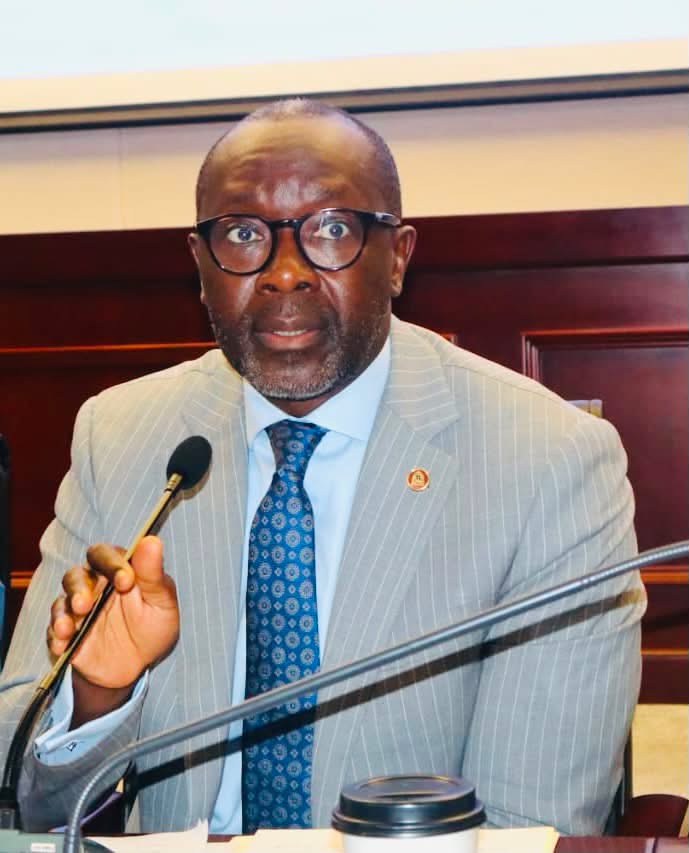
MONROVIA — Gbarpolu County Senator Amara Konneh has called for a careful balance between protecting victims of online abuse and safeguarding constitutionally guaranteed free expression, as Liberia’s newly enacted Cybercrime Act faces its first major enforcement test.
In a statement issued Tuesday, Konneh acknowledged the passionate and divided public reaction to the arrest of Jerry Nyantee Wrato, who was detained over AI-generated images and videos depicting Vice President Jeremiah Kpan Koung. The senator, who voted for the law, said the case represents a critical moment for Liberian democracy.
“This is a test case for Liberia, and how we handle it matters,” Konneh said. “If enforcement targets journalists, comedians, opposition voices, or citizens expressing their views, then we have failed—and I will be the first to speak out and push for an amendment.”
Konneh emphasized that the law was never intended to silence free speech, noting that Article 15 of the Liberian Constitution guarantees freedom of expression. He stated that AI-generated content, including satire, parody, and political commentary, constitutes protected speech even when created with artificial intelligence.
“Legitimate criticism of public officials, including me, is not a cybercrime. It is democracy at work,” he said.
The Case Against Wrato
The Liberia National Police formally charged Wrato with four cybercrime offenses on Monday, September 21, 2026, moving forward with prosecution days after Vice President Koung publicly called for the young man’s release.
In a letter addressed to Koung, Inspector General Gregory O. W. Coleman confirmed that the investigation had concluded and that Wrato would face charges of Misuse of Devices, Cyberstalking, Distribution of Data Messages That Incite Damage to Property or Violence, and Distribution of Harmful Data Messages under the Cybercrime Act of 2025.
The charges followed the circulation of AI-generated images purporting to show Koung undergoing unusual security screening at Brussels Airport—content that fact-checkers determined was manipulated and which Koung has denied.
Vice President Koung had publicly urged leniency, stating that “public office comes with criticism, ridicule and sometimes deliberate provocation” and that leadership “must also exercise tolerance, restraint and compassion”.
Coleman acknowledged the Vice President’s position but maintained that police could not treat the matter as a private dispute.
“Once conduct potentially constituting a criminal offense comes to the attention of law enforcement, the matter is no longer determined solely by the personal wishes of the individual affected,” Coleman wrote, citing the LNP’s statutory responsibility to investigate objectively.
Wrato was released from police custody on Tuesday, September 22, following a petition for a writ of habeas corpus filed by his legal counsel. Criminal Court “B” Judge Pape Suah issued the writ directing his release, though the court action does not constitute a determination on the underlying allegations.
Three Principles for Enforcement
Senator Konneh outlined three principles he believes must guide the handling of this and future cases under the Cybercrime Act:
Due process — warrants, evidence, and open court proceedings, not intimidation.
Proportionality — punishment must fit the crime.
Public education — the Ministry of Justice and Liberia Telecommunications Authority must clearly explain what is and is not prohibited under the law.
Konneh said he would engage the Judiciary Committee and Ministry of Justice upon the Senate’s return from recess to ensure proper implementation.
Victims and Vulnerable Populations
While defending free expression, Konneh also stressed that the law was passed to protect Liberians from real harm, including fraud, identity theft, hacking, nonconsensual sharing of intimate images, and online harassment.
“Free speech is not a license to harm others,” he said. “Our cybercrime law was not passed to silence critics. It was passed to protect victims.”
The senator referenced conversations with Liberians who had been shamed or harassed online, and parents whose daughters dropped out of school after explicit photos were shared without consent.
“When an AI-generated image or video is used to create nude or sexual images of a real person without their consent, knowingly defame someone by falsely depicting them as having committed a crime, defraud the public, or systematically bully, harass, and threaten—especially women and young people—then it crosses the line from protected speech to punishable cybercrime,” Konneh said.
Legal Tensions and Regional Precedent
The Cybercrime Act of 2025, signed into law by President Joseph Nyuma Boakai on August 19, 2026, established a comprehensive legal framework for prosecuting digital offenses. However, critics contend that certain provisions effectively resurrect the criminalization of speech targeting public officials—a practice the Kamara Abdullah Kamara (KAK) Press Freedom Act of 2019 sought to end by repealing criminal libel, sedition, and criminal malevolence.
Media expert Samuka V. Konneh criticized the police’s handling of the law, questioning the lack of public awareness since its recent passage.
“In all fairness, we are not supposed to be arresting people for a law that passed only a month ago,” Konneh stated, arguing that while legal tradition dictates ignorance is no excuse, the government has failed in its responsibility to educate the public.
Former Finance Minister Samuel Tweah characterized the legislation as a regression for Liberian democracy, stating that “the citizen should never have been jailed for free speech to begin with” and labeling the cyberbullying statute an “illegal, draconian measure”.
The legal debate echoes a 2022 ECOWAS Court of Justice ruling that found Nigeria’s cybercrime provisions criminalizing offensive or insulting messages incompatible with international human rights standards. Liberia’s cyberstalking provision requires an actual fear of death, violence, or bodily injury—a narrower standard than Nigeria’s invalidated language—but the harmful-data-message provision’s falsity-and-harm branch remains vulnerable to abuse, according to legal analysts.
Who Controls Prosecution?
The case has also raised questions about the role of the alleged victim in criminal proceedings. Vice President Koung is not an ordinary citizen in this debate—under Liberia’s constitutional system, he serves as President of the Senate, the chamber that approved the Cybercrime Act in November 2025.
Some observers have noted that Koung’s request for Wrato’s release, while demonstrating restraint, does not automatically terminate the prosecution.
“An individual does not ordinarily possess unilateral authority to terminate a criminal prosecution merely by saying that he does not want charges pursued,” legal analysts noted. “Criminal prosecutions are matters of public law and are generally controlled by prosecuting authorities”.
Former lawmaker Acarous Moses Gray and other opposition voices accused the Vice President of political posturing, pointing out that the Cybercrime Act bears Koung’s own signature from its passage in 2025. Gray argued that if Koung truly believes the law targets citizens for mere criticism, he should lead a legislative process to repeal it rather than selectively pardoning individuals.
The Path Forward
As the case proceeds, Senator Konneh’s call for balance reflects the broader challenge facing Liberia: how to protect citizens from genuine online harm without recreating the criminal libel regime that the KAK Act deliberately dismantled.
“The same internet that gives a market woman a voice to complain about the government must not become a weapon to destroy her reputation with lies,” Konneh said. “We can and must protect both free speech and citizens from online bullying. That is the balance every democracy is trying to strike.”
The case is expected to continue in the courts, where the central question will be whether the State can prove a specific criminal offense without crossing the constitutional boundary protecting freedom of expression.