

BY SHALLON S. GONLOR | shallonsgonlor@gmail.com
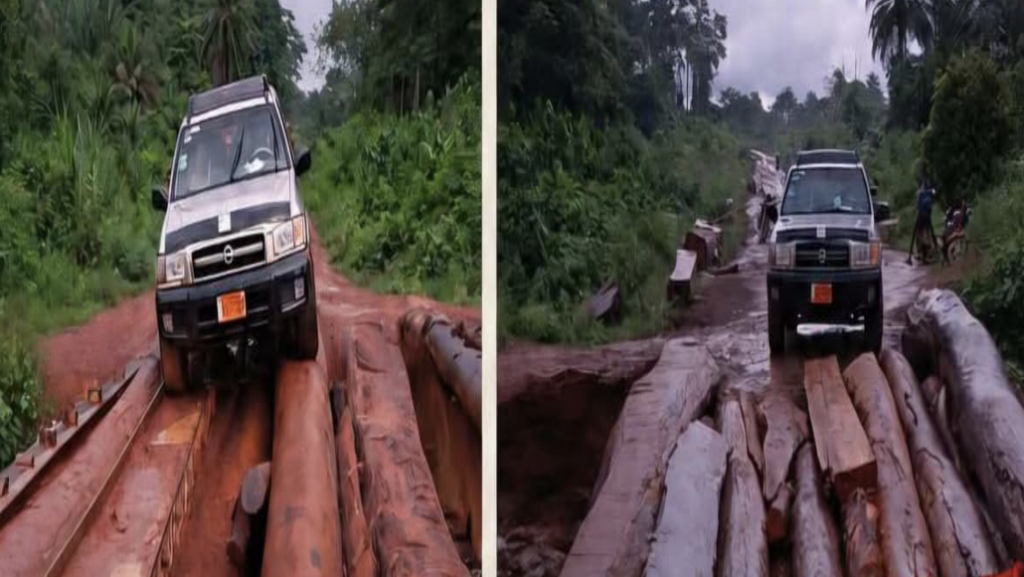
NIMBA COUNTY, Liberia — A peaceful public protest is expected to take place in Upper Nimba as frustrated residents prepare to erect symbolic signboards at two deteriorating wooden bridges they describe as “death traps,” in a move aimed at drawing national attention to what they call years of legislative neglect and the government’s failure to improve critical road infrastructure.
The planned action will target the wooden bridge linking Loelay and Tahnplay in Electoral District #3 and another connecting Behplay and Garplay in Electoral District #4.
Residents say both bridges have deteriorated significantly over the years, posing serious risks to motorists, pedestrians, commercial riders, students, farmers, and other commuters who rely on them daily.
The protest is being organized by Michael T. Biddle, a prominent citizen of Electoral District #4, who says the campaign is intended to peacefully demand the immediate replacement of the aging wooden structures with durable reinforced concrete bridges.
According to Biddle, the affected roads serve as one of Upper Nimba’s most important agricultural corridors, particularly for the transportation of cocoa and other cash crops from farming communities to commercial markets. He argued that the deplorable condition of the bridges continues to hinder economic activities, increase transportation costs, and expose residents to unnecessary danger.
In a statement, Biddle lamented that despite repeated appeals from local residents and numerous political promises made over the years, little or no meaningful progress has been made to permanently address the situation.
He further asserted that since Liberia’s return to democratic governance in 2006, successive lawmakers representing the affected districts have failed to deliver lasting infrastructure projects capable of improving transportation and safeguarding the lives of citizens.
“An elected legislator is not merely a titleholder but the voice, advocate, and guardian of the people’s welfare,” the protest statement reads. “For years, promises have been made, budgets announced, and speeches delivered, yet these bridges remain dangerous symbols of abandonment.”
Biddle emphasized that the demonstration will remain peaceful and lawful, stressing that it is not intended to attack any individual but to encourage accountability and remind elected officials of their responsibilities to the people they serve.
“This is about development, public safety, and accountability,” he noted. “Our people deserve safe roads and bridges. We are simply demanding what every Liberian community deserves—basic infrastructure that protects lives and supports economic growth.”
The campaign also carries a strong political message ahead of Liberia’s 2029 General and Presidential Elections. Organizers warn that continued failure to replace the deteriorating bridges with modern concrete structures could significantly influence the voting decisions of residents in the affected districts.
The signboards to be installed at the two bridge sites will reportedly bear the slogan:
“No Construction of Durable Concrete Bridges, No Re-election in 2029.”
According to the organizers, the message reflects growing public frustration over what they describe as years of unfulfilled promises and inadequate development in Upper Nimba.
Residents say every rainy season worsens the condition of the wooden bridges, making travel increasingly hazardous and, in some cases, temporarily cutting off communities from markets, schools, health facilities, and other essential services. They argue that the lack of reliable infrastructure continues to impede local development and economic growth in the region.
Nimba County’s Electoral District #3 is represented by Representative Nehker E. Gaye, while Electoral District #4 is represented by Representative Ernest M. Manseah Jr., who assumed office in 2024.
As of filing this report, neither Representative Gaye nor Representative Manseah had publicly responded to the concerns raised by the organizers or commented on the planned peaceful protest. Efforts to obtain their reactions were unsuccessful.
Despite steady development in some parts of Nimba County, residents of several rural communities across the county’s electoral districts continue to grapple with four major and interconnected development challenges: poor farm-to-market road connectivity, deteriorating healthcare and educational infrastructure, widespread youth unemployment, and the limited economic benefits flowing to local communities from natural resource extraction.
One of the most pressing concerns is the deplorable condition of the road network. Major routes linking farming communities to commercial centers become flooded or virtually impassable during the rainy season, cutting off entire towns from markets and essential services. The poor road conditions delay the transportation of agricultural produce, leading to significant post-harvest losses, crop spoilage, and sharply increased transportation costs for both farmers and traders. As a result, the prices of basic commodities continue to rise, placing additional financial strain on already struggling households.
Beyond transportation challenges, many communities are burdened by crumbling school buildings and poorly equipped health facilities that are unable to meet the needs of growing populations.
Residents say addressing these interconnected challenges will require coordinated investments in road rehabilitation, education, healthcare, agriculture, and youth empowerment to promote inclusive and sustainable development throughout rural Nimba County.